Enviroboys recognizes the importance of continuing an on-going discussion on Canada’s water. This blog has covered water issues extensively albeit mostly on water quantity issues and the need to explore urban water conservation policy (the focus of my thesis next year). What we need to start talking about is water security in Canada.
Water security is measured in terms of access to adequate quantities of water. Similarly to urban water conservation, water security explores how stakeholders are involved and how to best appropriate water through establishing an agreement. Water security is particularly challenging in Canada because we share the 5 Great Lakes with the U.S. Eight states and two Canadian provinces (40 million people) border these vast bodies of water and therefore many stakeholders are involved.
With water shortages and the ominous unknowns of climate change, water withdrawals from the lakes are going to have be a tad more sustainable. Both states and provinces have increased their water withdrawals for uses such as irrigation, export/diversion and industrial practices.
Having agreements such as NAFTA and the WTO pose challenges to Canada for water security. Generally, these kinds of agreements can erode Canada’s sovereignty over water and can compromise the ability of the Canadian government to manage water resources. Moreover, under NAFTA, if water enters commerce by becoming a good or product, such as an ingredient in a food, or as bottled water, it will then be covered by the Agreement which means the other party can demand the product as much as it wants.
NAFTA prevents any member country from forbidding exports, once a good is traded it cannot be withdrawn from commerce by a political decision unless that decision applies and receives consent from all parties. Worse yet, Article 11 under the WTO, states “the use of quantitative export controls, such as a ban or embargo, on any product ‘destined for the territory of any other contracting party’ is prohibited.”
Such agreements sound frightening and have several implications for water security. One sigh of relief however is the Boundary Waters Treaty. The Boundary Waters Treaty, signed in 1909, is a critical transboundary institutional arrangement that promotes water security for Canada and the U.S. It was recently amended in 2001 with major amendments including the prohibition of the bulk removal of water out of the Canadian portion of boundary water basins. Another major player involved with mediating water security for both countries is the International Joint Commission (IJC), which is a bi-national commission that prevents and resolves water disputes between Canada and U.S.
The Boundary Waters Treaty and the IJC will serve to help us in our endeavors to formulate adequate water security strategies but real disputes are imminent. The Great Lakes (about 90% of America`s water) are indispensable for both economies and important for the well-being of preserving streams, smaller lakes and wetlands that lie within the natural environment. The U.S. has seen many of its aquifers and rivers deplete over the past ten years because of the overuse and unrestrained demand and pressure that accompanied extraction.
It is time that Canada develop a Water Security agenda with a clear policy and strategy on bulk water exports. We are seriously lacking federal legislation and a plan on water security. Climate change, increasing population and agricultural development provide a great deal of conflict and uncertainty in an era where we already have too much of both. Before I provide some strategies and ideas on a water security agenda, what do you think our federal government should do?
Key message: Water security is worth talking about. Let’s start a discussion on how we can navigate some of our contemporary challenges through NAFTA, the WTO and the U.S. government.
Sunday, June 28, 2009


Thursday, June 25, 2009
A naturalized swimming pool...
I saw this on TV a little while ago and was immediately fascinated. As you'll see from the video, this Peterborough resident decided to build a swimming pool in his backyard. But rather than building a regular concrete, chlorinated swimming pool, he built a naturalized one.
That is, rather than requiring chemicals like chlorine or salt, the homeowner planted different trees, bushes and other plants in on the edges of the pool that naturally clean the water. He also has a rock waterfall where the water is pumped up to the top of the waterfall and is slowly fed back through the rocks, which also helps to filter the water.
It has a rubber lining underneath which was covered by rock, gravel and plants to simulate a pond. It's deep enough the jump into from a well-hidden diving board and most importantly, blends into the backyard very well.
It's clean, green and looks very natural.
I'm personally intrigued by such a thing because I (like many other people) love swimming pools, but am fully aware of the environmental downsides of them. This type of thing could be a wonderful, guilt-free alternative. And he lives in the city. It's a little touch of the cottage or country in your urban backyard.
No word on cost, but maintenance sounds very low. No need to add chemicals or to unnecessarily heat it (it might be a bit cold, but perhaps you could look into heating it slightly, maybe with solar...) and no need to drain it in the winter. He just shovels off the snow and turns it into a make-shift hockey rink.
One bit of opposition to such a thing is that this particular pool has wildlife in it: frogs, water-insects and other little creatures. While it certainly makes it more natural, it can creep some people out...
Green Cities: Light-rail transit in Edmonton...
Cities are going to lead the 21st century in innovative policies that are pro-active in addressing social, economic and sustainable environmental goals. As I have blogged about before, city transit initiatives are an excellent way to bring about all of the aforementioned goals. What we need to vigorously research and explore is light-rail transit.
Light-rail transit is a “public transit option that has a lower capacity and lower speed than heavy rail and metro systems but higher capacity and higher speed than street-running tram systems.” They are very similar to street cars in the sense that they operate mostly in private rights-of-way separated from other traffic. However, depending on the city, LRTs are sometimes mixed with other traffic on city streets.
Light-rail transit is taking off in the city of Edmonton. This city has realized that because the internationally accepted value for the cost of a subway per kilometre is $100 million, such infrastructural investments are not financially viable. Light right provides a less expensive transit system and is highly efficient with high ridership. One of the biggest cited examples of an LRT advantage is the fact that it reduces traffic congestion. More importantly however, it reduces future road construction because one commuter train can replace up to “15 lanes of traffic at peak periods.”
There are two more categories that the LRT sufficiently meets. One is community, the other, the environment. In short, and similar to Curitiba’s Bus Rapid Transit (BRT) model, an LRT can help in bringing about greater social cohesion and creating a more diverse and inclusive city. Because of its efficiency and reliability, an LRT usually discourages automobility in the inner city. This reduces traffic congestion and provides an incentive for citizens to explore other alternatives like walking and biking. It contributes to the livability of the space.
Also, as LRT systems become more efficient, urban amenities concomitantly became more commonplace with a push towards urban intensity and density. More and more citizens become attracted to the urban centre because of the numerous urban amenities available to them such as good transit options like LRTs. This creates a sense of community because of shared interests among the city’s populace. As demonstrated in Edmonton, an LRT system “reduces air pollution, contributing to the quality of our health and our environment, because it emits significantly fewer pollutants and greenhouse gases.” Also, “A transit rider creates 65% fewer greenhouse gas emissions than an auto user for the same trip.”
Key message: LRT systems as demonstrated in San Francisco, Edmonton, Manchester, Luas and Sydney are remarkably efficient, effective and energy smart. They cost significantly less than a subway and create a better sense of civic cohesion.
Light-rail transit is a “public transit option that has a lower capacity and lower speed than heavy rail and metro systems but higher capacity and higher speed than street-running tram systems.” They are very similar to street cars in the sense that they operate mostly in private rights-of-way separated from other traffic. However, depending on the city, LRTs are sometimes mixed with other traffic on city streets.
Light-rail transit is taking off in the city of Edmonton. This city has realized that because the internationally accepted value for the cost of a subway per kilometre is $100 million, such infrastructural investments are not financially viable. Light right provides a less expensive transit system and is highly efficient with high ridership. One of the biggest cited examples of an LRT advantage is the fact that it reduces traffic congestion. More importantly however, it reduces future road construction because one commuter train can replace up to “15 lanes of traffic at peak periods.”
There are two more categories that the LRT sufficiently meets. One is community, the other, the environment. In short, and similar to Curitiba’s Bus Rapid Transit (BRT) model, an LRT can help in bringing about greater social cohesion and creating a more diverse and inclusive city. Because of its efficiency and reliability, an LRT usually discourages automobility in the inner city. This reduces traffic congestion and provides an incentive for citizens to explore other alternatives like walking and biking. It contributes to the livability of the space.
Also, as LRT systems become more efficient, urban amenities concomitantly became more commonplace with a push towards urban intensity and density. More and more citizens become attracted to the urban centre because of the numerous urban amenities available to them such as good transit options like LRTs. This creates a sense of community because of shared interests among the city’s populace. As demonstrated in Edmonton, an LRT system “reduces air pollution, contributing to the quality of our health and our environment, because it emits significantly fewer pollutants and greenhouse gases.” Also, “A transit rider creates 65% fewer greenhouse gas emissions than an auto user for the same trip.”
Key message: LRT systems as demonstrated in San Francisco, Edmonton, Manchester, Luas and Sydney are remarkably efficient, effective and energy smart. They cost significantly less than a subway and create a better sense of civic cohesion.
Wednesday, June 24, 2009
E-Bikes on Peterborough trails...
It's like a bike, but better. Well, maybe. E-bikes are just as the name entails: electric bikes. Originally designed as regular mountain bikes with a small electric motor mounted on the frame, the designation of an e-bike has since been extended to larger, wider "bikes" that are nearly identical to the electric scooters you might see people driving around the streets.
In Peterborough, these types of vehicles had been left only to travel on city streets - where the drivers of the e-bikes feel less than safe with cars flying by - and the city's bike and walking trails. Just like regular bicycles, e-bikes can not be ridden on city sidewalks. But in light of the growing danger of the larger, heavier and faster e-bikes on the trails, a few weeks ago city council elected to prohibit them on the city's bike trails. The infamous Segway was also included in the prohibition.
But last week the city changed its mind. In a lengthy, four hour meeting, many members of the public and council members fought out the e-bike issue. Very good points were made on both sides.
Those in opposition of the ban argued the environmental benefits of e-bikes (they use them instead of a car), the advantage they have for people who are less able-bodied (less pedalling is required), the dangers faced by e-bike riders on city's streets (the fastest e-bikes can only go up to 32 km/h) and the onus of responsible trail riding falling on the operator rather than the bike itself.
However, those in support of the ban consistently cited the dangers e-bikes might pose to others on the trail. The brakes on e-bikes are argued to be less than effective when travelling at speeds above 30 km/h, which is particularly dangerous on the heavily-travelled Peterborough trails where (this comes from much personal experience) some people are less than aware of other people or bikes around them. This is especially worrying with the larger e-bikes, that weigh several hundred pounds and could do severe damage to anything it might hit. The definition of an e-bike is also controversial, as the electric scooter types are only considered e-bikes because two small and nearly unusable pedals are inserted on the sides in order to fit with the legislative definition.
A local environmental group and a city councillor brought up the issue of this repeal of a bylaw as opening the door to other modes of transportation. Where does it stop? If a golf cart tacks a few pedals on, could it be allowed? What about a new Chevrolet Volt? It seems ridiculous, but laws have been exploited in worse ways before.
Furthermore, there are legitimate concerns that the e-bike speeds might be too fast for the trails. Proponents of the e-bikes argued that many road bike riders exceed 32 km/h, which is true, although the riders that travel at those kinds of speeds are often very experienced riders and tend to travel on the roads rather than the trails.
The province is supposed to come up with a provincial policy position on e-bikes and their appropriateness on city trails in the coming months, so many of those in favour of the ban argued that Peterborough's city council should wait to reverse the ban until that time. Makes sense. It is better to be safe than sorry.
Personally I don't think a ban on the traditional e-bikes is in order because of the wonderful benefits they could have and the fact that they seem just as safe as any other bike. However, banning the larger, heaving 'e-bikes' is completely appropriate. The dangers are too high with such things on the trails and the way in which the manufacturers have put dinky little pedals on them to get around legislation is very bothersome.
I love using the paths in Peterborough and there are many nice, happy and responsible people who use them. But there's also a lot of idiots. Putting those 'bikes' on the trails will only lead to people being hurt or worse. It's true that it's dangerous using the roads on one of those things, but I've been doing it for years on my bicycle, which many would consider more dangerous. But allowing them onto the main paths could be more dangerous.
The solution I could propose is to license those who want to go on the road so only those who are confident on the roads can use them and people who don't want to use a larger one can use a traditional e-bike. Some might not be happy. Tough.
Tuesday, June 23, 2009
User Fees… The best option municipalities face right now?
Over the course of the year, I had the opportunity to explore user fees in various municipalities in Southern Ontario. I did research through my Waste Management and Public Policy classes and learned a tonne about their theory, implementation and widespread use. Most of the work I did was on municipal waste management and why cities should stop using property taxes for waste collection and why we should alternatively introduce a user fee system for conservation purposes, economic opportunity and optimal efficiency.
Looking at a user fee system for waste management would require city taxpayers (residents, companies, businesses) to pay for the pick-up of general waste based on volume or weight rather than through general tax levies (property tax) that are unrelated to quantities of household waste. They are great systems because they are flexible and allow the household to set out one or two bags for free before being charged for collection. This will of course depend on the municipality but generally there is some leeway. For those not familiar with these systems, the economic rationale for user fees is that by attaching a cost to each bag of garbage a household produces, the economic incentive will encourage householders to recycle more and to reduce the amount of waste they produce. And due to the cost involved, the household would theoretically re-think how much waste it produces.
Hundreds of municipalities across Canada including Toronto rely on property taxes for financing residential waste management costs. Ostensibly though, Toronto has introduced some user fees for its waste and has seen waste management costs and volume go down by as much as 15%. One advantage of financing a city’s waste management system through property taxes is the low administrative requirements that accompanies this and it also provides a secure and predictable revenue stream for the city. But again, the argument, which I vigorously support, is that property taxes are a general tax that does not affect demand for municipal services. In other words, property tax systems may lack a cost incentive to reduce the total amount of waste a household generates because residents can continue to produce waste and pay their taxes at a fixed rate.
A user fee system can replace a property tax mechanism thereby sensitizing residents about their waste generation practices and providing them with an incentive to reduce and divert waste. When there is a direct cost involved for each garbage bag a household creates, the household will have a better understanding of the actual costs of waste. As an example, Peel has become the largest municipality in Ontario to adopt a user-pay three bag system where the first three bags of garbage are free. The city charges $1.00 a bag after that. In 2005 alone, Peel generated 442,015 tonnes of garbage under a two-bag limit, diverted 60 percent of its waste from landfills through recycling, reusing and cutting down on household waste production.
Toronto’s waste management workers are currently on strike. What does this mean for the city? It means mounting frustration, chaos, diffusion of municipal and civic responsibility and a wake-up call to our extravagant and consumerist lifestyles. Maybe a strike will provide us with the realization that we generate too much waste. Maybe we will have to re-think our waste management and turn to user fee systems which are environmentally and economically smarter. Could this strike act as an impetus to explore user fees in more depth?
Key message: User fees can relieve pressure on municipal property taxes and ultimately reduce the quantities of waste requiring disposal. This means less waste being sent to landfills which we know have numerous environmental health implications.
Looking at a user fee system for waste management would require city taxpayers (residents, companies, businesses) to pay for the pick-up of general waste based on volume or weight rather than through general tax levies (property tax) that are unrelated to quantities of household waste. They are great systems because they are flexible and allow the household to set out one or two bags for free before being charged for collection. This will of course depend on the municipality but generally there is some leeway. For those not familiar with these systems, the economic rationale for user fees is that by attaching a cost to each bag of garbage a household produces, the economic incentive will encourage householders to recycle more and to reduce the amount of waste they produce. And due to the cost involved, the household would theoretically re-think how much waste it produces.
Hundreds of municipalities across Canada including Toronto rely on property taxes for financing residential waste management costs. Ostensibly though, Toronto has introduced some user fees for its waste and has seen waste management costs and volume go down by as much as 15%. One advantage of financing a city’s waste management system through property taxes is the low administrative requirements that accompanies this and it also provides a secure and predictable revenue stream for the city. But again, the argument, which I vigorously support, is that property taxes are a general tax that does not affect demand for municipal services. In other words, property tax systems may lack a cost incentive to reduce the total amount of waste a household generates because residents can continue to produce waste and pay their taxes at a fixed rate.
A user fee system can replace a property tax mechanism thereby sensitizing residents about their waste generation practices and providing them with an incentive to reduce and divert waste. When there is a direct cost involved for each garbage bag a household creates, the household will have a better understanding of the actual costs of waste. As an example, Peel has become the largest municipality in Ontario to adopt a user-pay three bag system where the first three bags of garbage are free. The city charges $1.00 a bag after that. In 2005 alone, Peel generated 442,015 tonnes of garbage under a two-bag limit, diverted 60 percent of its waste from landfills through recycling, reusing and cutting down on household waste production.
Toronto’s waste management workers are currently on strike. What does this mean for the city? It means mounting frustration, chaos, diffusion of municipal and civic responsibility and a wake-up call to our extravagant and consumerist lifestyles. Maybe a strike will provide us with the realization that we generate too much waste. Maybe we will have to re-think our waste management and turn to user fee systems which are environmentally and economically smarter. Could this strike act as an impetus to explore user fees in more depth?
Key message: User fees can relieve pressure on municipal property taxes and ultimately reduce the quantities of waste requiring disposal. This means less waste being sent to landfills which we know have numerous environmental health implications.
Friday, June 19, 2009
A carpool permit system...
OK, so first let me say that this is only an idea and that the wheels are still spinning in my head. I also acknowledge that getting something like this to work might be incredibly complex and difficult, but so be it.
Much concern is often put on how we drive cars. Many would argue we drive them too much, they're too big and there are too many of them. The latter may very well be (among others) a factor of wanting to drive by one's self. If you have four people who don't want to share a vehicle, they could go out and by their own. Now there are four vehicles on the road instead of one.
That's four times the GHG emissions, four times the congestion, four times worse air pollution and probably four times of a lot more other stuff. But what if we could reduce that.
Carpooling is slowly becoming a popular, or at least encouraged, thing to do. Carpool lanes are common on the main thoroughfares in many of North America's major urban centres, although they are often not enforced properly. Carpooling is also encouraged by many workplaces and online carpool networks are in existence where people can find convenient ways to carpool to and from regions.
Still, such methods seem to be of little match for the beast that is North Americans' feeling of entitlement to driving a car by themselves. It is a freeing experience. You can listen to your own music, go where you want, be safe from the weather and ultimately feel in control of your journey.
So what if the government were to implement an aggressive program to not only encourage carpooling or taking alternative transportation, but also severely discourage driving by one's self?
I propose a tax or penalty system. That is, people who drive by themselves would be taxed or fined. A law could be written that would require a special permit to drive by one's self, which could be set at a specific price. If people feel the need to drive by themselves, they could pay for a permit. Vehicles could be identified as having a "single-occupant" permit by placing tags on the license plate, similarly to insurance tags.
If one is caught driving by themselves without a permit, they could be fined at rates similar to speeding tickets or even harsher depending on the level of disincentive needed to change people's behaviour. The program could also recognize the need for people to drive by themselves sometimes, such as an emergency, and each non-permit vehicle could be allocated a series of 'emergency' coupons whereby they wouldn't get fined. However, if found to have been used in a non-emergency matter, serious penalties could be applied as to discourage misuse.
I can immediately tell that criticism to such an idea might stem from the issue of enforcement. It is true that such a policy might be difficult to enforce. But if tags are clearly displayed, police officers on routine patrol would easily be able to tell whether or not someone is legally driving by themselves.
All the permits sold could be put directly into alternative transportation projects, such as public transportation or bike lanes/paths. The revenue from fines could also be allocated to such programs but also be shared with the police service as to encourage effective enforcement.
Special exemptions could be made for particular businesses that are deemed to require travelling by one's self, such as electricians' vehicles or other workers who may need to carry a lot of equipment.
This could be done as a municipal bylaw (which would be difficult to enforce because of out-of-town travellers) or as a provincial or national law (which would work well with the car licensing programs).
I imagine there would be a lot of opposition (automakers, for one) to such a policy, but it could be effective.
What do you think?
Much concern is often put on how we drive cars. Many would argue we drive them too much, they're too big and there are too many of them. The latter may very well be (among others) a factor of wanting to drive by one's self. If you have four people who don't want to share a vehicle, they could go out and by their own. Now there are four vehicles on the road instead of one.
That's four times the GHG emissions, four times the congestion, four times worse air pollution and probably four times of a lot more other stuff. But what if we could reduce that.
Carpooling is slowly becoming a popular, or at least encouraged, thing to do. Carpool lanes are common on the main thoroughfares in many of North America's major urban centres, although they are often not enforced properly. Carpooling is also encouraged by many workplaces and online carpool networks are in existence where people can find convenient ways to carpool to and from regions.
Still, such methods seem to be of little match for the beast that is North Americans' feeling of entitlement to driving a car by themselves. It is a freeing experience. You can listen to your own music, go where you want, be safe from the weather and ultimately feel in control of your journey.
So what if the government were to implement an aggressive program to not only encourage carpooling or taking alternative transportation, but also severely discourage driving by one's self?
I propose a tax or penalty system. That is, people who drive by themselves would be taxed or fined. A law could be written that would require a special permit to drive by one's self, which could be set at a specific price. If people feel the need to drive by themselves, they could pay for a permit. Vehicles could be identified as having a "single-occupant" permit by placing tags on the license plate, similarly to insurance tags.
If one is caught driving by themselves without a permit, they could be fined at rates similar to speeding tickets or even harsher depending on the level of disincentive needed to change people's behaviour. The program could also recognize the need for people to drive by themselves sometimes, such as an emergency, and each non-permit vehicle could be allocated a series of 'emergency' coupons whereby they wouldn't get fined. However, if found to have been used in a non-emergency matter, serious penalties could be applied as to discourage misuse.
I can immediately tell that criticism to such an idea might stem from the issue of enforcement. It is true that such a policy might be difficult to enforce. But if tags are clearly displayed, police officers on routine patrol would easily be able to tell whether or not someone is legally driving by themselves.
All the permits sold could be put directly into alternative transportation projects, such as public transportation or bike lanes/paths. The revenue from fines could also be allocated to such programs but also be shared with the police service as to encourage effective enforcement.
Special exemptions could be made for particular businesses that are deemed to require travelling by one's self, such as electricians' vehicles or other workers who may need to carry a lot of equipment.
This could be done as a municipal bylaw (which would be difficult to enforce because of out-of-town travellers) or as a provincial or national law (which would work well with the car licensing programs).
I imagine there would be a lot of opposition (automakers, for one) to such a policy, but it could be effective.
What do you think?
Thursday, June 18, 2009
Bill McKibben, mobilizing America on climate change action…
American environmentalist and author Bill McKibben, has and continues to vehemently spread awareness and education over global climate change. We don’t hear much about McKibben in Canada because of David Suzuki’s ubiquity, but McKibben has raised some really important questions around climate change and America’s energy challenge.
Among many of his noble efforts in the climate change movement, he has created a website called 350.org which is campaign dedicated to raising awareness over this salient issue. 350 refers to 350 parts per million. Climate change experts have identified this number as the safe upper limit for carbon dioxide emissions in our atmosphere. We are presently at 385 parts per million and as McKibben continues to exclaim “climate change is not a problem for the future; it’s a crisis for this moment". Anyone can join 350.org and become a member of this movement. More to come on local initiatives and groups you can join to further your knowledge on climate change and how you can educate and mobilize others in your community to think more seriously about it.
Wednesday, June 17, 2009
Marketing bottled water...
So where is the real fight in the bottled water debate?
It really depends on who you ask. Pose the question to an environmentalist and the answer is clearly a battle between tap and bottled water. But if you pose the question to the industry, you get quite a different answer. The bottled water industry would not compare the two but would instead consider it a battle between bottled water and other packaged drinks, like soft drinks or juices.
This is a very important distinction to recognize and respect. Not because it's necessarily the right one (the differences between bottled and tap water are great and weigh largely in favour of tap) , but because it is a view that is held by a very influential and highly resourced group: the bottled water industry itself.
While some may go as far as to say the industry is evil, from a marketing perspective the industry is masterful. After all, they manage to convince millions of people every year to pay a few bucks each for something they could get for higher quality at less than 1/10th of a penny.
There was a time when some of the main facets of the industry's arguments encompassed the advantages of bottled water over tap, citing convenience, taste, quality and, most of all, safety (I would imagine Walkerton boosted the sales of bottled water significantly). But as more and more reports and studies came out chastising the industry's activities related to bottled water, the industry has seemingly taken a step towards comparing itself not with tap water, but with other soft drinks and packaged beverages.
The reasoning behind this is fairly straightforward: bottled water looks better than the rest of the packaged beverages. It is marketed as a healthy alternative to traditionally sugar-filled and caffeinated drinks like Coke and Pepsi, which certainly hits consumers. An industry-wide push to recycle and use better shaped bottles has led to bottled water having better "environmental performance" (depending on your definition) than its competitors in the soft drinks industry.
Recognizing this argument is incredibly important. I first strongly encountered it when dealing with a municipality in Ontario that is considering banning the sale of bottled water in public buildings. One of the nation's biggest suppliers of bottled water was adamantly opposed to the potential ban and in its communication with the municipality it never once compared itself to tap water. The entire argument was based on how much of a great alternative it is to Coke, Pepsi and the like and how they really encourage recycling.
By changing the nature of the argument, the industry is able to effectively argue against anyone trying to do something about them, especially 'tap water advocates'. Rather than trying to counter them, the industry simply ignores them, which is far more lethal since tap water just gets left out of the conversation.
If people want to really promote tap water and discourage bottled water, the nature of the conversation with industry needs to be changed. Environmentalists and policymakers discussing tap water amongst themselves is only so effective when the dialogue switches gears when you actually talk to industry.
So just be aware.
It really depends on who you ask. Pose the question to an environmentalist and the answer is clearly a battle between tap and bottled water. But if you pose the question to the industry, you get quite a different answer. The bottled water industry would not compare the two but would instead consider it a battle between bottled water and other packaged drinks, like soft drinks or juices.
This is a very important distinction to recognize and respect. Not because it's necessarily the right one (the differences between bottled and tap water are great and weigh largely in favour of tap) , but because it is a view that is held by a very influential and highly resourced group: the bottled water industry itself.
While some may go as far as to say the industry is evil, from a marketing perspective the industry is masterful. After all, they manage to convince millions of people every year to pay a few bucks each for something they could get for higher quality at less than 1/10th of a penny.
There was a time when some of the main facets of the industry's arguments encompassed the advantages of bottled water over tap, citing convenience, taste, quality and, most of all, safety (I would imagine Walkerton boosted the sales of bottled water significantly). But as more and more reports and studies came out chastising the industry's activities related to bottled water, the industry has seemingly taken a step towards comparing itself not with tap water, but with other soft drinks and packaged beverages.
The reasoning behind this is fairly straightforward: bottled water looks better than the rest of the packaged beverages. It is marketed as a healthy alternative to traditionally sugar-filled and caffeinated drinks like Coke and Pepsi, which certainly hits consumers. An industry-wide push to recycle and use better shaped bottles has led to bottled water having better "environmental performance" (depending on your definition) than its competitors in the soft drinks industry.
Recognizing this argument is incredibly important. I first strongly encountered it when dealing with a municipality in Ontario that is considering banning the sale of bottled water in public buildings. One of the nation's biggest suppliers of bottled water was adamantly opposed to the potential ban and in its communication with the municipality it never once compared itself to tap water. The entire argument was based on how much of a great alternative it is to Coke, Pepsi and the like and how they really encourage recycling.
By changing the nature of the argument, the industry is able to effectively argue against anyone trying to do something about them, especially 'tap water advocates'. Rather than trying to counter them, the industry simply ignores them, which is far more lethal since tap water just gets left out of the conversation.
If people want to really promote tap water and discourage bottled water, the nature of the conversation with industry needs to be changed. Environmentalists and policymakers discussing tap water amongst themselves is only so effective when the dialogue switches gears when you actually talk to industry.
So just be aware.
Tuesday, June 16, 2009
How much energy does it take to produce bottled water?
I am reading a highly edifying book these days called “Bottlemania: How Water Went on Sale and Why We Bought It” written by a journalist named Elizabeth Royte. It discusses bottled water as a multifaceted issue that has entered disciplines such as economics, environmental science, ecology, engineering and business. It is an excellent book and I recommend it to anyone interested in the hitherto numerous controversies surrounding bottled water.
I have been doing some reading on the energy side of bottled water and let me tell you, there are some really striking stats. A lot of the data in this blog post is derived from the Pacific Institute in Oakland, California. So, we all know that bottled water costs a lot more than tap water. Somewhere in the range of 3,000 to 10,000 times the price you pay for tap water according to may experts on the economics of water. The numbers are not even worth sharing here because it has been statistically proven time and time again that bottled water simply costs a lot more than tap water. Anyway, this is what you should know about bottled water:
In the U.S., about 33 billion litres of bottled water are purchased every year. This is equivalent to 110 litres per person every year just for drinking purposes. The only beverage category with larger sales is carbonated soft-drinks aka CSDs. Yes this means that bottled water sales have surpassed beer and milk. Amid this exciting bottled water discussion there is a distinction we must make between two types of bottled water. Royte in her book makes this explicit in the first ten pages. “Purified water” includes municipal tap water that has received further treatment through distillation, deionization and reverse osmosis. “Spring Water” is derived from an underground formation from which water flows naturally to the surface of the earth. This is how corporations access this water and subsequently bring it to the marketplace. And by the way, most of the purified water sales come from the three largest producers of bottled water including Coke (Dasani), Pepsi (Aquafina) and Nestle (everything).
ENERGY ENERGY ENERGY. This is the fascinating stuff. So energy is required in every step of the bottled water process. It takes energy to make the plastic materials used in bottles, then we have to fabricate the plastic into bottles, process the water prior to the bottling stage, fill and seal the bottle, transport the “product” and chill it. That requires copious amounts of energy. Combined, this is somewhere in the range of 5.6 to 10.2 megajoules (MJ). To put this in perspective, to produce tap water it requires about 0.0005 MJ of energy. Notice the massive disparity in the total energy used, about 2000 times the energy cost of producing tap water.
I am not going to delve into all of the stages of bottled water that require energy but the transportation aspect I must share. Firstly, air cargo and heavy trucks are common methods of transport for bottled water and are both really energy intensive, air cargo being the most. Using LA county as an example, think about this, the spring water that arrives in Southern California that has traveled close to 9000 KM all the way from Fiji has a huge energy cost. It is transported on ships and once it arrives in LA county it has to be locally transported on heavy trucks which are egregiously congesting and polluting the area. Combine the shipping and local trucking, we are looking at a total energy cost of 5.4 MJ.
All of the bottled water that comes from France uses a lot of energy in the transportation process. The French spring water is transported by truck from the source to the French ports, then it travels by ship across the Atlantic ocean, and then trained from the Northeast U.S. to LA county and then locally by truck. Add this together and you have used 5.8 MJ of energy just for transportation.
Key message: Bottled water is energy intensive, expensive and environmentally degrading.
I have been doing some reading on the energy side of bottled water and let me tell you, there are some really striking stats. A lot of the data in this blog post is derived from the Pacific Institute in Oakland, California. So, we all know that bottled water costs a lot more than tap water. Somewhere in the range of 3,000 to 10,000 times the price you pay for tap water according to may experts on the economics of water. The numbers are not even worth sharing here because it has been statistically proven time and time again that bottled water simply costs a lot more than tap water. Anyway, this is what you should know about bottled water:
In the U.S., about 33 billion litres of bottled water are purchased every year. This is equivalent to 110 litres per person every year just for drinking purposes. The only beverage category with larger sales is carbonated soft-drinks aka CSDs. Yes this means that bottled water sales have surpassed beer and milk. Amid this exciting bottled water discussion there is a distinction we must make between two types of bottled water. Royte in her book makes this explicit in the first ten pages. “Purified water” includes municipal tap water that has received further treatment through distillation, deionization and reverse osmosis. “Spring Water” is derived from an underground formation from which water flows naturally to the surface of the earth. This is how corporations access this water and subsequently bring it to the marketplace. And by the way, most of the purified water sales come from the three largest producers of bottled water including Coke (Dasani), Pepsi (Aquafina) and Nestle (everything).
ENERGY ENERGY ENERGY. This is the fascinating stuff. So energy is required in every step of the bottled water process. It takes energy to make the plastic materials used in bottles, then we have to fabricate the plastic into bottles, process the water prior to the bottling stage, fill and seal the bottle, transport the “product” and chill it. That requires copious amounts of energy. Combined, this is somewhere in the range of 5.6 to 10.2 megajoules (MJ). To put this in perspective, to produce tap water it requires about 0.0005 MJ of energy. Notice the massive disparity in the total energy used, about 2000 times the energy cost of producing tap water.
I am not going to delve into all of the stages of bottled water that require energy but the transportation aspect I must share. Firstly, air cargo and heavy trucks are common methods of transport for bottled water and are both really energy intensive, air cargo being the most. Using LA county as an example, think about this, the spring water that arrives in Southern California that has traveled close to 9000 KM all the way from Fiji has a huge energy cost. It is transported on ships and once it arrives in LA county it has to be locally transported on heavy trucks which are egregiously congesting and polluting the area. Combine the shipping and local trucking, we are looking at a total energy cost of 5.4 MJ.
All of the bottled water that comes from France uses a lot of energy in the transportation process. The French spring water is transported by truck from the source to the French ports, then it travels by ship across the Atlantic ocean, and then trained from the Northeast U.S. to LA county and then locally by truck. Add this together and you have used 5.8 MJ of energy just for transportation.
Key message: Bottled water is energy intensive, expensive and environmentally degrading.
Monday, June 15, 2009
Hmmm, do I want to be a Maserati or an F-16?...
Out of all the topics dominating the discussions over the adoption of electric cars these days, it's a tad surprising that one of the most talked-about has nothing to do with climate change, a revamping of the near lifeless American auto industry nor reducing the dependence on foreign oil. Instead, a good deal of talk is hovering around the amount of noise the cars will make (or lack there of).
If you've been in an electric car (or more probably a hybrid) you've probably noticed that they are remarkably quiet. The engine noise is significantly lower in an electric engine than in a combustion engine. For a quick example, simply compare the noise of an electric mower to a gas-powered one. Big difference. My mother once rented a hybrid and repeatedly forgot whether or not the car was one since it gave no clear indication.
Of course, the main concern over the lack of engine noise is not immediately directed at the driver being able to hear the engine, but moreso the people outside of the car. While having all the cars on the road run silently would have wonderful significance for noise pollution, it is not very safe.
When cars are loud you can hear them coming and stay away. After all, in a fight between human and moving vehicle, the moving vehicle often wins. If all cars ran silently, an upsurge in collisions with people could almost be guaranteed. Furthermore, other cars wouldn't necessarily be able to sense the quiet cars either.
This particular issue has a special significance for me that is probably shared by millions of others throughout the world. I'm a cyclist; both urban and distance. City roads and highways are already dangerous enough for cyclists, but imagine what it would be like if cyclists couldn't hear any of the cars coming by. A few days ago I went on a bike tour on the highways near Peterborough and cars, trucks and trailers went whizzing by me quite often. Because they are loud, I was able to prepare myself for having a semi-trailer fly-by inches away from me. If it had been silent, I would not be expecting it and I could very well be lying flat on the highway right now.
This is not a secret. So policymakers have been tossing about ideas as to what to do about it. The most common and popular choice seems to be requiring that each car be equipped with a sound making device. A letter to the editor in the most recent issue of The Economist took it one step further. A man from Victoria, BC (whose name I've forgotten) expressed the idea of "Vroomtones". Similar to ringtones for a cellphone, Vroomtones could be customizable noises your car could make. The possibilities are endless. Want to sound like a Ferrari? Or maybe a motorcycle noise is your thing? How about a tidal wave or a series of small explosions?
Electric cars might not be the fastest things on the road, but they'll sure sound like it.
If you've been in an electric car (or more probably a hybrid) you've probably noticed that they are remarkably quiet. The engine noise is significantly lower in an electric engine than in a combustion engine. For a quick example, simply compare the noise of an electric mower to a gas-powered one. Big difference. My mother once rented a hybrid and repeatedly forgot whether or not the car was one since it gave no clear indication.
Of course, the main concern over the lack of engine noise is not immediately directed at the driver being able to hear the engine, but moreso the people outside of the car. While having all the cars on the road run silently would have wonderful significance for noise pollution, it is not very safe.
When cars are loud you can hear them coming and stay away. After all, in a fight between human and moving vehicle, the moving vehicle often wins. If all cars ran silently, an upsurge in collisions with people could almost be guaranteed. Furthermore, other cars wouldn't necessarily be able to sense the quiet cars either.
This particular issue has a special significance for me that is probably shared by millions of others throughout the world. I'm a cyclist; both urban and distance. City roads and highways are already dangerous enough for cyclists, but imagine what it would be like if cyclists couldn't hear any of the cars coming by. A few days ago I went on a bike tour on the highways near Peterborough and cars, trucks and trailers went whizzing by me quite often. Because they are loud, I was able to prepare myself for having a semi-trailer fly-by inches away from me. If it had been silent, I would not be expecting it and I could very well be lying flat on the highway right now.
This is not a secret. So policymakers have been tossing about ideas as to what to do about it. The most common and popular choice seems to be requiring that each car be equipped with a sound making device. A letter to the editor in the most recent issue of The Economist took it one step further. A man from Victoria, BC (whose name I've forgotten) expressed the idea of "Vroomtones". Similar to ringtones for a cellphone, Vroomtones could be customizable noises your car could make. The possibilities are endless. Want to sound like a Ferrari? Or maybe a motorcycle noise is your thing? How about a tidal wave or a series of small explosions?
Electric cars might not be the fastest things on the road, but they'll sure sound like it.
Sunday, June 14, 2009
Re-visiting that national parks conundrum…
Managing parks can always be challenging. As previously discussed, India and Botswana have serious political pressures with their park management. In India, state governments in the south are adding more zoning laws to protect the endangered tiger species. The creation of this zoning has led to the displacement of thousands of Indigenous peoples living within these vast parks. In Botswana, people are forcefully removed from parks because the government ostensibly wants to protect and preserve species. Removing human pressures is seen as an optimal goal. But remember, there is always that hidden agenda of actually getting to the natural resources that are overwhelmingly concentrated in these parks.
Is this really a problem though? Well, yes because natural resource extraction produces winners and losers. In natural resource management theory there is a concept called Pareto Optimality. The Pareto Optimality principle suggests “a state in which the resources of the environment are being used in such a way that no individual can be made better off without some other individual being made worse off. In other words, it describes a ‘zero-sum’ situation because new benefits that one individual receives must be compensated by losses experienced by another individual. So with context to parks and wildlife, time and time again resource interests from companies supersede those of community and wilderness interests. The benefits of resource extraction for instance, always favour the company because of collected capital or wealth, however the loser continues to be the community at large and the various species affected by the process of resource extraction.
Namibia seems to understand how to minimize this through their policy of Community-Based Natural Resource Management (CBNRM) but this problem continues to be manifested in parks around the world.
So, the primary economic decision is always associated with extracting the resource in abundance to generate higher returns for the end product. The result, there is no concept of a conservation culture or wilderness recognition and at times, the environment is simply ravaged, leaving no room for regeneration.
This may not seem like a big issue but it certainly is. Canada will face numerous challenges in the future with its national and provincial parks. As natural resources dwindle in supply, we are going to turn to areas that we have not adequately explored yet because of rigid zoning laws. Those areas are parks. We need to take pro-active measure to ensure that those laws do not vanish. I think we need to have a stricter biosphere reserve zonation policy. The biosphere reserve concept was first introduced in 1968 by the United Nations Educational, Scientific, and Cultural Organization (UNESCO). Its primary aims at that time were threefold- promote ecological sustainability, minimize biodiversity loss, and enhance linkages between cultural and biological diversity.
The biosphere reserve zonation concept is an effective and rational tool for park management. It has three zones- The core zone monitors natural changes and serves as a conservation area for biodiversity. Human influences are limited because of its rigorous protection standards. The next zone is equally as important for the park- a buffer zone which allows for low-impact activities such as research, environmental education and recreation. Finally, the transition zone, as stated by UNESCO, allows and encourages sustainable use of resources by local communities.
Key message: Biosphere reserves are crucial for advocating the protection of ecosystems and striving towards protecting the rights of the species found therein. They involve and heavily draw upon the community for consultation and advice.
They also limit natural resource extraction because the rights of wildlife supersede those of the companies.
Is this really a problem though? Well, yes because natural resource extraction produces winners and losers. In natural resource management theory there is a concept called Pareto Optimality. The Pareto Optimality principle suggests “a state in which the resources of the environment are being used in such a way that no individual can be made better off without some other individual being made worse off. In other words, it describes a ‘zero-sum’ situation because new benefits that one individual receives must be compensated by losses experienced by another individual. So with context to parks and wildlife, time and time again resource interests from companies supersede those of community and wilderness interests. The benefits of resource extraction for instance, always favour the company because of collected capital or wealth, however the loser continues to be the community at large and the various species affected by the process of resource extraction.
Namibia seems to understand how to minimize this through their policy of Community-Based Natural Resource Management (CBNRM) but this problem continues to be manifested in parks around the world.
So, the primary economic decision is always associated with extracting the resource in abundance to generate higher returns for the end product. The result, there is no concept of a conservation culture or wilderness recognition and at times, the environment is simply ravaged, leaving no room for regeneration.
This may not seem like a big issue but it certainly is. Canada will face numerous challenges in the future with its national and provincial parks. As natural resources dwindle in supply, we are going to turn to areas that we have not adequately explored yet because of rigid zoning laws. Those areas are parks. We need to take pro-active measure to ensure that those laws do not vanish. I think we need to have a stricter biosphere reserve zonation policy. The biosphere reserve concept was first introduced in 1968 by the United Nations Educational, Scientific, and Cultural Organization (UNESCO). Its primary aims at that time were threefold- promote ecological sustainability, minimize biodiversity loss, and enhance linkages between cultural and biological diversity.
The biosphere reserve zonation concept is an effective and rational tool for park management. It has three zones- The core zone monitors natural changes and serves as a conservation area for biodiversity. Human influences are limited because of its rigorous protection standards. The next zone is equally as important for the park- a buffer zone which allows for low-impact activities such as research, environmental education and recreation. Finally, the transition zone, as stated by UNESCO, allows and encourages sustainable use of resources by local communities.
Key message: Biosphere reserves are crucial for advocating the protection of ecosystems and striving towards protecting the rights of the species found therein. They involve and heavily draw upon the community for consultation and advice.
They also limit natural resource extraction because the rights of wildlife supersede those of the companies.
Wednesday, June 10, 2009
Trent University's summer endeavours...
Universities are interesting things. The idea of one probably brings thoughts of learning, knowledge and especially at a liberal-arts school like Trent, progressive policies. While we could bat around the actual definition of progressive for days, I use the term to describe policies that are more holistic, perhaps edgy and certainly less than holistic.
Environmentalists should be familiar with the idea of progressiveness. After all, environmentalism in its modern form is a component of progressiveness.
University's are often at the forefront of developing or at least implementing new technologies and ideas. I'm currently working at Trent University over the summer and I'm witnessing a whole swath of these new technologies and ideas being put into place.
Thanks in large part to a generous donation Montreal Canadien's GM Bob Gainey, Trent is currently constructing one of Canada's greenest buildings. Known as the Camp Kawartha Environment Centre, the straw-bale building will be powered by the sun, have innovative rainwater collection systems and have composting toilets.
Last week, this year's Trent graduates gathered with guests, faculty and staff for convocation. The convocation turned out to be a very "green" affair. Apart from grads sporting green gowns, free transit passes were given out to discourage driving to the ceremonies and encourage the use of public transportation and graduates were encouraged to take the "green pledge", an oath to take the environment into consideration during one's future endeavours. The most notable aspect of the ceremonies was the decision to not provide bottled water, which was a significant change from the norm at Trent and throughout North America. The move was expected to save thousands of bottles from being consumed. Appropriately, bottled water's worst nightmare and Canada's own Maude Barlow was awarded an honorary degree as well.
A significant addition is also being added to the Athletic Centre, which is supposed to be standardized at one of LEED's (Leadership in Energy and Environmental Design) highest bars.
But we must also acknowledge the institutional nature of Trent. It may be a wonderful breeding ground for progressive ideas, but every breeding ground needs an infrastructure. As such, the 'green' endeavours of our small university this summer may very well be overshadowed by the 'not-so-green' activities.
While the Camp Kawartha Environment Centre might be one of Canada's greenest, the DNA Building being built just north of it is anything but. Despite a multi-million dollar price tag, the facility is being built very quickly and the materials are fairly cheap in quality. There is no effort to make the buildings architecturally interesting or to even make them fit with the rest of the school. And because Trent is almost completely surrounded by Nature Areas, a good deal of greenspace has been removed for building and parking lots.
To the north of the campus, a highly controversial hydro dam is being built. While it will deliver greenhouse-gas free power to Peterborough, its construction has resulted in the clearance of acres of Trent's famous Nature Areas.
Roads are parking lots are being put all over campus. One such road, currently designated 'temporary', has gone over a wonderful piece of grassland by the athletic facility that once housed two beach volleyball courts. Unfortunately, I've learned over the years that nothing like that at Trent is really temporary. And even if it were, I highly doubt they'd put the volleyball courts back.
Even some of Trent's most modest 'green' efforts are being squashed. Literally. A month or so ago, landscapers started digging up tons of grassy area around the sides of the buildings to replant grass seeds. Just as that slowly started to get going, we find this morning that a construction crew brought all their trucks into the replanted area. Bye bye grass.
Trent is a wonderful place. It's full of greenery and is trying its best to maintain its 'green' reputation. Unfortunately, sometimes other forces are a little too strong. The worry is that these other forces will eventually remove so much of the 'green' that Trent will lose the majority of its natural environment. That environment, both physical and amongst the people, is what makes Trent unique and so great.
Environmentalists should be familiar with the idea of progressiveness. After all, environmentalism in its modern form is a component of progressiveness.
University's are often at the forefront of developing or at least implementing new technologies and ideas. I'm currently working at Trent University over the summer and I'm witnessing a whole swath of these new technologies and ideas being put into place.
Thanks in large part to a generous donation Montreal Canadien's GM Bob Gainey, Trent is currently constructing one of Canada's greenest buildings. Known as the Camp Kawartha Environment Centre, the straw-bale building will be powered by the sun, have innovative rainwater collection systems and have composting toilets.
Last week, this year's Trent graduates gathered with guests, faculty and staff for convocation. The convocation turned out to be a very "green" affair. Apart from grads sporting green gowns, free transit passes were given out to discourage driving to the ceremonies and encourage the use of public transportation and graduates were encouraged to take the "green pledge", an oath to take the environment into consideration during one's future endeavours. The most notable aspect of the ceremonies was the decision to not provide bottled water, which was a significant change from the norm at Trent and throughout North America. The move was expected to save thousands of bottles from being consumed. Appropriately, bottled water's worst nightmare and Canada's own Maude Barlow was awarded an honorary degree as well.
A significant addition is also being added to the Athletic Centre, which is supposed to be standardized at one of LEED's (Leadership in Energy and Environmental Design) highest bars.
But we must also acknowledge the institutional nature of Trent. It may be a wonderful breeding ground for progressive ideas, but every breeding ground needs an infrastructure. As such, the 'green' endeavours of our small university this summer may very well be overshadowed by the 'not-so-green' activities.
While the Camp Kawartha Environment Centre might be one of Canada's greenest, the DNA Building being built just north of it is anything but. Despite a multi-million dollar price tag, the facility is being built very quickly and the materials are fairly cheap in quality. There is no effort to make the buildings architecturally interesting or to even make them fit with the rest of the school. And because Trent is almost completely surrounded by Nature Areas, a good deal of greenspace has been removed for building and parking lots.
To the north of the campus, a highly controversial hydro dam is being built. While it will deliver greenhouse-gas free power to Peterborough, its construction has resulted in the clearance of acres of Trent's famous Nature Areas.
Roads are parking lots are being put all over campus. One such road, currently designated 'temporary', has gone over a wonderful piece of grassland by the athletic facility that once housed two beach volleyball courts. Unfortunately, I've learned over the years that nothing like that at Trent is really temporary. And even if it were, I highly doubt they'd put the volleyball courts back.
Even some of Trent's most modest 'green' efforts are being squashed. Literally. A month or so ago, landscapers started digging up tons of grassy area around the sides of the buildings to replant grass seeds. Just as that slowly started to get going, we find this morning that a construction crew brought all their trucks into the replanted area. Bye bye grass.
Trent is a wonderful place. It's full of greenery and is trying its best to maintain its 'green' reputation. Unfortunately, sometimes other forces are a little too strong. The worry is that these other forces will eventually remove so much of the 'green' that Trent will lose the majority of its natural environment. That environment, both physical and amongst the people, is what makes Trent unique and so great.
Sunday, June 7, 2009
Gleick on Peak Water...
Peter Gleick is the President of the Pacific Institute out of Oakland, California. He is an engineer who specializes in energy and resources with a focus on water. I am reading some of his articles in preparation for my honours thesis. Anyone interested in desalination, peak water, climate change and water, and the human right to water, I encourage you to read some of his articles available at the Pacific Institute website. Even if you are not particularly interested in water issues at this point, I would still recommend you look into desalination and its controversies. Forthcoming blog entries will delve into this technological phenomenon and explore both its advantages and disadvantages from a social, economic, environmental and political lens.
This particular video clip discusses the concept of peak water. As you have noticed through this blog and through the media, water is only becoming more of a salient issue.
Key message: "Anyone who solves the problem of water deserves not one Nobel Prize but two: one for science and the other for peace." - John F. Kennedy
Thursday, June 4, 2009
Green Cities: Eco cities and density…
I have blogged about green eco cities in the past particularly focusing on Curitiba, Montreal and a tad on Toronto. As an undergrad student who is planning on studying urban planning at grad school, this is a good time to continue a lively discussion on why green eco cities are critical for sustainable development in the 21st century. But really, green eco cities in the 21st century are those that are going to execute new initiatives that embrace and benefit the environment, local economies and quality of life.
There are many perspectives to the green eco city debate. Some believe that sound public transit systems are the most optimal way to reduce pollution and congestion and overall increase the efficiency and livability of city life. Some turn our attention to adequate waste management programs including recycling, composting etc. Some believe in taxes to reduce pollution like London’s congestion charge zone, which I have blogged about in the past. And the technological optimists point to green roofs on city buildings, wind turbines on the waterfront (assuming the city has one), solar panels including photovoltaic and micro-solar and finally geothermal power. I am a vehement advocate for all of these wonderful initiatives; however my interest lies with density.
Cities like San Francisco and Vancouver are firm believers in transport and density planning. Transport and density planning for these cities have included infrastructure to support walking, cycling and public transit. This means that city planning has focused on limiting outward growth and preserving large amounts of open space in their respective urban centres. This has in some way created a greater sense of community. Of course, density patterns will always be correlated with urban amenities meaning that areas with multiple services, green spaces, public transit access and educational institutions will have larger groups of people living in them. For instance, San Francisco and Bogota have high population densities and therefore the need to design neighbourhoods of high-density with urban amenities is justified.
The green eco cities that concentrate their energies on density planning are going to have both economic and environmental success. Let me take you through an example of density planning as it pertains to urban water systems: Sometimes a person living in a low-density neighbourhood pays the same rate for water as a person who lives in a high-density neighbourhood. In theory, the person in the high-density neighbourhood should pay less as they use a smaller amount of piping (because housing complexes are so much closer together) than individuals living in low-density areas. Higher density housing helps lower the costs of piping installation and reduces the maintenance costs for actually pumping the water through it. The water department loses money on low-density neighbourhoods; therefore causing high density areas to bear the burden of this financial loss through higher water rates and tax payments. Cities that begin to recognize these discrepancies and remedy them will gain tremendously.
Key message: Density planning is the indispensable component of green eco cities. High-density neighbourhoods can only be designed and built if citizens see the numerous economic, social and environmental aspects of doing so. Generally though, and as epitomized in Curitiba, a high-diversity and high-density urban environment creates employment opportunities, ultimately providing an impetus for citizens to live in closer propinquity to the urban centre.
There are many perspectives to the green eco city debate. Some believe that sound public transit systems are the most optimal way to reduce pollution and congestion and overall increase the efficiency and livability of city life. Some turn our attention to adequate waste management programs including recycling, composting etc. Some believe in taxes to reduce pollution like London’s congestion charge zone, which I have blogged about in the past. And the technological optimists point to green roofs on city buildings, wind turbines on the waterfront (assuming the city has one), solar panels including photovoltaic and micro-solar and finally geothermal power. I am a vehement advocate for all of these wonderful initiatives; however my interest lies with density.
Cities like San Francisco and Vancouver are firm believers in transport and density planning. Transport and density planning for these cities have included infrastructure to support walking, cycling and public transit. This means that city planning has focused on limiting outward growth and preserving large amounts of open space in their respective urban centres. This has in some way created a greater sense of community. Of course, density patterns will always be correlated with urban amenities meaning that areas with multiple services, green spaces, public transit access and educational institutions will have larger groups of people living in them. For instance, San Francisco and Bogota have high population densities and therefore the need to design neighbourhoods of high-density with urban amenities is justified.
The green eco cities that concentrate their energies on density planning are going to have both economic and environmental success. Let me take you through an example of density planning as it pertains to urban water systems: Sometimes a person living in a low-density neighbourhood pays the same rate for water as a person who lives in a high-density neighbourhood. In theory, the person in the high-density neighbourhood should pay less as they use a smaller amount of piping (because housing complexes are so much closer together) than individuals living in low-density areas. Higher density housing helps lower the costs of piping installation and reduces the maintenance costs for actually pumping the water through it. The water department loses money on low-density neighbourhoods; therefore causing high density areas to bear the burden of this financial loss through higher water rates and tax payments. Cities that begin to recognize these discrepancies and remedy them will gain tremendously.
Key message: Density planning is the indispensable component of green eco cities. High-density neighbourhoods can only be designed and built if citizens see the numerous economic, social and environmental aspects of doing so. Generally though, and as epitomized in Curitiba, a high-diversity and high-density urban environment creates employment opportunities, ultimately providing an impetus for citizens to live in closer propinquity to the urban centre.
Tuesday, June 2, 2009
Gee is a critic of Toronto’s new 5 cent plastic bag charge…
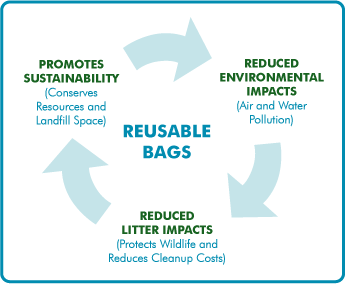
Marcus Gee, an international affairs columnist for the Globe and Mail, recently wrote an article criticizing Toronto’s new bylaw requiring all grocery stores to charge 5 cents for plastic bags. He writes “There is more sanctimony than sense behind this rule, which took effect Monday and which will require even the hard-pressed corner store guy to post signs explaining the five-cent charge.”
Other critics like Gee, also mention how plastic bags are recyclable and reusable anyway and serve multiple purposes. Marcus argues that they are especially useful for lining garbage bins. He thinks that we will have to buy plastic bags anyway whether from a grocery store or from another vendor to serve these various functions. One part of his article that is particularly irksome, erroneous and ill-informed is his discussion over landfills and waste diversion. “Modern landfills are marvels of environmental management that have next to no impact on the land around them. Impermeable, high-tech membranes prevent liquids from escaping into the groundwater. Methane is funnelled off and burned to produce electricity. “
Firstly, all modern landfills constitute “hazardous industrial waste landfill” and can be technical and scientific and therefore be exclusionary and esoteric to the general public. There are still a lot of uncertainties surrounding their impacts on groundwater, water quality and the environment generally. Further, they take up vast amounts of space, have no element of sustainability and produce a lot of social and environmental injustices. Additionally, many environmental law cases in Ontario deal with the controversies over landfills. The odour from the landfill site can permeate local farms and residential areas. Landfill odour can constitute a nuisance and unreasonable interference. It endangers life and health. Citizens have a lot of causes of actions (torts) that they can use for this very reason to sue and condemn the use of landfills.
Now, in terms of charging for plastic bags (something Gee thinks is preposterous), there are many benefits. In short, considering the number of shoppers in the metropolitan area, a five cent charge can induce citizens to change their behaviour. In addition, a user charge can persuade citizens to make the investment in buying reusable bags which are sturdier, compact and can carry a higher volume of groceries.
All the revenues collected from this five cent shopping bag charge will accumulate in the store’s budget, and it is expected that the money will be used for environmental projects. Again, “environmental projects and or funds” is quite nebulous. However, there can certainly be more regulation here whereby the municipal government monitors how these stores use their revenue. The biggest criticism of the 5 cent charge should not be its futility, but maybe how the 5 cents will be used. Economically, it makes sense. Chris and I both did some quick math on this in a previous post which you could see here.
Toronto wants to achieve a 70 percent diversion of waste from landfills by 2012. This is feasible. And achieving this will require a serious cut down on those ubiquitous disposable coffee cups, higher rates of composting, recycling and user charges like the 5 cent plastic bag fee. Regulatory measures are also significant for waste diversion and if the implementation of a bylaw reduces total waste generated, then a 5 cent charge certainly has merit. Marcus Gee may not approve of these various initiatives but they are all indispensable for achieving a higher waste diversion rate.
Key message: The real goal of such a bylaw is to promote sustainability through the use of reusable bags. Charging a small fee for plastic bags gets people thinking about the environment and provides an inclination and incentive to either consume less or make a switch to reusable bags.
Sunday, May 31, 2009
Environmentalism as a luxury is not always a bad thing...
You're at the supermarket and faced with a very tough decision: do you go with the apples labelled 'organic' (we'll assume in this example that they actually are organic and also not of the GMO variety) or the regular ones? You've seen the news shows and read the books on the risks of non-organic foods and are fully aware that those apples were probably splattered in pesticides. If you continue to eat them you might be slowly killing yourself in one way or another. But the organic apples are twice the price. Decisions, decisions...
I am a student, and like a hefty number of people living in Canada, student or not, I do not have huge amounts of money to be spending on groceries. I already spend a great share of my income on food, but at the prices charged for organic products, I simply can't afford it, at least without giving up on other aspects of my spending.
This is certainly not news. The organics debate (at least the pricing aspect of it) has been charging along for quite some time now. The common conclusion is quite simple: eating organic foods is reserved for those of us who can afford it. It is a luxury. Sure, you can grow a wide range of organic foods in your backyard for a much cheaper price, but the reality is that the majority of people do not have the time, space or most importantly, the patience, to do so.
In my own experience I've certainly run into people who think having expensive organics is an awful thing. Price gougers; bourgeoisie; capitalist exploiters: some of the phrases I've heard associated with organics in Canada (you'll notice the rather socialist leanings of some of these remarks. For more, I highly recommend taking a tour of the Trent Campus...).
A month or so ago I visited the Carrot Common in Toronto, a grouping of 'green' stores, headlined by a massive grocery store where nearly everything was organic. While it was a nice place to be, I came to realize that although I could be healthier, my grocery bill would probably be three to four times more expensive if I shopped there.
But here's the thing. Having organics so expensive is not necessarily a bad thing. This is simply because it is a relatively new product trying to make its way into an already overfilled market. If we look at products that today are very common we can quickly realize that the organics market is only at its earliest stages. For example, when computers first became consumer goods and battled the typewriter industry, they were outrageously expensive and reserved only for those with a nice chunk of change. But now the majority of people in Canada have or have access to a computer. Cars, too.
This is all because of the law of economies of scale: as more of a good is produced overall, the marginal cost of producing each good falls. Quite simply, it's like buying bulk. The more you make, the cheaper each individual one becomes. Compared to 'regular' foods, organics are a tiny share of the market and therefore are more expensive. But as they become more popular, the cost will go down. But in the meantime, the market has to start somewhere.
The other argument I'd pose is that organics (at least the ones that aren't price gouged and also the ones that are local) reflect what the more realistic economic cost should be. Although we've gotten used to our food industry, being able to buy whatever we want and whenever we want at remarkably low prices is a function of a lot of dangerous processes we're now learning might be more trouble than they're worth. Globalization, pesticide use and agricultural subsidies are making our food overly abundant and overly cheap, at the expense of our health, the world's farmers and the environment. More expensive food is seen as a bad thing (which largely, it is), but maybe more expensive food is a reality if we want to be living sustainably.
The expensiveness of being 'environmental' or 'green' is not reserved for organics. Renewable energy systems, hybrid cars and 'green' clothing products are also expensive and largely out of reach for many people. Having a completely solar powered home is a nice idea, but few can afford it, right now. So yes, these environmental products may be expensive and out of reach, but soon enough they'll be in the market place so the common-person can afford them.
The danger is if we denounce these products as being too luxurious, effectively reducing their desirability in the market and leaving them to go extinct. Everything has to start somewhere and unfortunately, it often starts with the rich.
Friday, May 29, 2009
Conservation often makes the most economic sense...sort of...
I recently saw a presentation by an architect & professor of architecture, Michael Pelken, from Syracuse University, on integrated wind technologies. Among other things, his talk focused on a now notorious offshore wind farm proposed to be built off the coast of Cape Cod in the Northeastern United States. The proposal was met with so much opposition from the local community that external designers (Mr. Pelken's group) were brought in to revamp the project.
The new proposal was quite impressive, though a tad impractical (as conceptual designs always seem to be). But the biggest piece of the design that stuck out to me was the idea to minimize the number of wind turbines (from 130 to 50) and offset the lost power generation with energy conservation measures (better lighting, smart meters etc) in the surrounding communities. Building less turbines would be cheaper and so the leftover cash could be put into the conservation measures.
This is a particularly attractive idea, especially for publicly-owned utilities. Instead of spending millions of dollars, time and other resources trying to site new renewable energy facilities (wind farms, solar farms, small-hydro dams), they could instead use the funds they would have put into the project into conservation measures, as the total energy saved could often equal or surpass the amount of energy that the project would have produced. This can also be a much cheaper process, both in money and time, as you won't have to deal with the same level of opposition that you might if siting a large project.
But it strikes me that this strategy would only be effective for public utilities, such as Peterborough Utilities (which already operates several conservation programs) and the Ontario Power Authority. The problem lies in the private and semi-private power generation companies (such as Ontario Power Generation).
The problem is quite simple. If your business is to produce energy, there is no profit in conservation. You want to build your project, make energy and sell it back to the grid. This is not always a bad thing. After all, it's now highly encouraged to build renewable energy systems.
And from a business and macro-economic perspective, power generation over conservation certainly works into the pro-growth model. And new projects can often look better politically, as people, companies and organizations become impressed with the project, especially in this new era of renewable development. But as we're seeing, unsustainable growth (a model without much conservation) is fraught with problems.
There will always be a hefty demand for energy in Canada, regardless of conservation and efficiency measures (we can only conserve so much), so this is certainly not a call for the cessation of energy projects. And we certainly need more renewables adding to the grid. But if the ultimate goal is to reduce GHG emissions while still being economically viable, perhaps governments should shift a portion of their immediate focus away from the often slow development of renewables and put those resources into conservation. It might not make millions of dollars, but it will certainly save millions of them.
The new proposal was quite impressive, though a tad impractical (as conceptual designs always seem to be). But the biggest piece of the design that stuck out to me was the idea to minimize the number of wind turbines (from 130 to 50) and offset the lost power generation with energy conservation measures (better lighting, smart meters etc) in the surrounding communities. Building less turbines would be cheaper and so the leftover cash could be put into the conservation measures.
This is a particularly attractive idea, especially for publicly-owned utilities. Instead of spending millions of dollars, time and other resources trying to site new renewable energy facilities (wind farms, solar farms, small-hydro dams), they could instead use the funds they would have put into the project into conservation measures, as the total energy saved could often equal or surpass the amount of energy that the project would have produced. This can also be a much cheaper process, both in money and time, as you won't have to deal with the same level of opposition that you might if siting a large project.
But it strikes me that this strategy would only be effective for public utilities, such as Peterborough Utilities (which already operates several conservation programs) and the Ontario Power Authority. The problem lies in the private and semi-private power generation companies (such as Ontario Power Generation).
The problem is quite simple. If your business is to produce energy, there is no profit in conservation. You want to build your project, make energy and sell it back to the grid. This is not always a bad thing. After all, it's now highly encouraged to build renewable energy systems.
And from a business and macro-economic perspective, power generation over conservation certainly works into the pro-growth model. And new projects can often look better politically, as people, companies and organizations become impressed with the project, especially in this new era of renewable development. But as we're seeing, unsustainable growth (a model without much conservation) is fraught with problems.
There will always be a hefty demand for energy in Canada, regardless of conservation and efficiency measures (we can only conserve so much), so this is certainly not a call for the cessation of energy projects. And we certainly need more renewables adding to the grid. But if the ultimate goal is to reduce GHG emissions while still being economically viable, perhaps governments should shift a portion of their immediate focus away from the often slow development of renewables and put those resources into conservation. It might not make millions of dollars, but it will certainly save millions of them.
Wednesday, May 27, 2009
A Recession should not post-pone EPR legislation…
In the past, I have blogged about extended-producer responsibility (EPR). In short, EPR is an environmental policy approach in which a producer’s responsibility including physical and/or financial for a product is extended to the post-consumer stage of a product’s life cycle. Because producers, importers and/or sellers have to internalize waste management costs in their product prices, they would have to be more efficient and less profligate when designing their products.
Some critics of the EPR model have discussed its futility in an economic downturn. I think the implicit assumption here is that manufacturers are already struggling to produce and sell their products because demand for goods has plummeted amid the recession. Therefore, they would be unwilling to invest in an EPR model because of their ostensible limitations and constraints. This however is absolute bogus and is delaying the indispensable legislative requirements that are badly needed to advance sustainability in waste management. Some of the cynics found within these manufacturing companies are completely overlooking the benefits that one can obtain from making simple switches through EPR.
Over the long-term, producers can profit by taking materials back and reusing them. By re-using products producers are effectively becoming less reliant on aggregate resources from the environment and therefore extraction costs go down and it makes the manufacturing process more efficient for them. Like many topics within the environment, an EPR model is highly interconnected. When manufacturers and producers jump on board, citizens begin to recognize their good habits and the government becomes more generous in terms of creating waste management funds and incentive programs to reduce total waste.
Though I am not always an advocate for regulatory measures, having legislation on EPR is absolutely critical. This is important because by transferring the costs from taxpayer funded municipal waste management systems to manufacturers and citizens, it can enforce the polluters pay principle where level of effort to conserve or pollute is reflected in the cost.
Fortunately, the recession has provided us with realization that rampant consumerism and neglecting the environment can be costly both economically and environmentally. There have been some minor funding cuts in renewable technology, environmentally friendly products, and highly innovative waste management models like EPR. However, I vehemently believe that the recession has not stifled but stimulated innovation for green design and development. And now we are going to see an upward trend in more funding allocation to the environment for research and development purposes (of course I am an optimist). Whether my hypothesis is accurate or not, the bottomline is that we will have to be cautious in our ambitious pursuits and start to better understand why environmental education is important for this era. Being educated on things like EPR or recycling programs for instance can take us along way and broaden our knowledge on sustainable development.
This is no time to gamble with risks for things like EPR, the advantages and cost-savings associated with EPR are extensive and wide-ranging. This is the time to bring about EPR legislation as British Columbia has so adequately done. We are going to have to be more forward thinking in this era of sustainable development. A recession should teach us about how to become smarter with green innovation and certainly a degree of collective accountability.
Key message: EPR is an effective method because it can stimulate innovation in manufacturing companies through reducing materials, resources and energy usage. All of which are important for optimal waste minimization.
Some critics of the EPR model have discussed its futility in an economic downturn. I think the implicit assumption here is that manufacturers are already struggling to produce and sell their products because demand for goods has plummeted amid the recession. Therefore, they would be unwilling to invest in an EPR model because of their ostensible limitations and constraints. This however is absolute bogus and is delaying the indispensable legislative requirements that are badly needed to advance sustainability in waste management. Some of the cynics found within these manufacturing companies are completely overlooking the benefits that one can obtain from making simple switches through EPR.
Over the long-term, producers can profit by taking materials back and reusing them. By re-using products producers are effectively becoming less reliant on aggregate resources from the environment and therefore extraction costs go down and it makes the manufacturing process more efficient for them. Like many topics within the environment, an EPR model is highly interconnected. When manufacturers and producers jump on board, citizens begin to recognize their good habits and the government becomes more generous in terms of creating waste management funds and incentive programs to reduce total waste.
Though I am not always an advocate for regulatory measures, having legislation on EPR is absolutely critical. This is important because by transferring the costs from taxpayer funded municipal waste management systems to manufacturers and citizens, it can enforce the polluters pay principle where level of effort to conserve or pollute is reflected in the cost.
Fortunately, the recession has provided us with realization that rampant consumerism and neglecting the environment can be costly both economically and environmentally. There have been some minor funding cuts in renewable technology, environmentally friendly products, and highly innovative waste management models like EPR. However, I vehemently believe that the recession has not stifled but stimulated innovation for green design and development. And now we are going to see an upward trend in more funding allocation to the environment for research and development purposes (of course I am an optimist). Whether my hypothesis is accurate or not, the bottomline is that we will have to be cautious in our ambitious pursuits and start to better understand why environmental education is important for this era. Being educated on things like EPR or recycling programs for instance can take us along way and broaden our knowledge on sustainable development.
This is no time to gamble with risks for things like EPR, the advantages and cost-savings associated with EPR are extensive and wide-ranging. This is the time to bring about EPR legislation as British Columbia has so adequately done. We are going to have to be more forward thinking in this era of sustainable development. A recession should teach us about how to become smarter with green innovation and certainly a degree of collective accountability.
Key message: EPR is an effective method because it can stimulate innovation in manufacturing companies through reducing materials, resources and energy usage. All of which are important for optimal waste minimization.
Monday, May 25, 2009
Energy Conservation in Toronto…
On average, about 20% of your home electricity costs are attributed to lighting.
This past weekend I was working an event called “Spring Turn On” at a Home Depot location in Toronto. It is a two weekend event (May 23rd/24th and May 30th/31st) at Home Depot and Canadian Tire locations across the city. Toronto Hydro, the largest electricity utility in Canada, is the main organizer with aims to inform customers about the latest energy conservation programs available in the city. Summerhill Group, my employer is a company dedicated to transforming markets to achieve sustainability. They are running the event in conjunction with Toronto Hydro, Home Depot and Canadian Tire.
For both Saturday and Sunday, store customers found themselves wandering around curious to find the latest deals and bargains on new cool appliances. Once customers noticed our presence they were filled with excitement and irrational exuberance desperate to grab their free compact fluorescent light bulb. We provided 350 free CFLs to the first 350 customers which served as a great avenue to educate inform and discuss the numerous benefits that CFLs serve. There is more to it however, the customers were required to fill in a quick survey on energy conservation in Toronto so that Toronto Hydro can identify what part of the city their from, their knowledge on energy efficient strategies and how often they participate in these eco events. We are also providing $4 rebate coupons for all Energy Star Certified light bulbs, and $10 coupons for power bars with timers.
One of my responsibilities was to inform and educate customers on Toronto Hydro’s peak saver program. In short, only residents who have centralized air conditioners and/or water heaters are eligible. Why? In the summer months when residents profligately run their air conditioners, it contributes to peak demand because everyone in the city is doing it. So, Toronto Hydro figured that by installing peak savers on air conditioners for absolutely free and providing a $75 gift card in the process, residents would feel more inclined to have it.
How does it work? During peak periods, Toronto Hydro will send a signal to the AC or water heater to interrupt power to the appliance for a short time. Air conditioners are cycled off for 15 minutes out of every 30 minutes. This way, a lot of pressure is taking off of the hydro system thereby reducing demand and keeping the cost of power lower in the future. Additionally, this reduces the need to import electricity.
We are also informing people about “time of use” pricing. Both smart meters and time of use pricing help minimize peak demand. Let’s say for example you want to use your clothes dryer and it is 6 pm in the evening. Chances are a lot of people are using their dryers at this time and will have to pay the on-peak (highest price) of 8.8 cents per kWh. If you wanted to dry your clothes at 11:30 pm you would be paying off-peak (lowest price) of 4 cents per kWh. In other words, incentives do exist to encourage residents to think about when they wash and dry their clothes, use their AC and dishwasher.
Key message: “All electrical devices have two prices tags, the initial purchase price and the cost of operating it.”
This past weekend I was working an event called “Spring Turn On” at a Home Depot location in Toronto. It is a two weekend event (May 23rd/24th and May 30th/31st) at Home Depot and Canadian Tire locations across the city. Toronto Hydro, the largest electricity utility in Canada, is the main organizer with aims to inform customers about the latest energy conservation programs available in the city. Summerhill Group, my employer is a company dedicated to transforming markets to achieve sustainability. They are running the event in conjunction with Toronto Hydro, Home Depot and Canadian Tire.
For both Saturday and Sunday, store customers found themselves wandering around curious to find the latest deals and bargains on new cool appliances. Once customers noticed our presence they were filled with excitement and irrational exuberance desperate to grab their free compact fluorescent light bulb. We provided 350 free CFLs to the first 350 customers which served as a great avenue to educate inform and discuss the numerous benefits that CFLs serve. There is more to it however, the customers were required to fill in a quick survey on energy conservation in Toronto so that Toronto Hydro can identify what part of the city their from, their knowledge on energy efficient strategies and how often they participate in these eco events. We are also providing $4 rebate coupons for all Energy Star Certified light bulbs, and $10 coupons for power bars with timers.
One of my responsibilities was to inform and educate customers on Toronto Hydro’s peak saver program. In short, only residents who have centralized air conditioners and/or water heaters are eligible. Why? In the summer months when residents profligately run their air conditioners, it contributes to peak demand because everyone in the city is doing it. So, Toronto Hydro figured that by installing peak savers on air conditioners for absolutely free and providing a $75 gift card in the process, residents would feel more inclined to have it.
How does it work? During peak periods, Toronto Hydro will send a signal to the AC or water heater to interrupt power to the appliance for a short time. Air conditioners are cycled off for 15 minutes out of every 30 minutes. This way, a lot of pressure is taking off of the hydro system thereby reducing demand and keeping the cost of power lower in the future. Additionally, this reduces the need to import electricity.
We are also informing people about “time of use” pricing. Both smart meters and time of use pricing help minimize peak demand. Let’s say for example you want to use your clothes dryer and it is 6 pm in the evening. Chances are a lot of people are using their dryers at this time and will have to pay the on-peak (highest price) of 8.8 cents per kWh. If you wanted to dry your clothes at 11:30 pm you would be paying off-peak (lowest price) of 4 cents per kWh. In other words, incentives do exist to encourage residents to think about when they wash and dry their clothes, use their AC and dishwasher.
Key message: “All electrical devices have two prices tags, the initial purchase price and the cost of operating it.”
Thursday, May 21, 2009
Obama introduces new emissions laws...
Earlier this week, President Obama introduced new automotive legislation significantly increasing the level of fuel efficiency that new cars sold in the United States will be able to have. The legislation also curbs the level of harmful, toxic emissions that these new cars will be able to release.
The requirements are relatively simple: by 2016 all new cars and light trucks in the United States will have to have an average fuel efficiency level of 35.5 MPG (6.6 L/100 km; a 2009 Honda Civic coupe), up from an average level of 25 MPG (9.4 L/100 km; a 2009 Ford Escape SUV) today. Starting in 2012, carmakers will have to improve fuel efficiency by 5% annually.
According to the administration, this new legislation would reduce carbon emissions in the United States by 30%. Though you should not expect the changes to happen overnight. First, the goals of the legislation don't have to be met until 2016, which still leaves seven more years. Secondly-- and more importantly-- it will take quite a few years for the new, fuel efficient cars and trucks to diffuse into the market. Since car owners generally like to hold onto their vehicles for a number of years, many car buyers won't purchase the new, fuel efficient vehicles until much later. Especially since the new emissions and mileage targets will make new cars about $1300 more expensive.
According to a group at MIT, the main benefits of the legislation won't really be felt until 2030. So the massive carbon reduction from this policy that Obama talked about may not actually take place for a good while. But there is a provision in the legislation that seeks to speed up that process, known as the 'Cash for Clunkers' plan.
The plan would provide financial vouchers for car owners to scrap or trade in their old vehicles for new, fuel efficient ones, thereby quickening the pace that the fuel efficient vehicles get rolled onto the roads. The plan is being touted as environmentally friendly and a help to car buyers. It is true that it could have benefits for climate change, but we must keep in mind that building new cars (and disposing of old ones) is certainly not an environmentally friendly activity, no matter which way you cut it. Germany has also adopted such a plan, but instead of aiming for the fuel efficiency goal (Europe already has some of the highest mileage standards in the world), its goal is moreso to re-ignite its ailing auto industry.
While it is true that the 'Cash for Clunkers' plan could be effective, a number of critics are worried that the savings accrued by vehicle swappers may not be as high as everyone perceives. This is because of the Miles Per Gallon Illusion, a phenomenon I've described before, where the marginal increase in gas savings falls rapidly with higher levels of fuel efficiency. The authors of the MPG Illusion blog have researched the plan heavily and are concerned the savings may not be economically or environmentally viable.
But regardless of the minor problems with the legislation, it is still a masterful and landmark piece of policymaking. It will certainly have serious benefits from an environmental point of view. Although the carbon emissions cut will not happen for some time, a 30% reduction is still very significant and very realistic, especially in an industry that accounts for a hefty share of the U.S.'s GHG emissions.
Such legislation has been fought by automakers for many years. When California adopted its stringent efficiency limits a few years ago, automakers were less than excited and very quickly launched lawsuits that exist today (although they will be dropped as a result of the new legislation). A national policy similar to California's was called for, but was crushed at the powerful hands of the then 'Big Three' (GM, Ford & Chrysler). Since the 'Big Three' are all on the verge of collapse, their lobbying powers in this case were not all that powerful.
In fact, what makes this legislation so impressive is the fact that the auto industry is actually in support of it (although I wouldn't be surprised if even more stringent rules were watered down in exchange for their support). And it probably doesn't make it all that easy for them to say no since one of the main stakeholders in GM and Chrysler is the federal government.
This will have important implications for Canada since the federal Conservative government has no serious environmental policies and has openly stated its waiting for the US to make some moves so it could join up and follow the leader. Don't be surprised to hear Canada adopting similar efficiency standards and emissions limits within the next little while.
Tuesday, May 19, 2009
Perspectives on municipal water: Private or public…
In a time of great uncertainty over the use, consumption and trade of fresh water, municipalities are increasingly being plagued with tough water policy decisions. In Canada, there are numerous municipalities that have public water infrastructure systems meaning that water is managed, delivered and treated by a public body. Historically, municipalities relied on public water infrastructure because the private sector could not be relied upon to deliver a quality service at a price that all residents could afford. With 7% of the planet’s renewable fresh water, Canada could choose to position itself to profit through the privatization and commercialization of water resources municipally, provincially and federally. But should we really?
With municipal budgets only becoming more constrained, privatizing water infrastructure is only becoming more appealing. The U.S. Southwest has seen its fair share of egregious violations of water quality standards from corporations who have been negligent in water treatment. Moreover, many municipalities in the U.S. Southwest have privatized water infrastructure because water is scarce and can be profitable for private utility companies to charge for it at a higher rate. Further, privatization is presented to municipal governments in a pretty package, their proponents eager to capitalize on the difficult budget binds municipal councils often find themselves in.
Toronto finds itself in a precarious situation. It will have to pay ~$800 million to repair and upgrade its municipal water infrastructure. Let’s not forget that this cost can easily go up due to degrading infrastructure that is only exacerbated by population increases and unrestrained demand. The city of Toronto does not have $800 million right now to spend on upgrading and fixing its water infrastructure. However, a private company can do it for them with the condition that they have control over the delivery and allocation of water. This becomes tricky because the risks are not always known at this point of time. Privatization is appealing but what are the long-term effects? With water infrastructure or public infrastructure in general, the local governments pays about 50%. The province will chip in 40% and the federal government around 7%.
Personally I am an advocate for publicly owned and monitored systems. Provinces need to chip in however, municipalities cannot do it alone. Historically and contemporaneously, appropriate funding is not accompanying the downloading of provincial responsibilities to municipalities for a range of essential health and social services. Public capital investment has not kept pace with economic growth or population increases. Retaining public control allows governments to make appropriate investments for better water quality to protect people in their communities for the long term.
Finally, infrastructure construction and refurbishment could be funded through debt financing. Cities have an opportunity to arrange debt financing that maximizes benefits and services to the public while minimizing costs, thanks to having access to the lowest available borrowing rates.
Key message: Sometimes, when private operators move in, rates go up, quality deteriorates and accountability suffers. Should we then turn to public-private partnerships?
With municipal budgets only becoming more constrained, privatizing water infrastructure is only becoming more appealing. The U.S. Southwest has seen its fair share of egregious violations of water quality standards from corporations who have been negligent in water treatment. Moreover, many municipalities in the U.S. Southwest have privatized water infrastructure because water is scarce and can be profitable for private utility companies to charge for it at a higher rate. Further, privatization is presented to municipal governments in a pretty package, their proponents eager to capitalize on the difficult budget binds municipal councils often find themselves in.
Toronto finds itself in a precarious situation. It will have to pay ~$800 million to repair and upgrade its municipal water infrastructure. Let’s not forget that this cost can easily go up due to degrading infrastructure that is only exacerbated by population increases and unrestrained demand. The city of Toronto does not have $800 million right now to spend on upgrading and fixing its water infrastructure. However, a private company can do it for them with the condition that they have control over the delivery and allocation of water. This becomes tricky because the risks are not always known at this point of time. Privatization is appealing but what are the long-term effects? With water infrastructure or public infrastructure in general, the local governments pays about 50%. The province will chip in 40% and the federal government around 7%.
Personally I am an advocate for publicly owned and monitored systems. Provinces need to chip in however, municipalities cannot do it alone. Historically and contemporaneously, appropriate funding is not accompanying the downloading of provincial responsibilities to municipalities for a range of essential health and social services. Public capital investment has not kept pace with economic growth or population increases. Retaining public control allows governments to make appropriate investments for better water quality to protect people in their communities for the long term.
Finally, infrastructure construction and refurbishment could be funded through debt financing. Cities have an opportunity to arrange debt financing that maximizes benefits and services to the public while minimizing costs, thanks to having access to the lowest available borrowing rates.
Key message: Sometimes, when private operators move in, rates go up, quality deteriorates and accountability suffers. Should we then turn to public-private partnerships?
Friday, May 15, 2009
Getting the most bang for our buck...
I recently attended the Ontario Centres for Excellence (OCE) Discovery conference in Toronto. It was attended by 2000+ people and a host for hundreds of exhibitors from the world of technological innovation, commercialization and revolutionary thinking. Canadian universities, research groups, small businesses and large technology-focused conglomerates showed off their arsenal of gizmos, business catalysts and multimedia watchamadoozles.
One university's engineering department was showing off a hybrid car that had solar panels splattered all over the roof to help run the battery. Wonderful idea. A few other groups had innovative ideas to capture energy, such as smaller wind-capturing technologies and a process to use energy from grapes. There was even a small float plane being touted as the next-big-thing.
It was like looking into the future. One of the beauties of such a conference is its ability to bridge the gap between ideas & commercialization and actually take some of these great innovations and put them to use in the real world.
However, as I'm discovering with some of my research this summer, this gap is often much wider than many people believe. As Prof. Stephen Hill of Trent University (the prof I'm doing much of my summer research with) outlined in his brief discussion at the conference, a great deal of these innovations are technologically and economically feasible (often by a wide margin) but are not widely implemented in the world.
As he says, this is because of social and political opposition. What might be economically feasible might not be socially or politically feasible. For example, a large solar farm in the outskirts of a medium-sized town might be able to produce enough electricity to power the entire town with clean, emissions-free energy at a relatively low cost. But the residents near the proposed farm might be vehemently opposed to the proposed project, be it for a variety of reasons, making it a non-feasible project overall.
Much of our research is directed towards the renewable energy sector, where much popular talk revolves around economic incentives for these technologies (wind, solar, small-hydro etc) so they can compete with traditional energy sources. But while much time, money and research is being put into making these technologies economically feasible, a far lesser proportion is being put towards making them socially and politically feasible.
As technologies become increasingly efficient and governments provide incentives to make them cost-effective, the economic barriers are essentially eliminated. But the socio-political barriers are still standing and are very, very strong.
While putting millions of dollars into getting that extra few miles per gallon out of our hybrid vehicles (which is not as effective as many think) is a great technological leap, perhaps we would get more bang for our buck if we put that money towards safely and effectively implementing the wonderful technology.
The money and resources could be put into research of social acceptance, making stakeholder involvement in projects more inclusive and widely distributed, the training of specialists (ex. engineers and other designers) to include social and political aspects of their work and even an established framework for standardizing project development processes to make them more socially and politically acceptable.
This is certainly not a call to withdraw funding from technology research and development. That would be idiotic. But if our goal is to actually implement this technology, we should probably divvy those funds up a little bit.
Wednesday, May 13, 2009
Getting stuff done... Academia versus policy-making
I watched a bloggingheads video yesterday that featured two academics discussing how there are not too many academic political scientists within the Obama administration. Daniel Drezner, Professor of Political Science at Tufts University’s Fletcher school and Joseph Nye, University Distinguished Service Professor at the Kennedy School of Government at Harvard University discuss extensively how academia and policy sometimes do not match. For instance, academia usually focuses on the more theoretical concepts and applications.
In international relations and political science, if you want to publish something that is policy related, it may have some utility value in government but is not widely embrace in the academy. The academy will always prefer highly abstract statistical and mathematical models that require a lot of rigor and analysis. There is a lot more to this discussion and if you are interested I encourage you to watch this 45 minute clip of Drezner and Nye.
When thinking of the environment in academia I think of the theories that have been constructed over the years. When I do research for my environment classes, I always read the scholarly journals published on things like green neo-liberalism or green theory. I use these journals for my research papers but I also look at the publications of think-tanks and institutes that have done some work on public transit initiatives and climate change policy tools, and everything in between. Overall, I find both the theoretical (academia) and more policy-based work (think-tanks, government agencies) to be useful for my understanding and for actually writing the research paper. What is more applicable to society and government?
Nye will tell you that within academia and within his very own department at Harvard, there are profs who are more theoretical and some who are more practical. In fact, he uses the illustration of a bell curve where one side has the really theoretical thinkers who publish extensively within the academy, and other profs who are more policy-oriented and produce a lot of good work for government and foreign affairs.
You may be wondering why such a topic is even worth exploring. Well the Obama administration for instance has academic scientists and economists but is lacking these scholars in international relations and politics. But think about this: the administration still has many bright individuals that are advising national security and foreign affairs, albeit not all academics. However, an anomaly exists with Professor of Public Policy at Harvard Samantha Power and Professor of Law Cass Sunstein (Harvard as well). Both will be highly influential people on the environment. But oh no, policy professor and lawyer? What are we thinking? Both come from academia and are generally more practical, but how theoretical are they?
This question also applies to Canada and who we should turn to for climate change policy advice, or renewable energy. Should we turn to the person who has their PhD in physics, or the person who has their Masters in Public Policy and works for a think tank?
Key message: We are only going to make progress once academia and government work exceptionally well together.
In international relations and political science, if you want to publish something that is policy related, it may have some utility value in government but is not widely embrace in the academy. The academy will always prefer highly abstract statistical and mathematical models that require a lot of rigor and analysis. There is a lot more to this discussion and if you are interested I encourage you to watch this 45 minute clip of Drezner and Nye.
When thinking of the environment in academia I think of the theories that have been constructed over the years. When I do research for my environment classes, I always read the scholarly journals published on things like green neo-liberalism or green theory. I use these journals for my research papers but I also look at the publications of think-tanks and institutes that have done some work on public transit initiatives and climate change policy tools, and everything in between. Overall, I find both the theoretical (academia) and more policy-based work (think-tanks, government agencies) to be useful for my understanding and for actually writing the research paper. What is more applicable to society and government?
Nye will tell you that within academia and within his very own department at Harvard, there are profs who are more theoretical and some who are more practical. In fact, he uses the illustration of a bell curve where one side has the really theoretical thinkers who publish extensively within the academy, and other profs who are more policy-oriented and produce a lot of good work for government and foreign affairs.
You may be wondering why such a topic is even worth exploring. Well the Obama administration for instance has academic scientists and economists but is lacking these scholars in international relations and politics. But think about this: the administration still has many bright individuals that are advising national security and foreign affairs, albeit not all academics. However, an anomaly exists with Professor of Public Policy at Harvard Samantha Power and Professor of Law Cass Sunstein (Harvard as well). Both will be highly influential people on the environment. But oh no, policy professor and lawyer? What are we thinking? Both come from academia and are generally more practical, but how theoretical are they?
This question also applies to Canada and who we should turn to for climate change policy advice, or renewable energy. Should we turn to the person who has their PhD in physics, or the person who has their Masters in Public Policy and works for a think tank?
Key message: We are only going to make progress once academia and government work exceptionally well together.
Tuesday, May 12, 2009
Trent's Green Roof...
A Trent student recently wrote a detailed and highly informative 6 page overview of Trent's rooftop garden. As I have blogged about before, green roofs are innovative solutions for urban sustainability. However, people are only going to see the advantages of having them through the creation of market incentives, rebates and pilot projects. The report on Trent's rooftop gardens in available here.
Monday, May 11, 2009
Green Cities: Montreal’s Bixi… Not quite the Parisian Model
Montreal, known for its vehement and wild Habs fans, high levels of vandalism and great city life is going to bring about a public bike rental system. Known as bixi, which is a combination of bike and taxi, is going to be implemented with the $15 million made available from the Montreal parking authority. For details see here.
The only difference between Paris’s bike rental system and Montreal’s is that Paris’s system is owned by a private company. Montreal will have a city-owned bike rental system. Paris and other European cities have had great success with such a system in place. Why? Because the streets and urban environments are much more conducive for biking and scooters. Plus, automobiles are not as ubiquitous in European cities as they are in North American ones.
There has always been sufficient demand for bike rental services in Montreal, and the city plans on bringing about 800 kilometres of bike routes by 2013. This city initiative is the epitome of New Urbanism and smart growth. Montreal’s public transit system, albeit popular, is not as established as cities like Curitiba or San Francisco. Nonetheless, having a public bike rental system in place adds to urban amenities, attracts tourists and will undoubtedly mitigate smog and pollution levels in the inner city.
A city-owned bike rental system is good for urban planning as well. Transportation initiatives in cities across the world are sometimes privatized such as a bus system, subways, and even bike rental services. A city-owned system though more expensive, is better from a planning and policy lens. Firstly, accountability with a private company may not be as adequate as a city-owned system. Secondly, policies and incentive programs for encouraging cycling can be easier to implement through municipal government.
Key message: Montreal is en route to becoming one of Canada’s greener cities. Let’s celebrate this new initiative, track and study its development and think about how we can make our very own cities more environmentally-friendly.
The only difference between Paris’s bike rental system and Montreal’s is that Paris’s system is owned by a private company. Montreal will have a city-owned bike rental system. Paris and other European cities have had great success with such a system in place. Why? Because the streets and urban environments are much more conducive for biking and scooters. Plus, automobiles are not as ubiquitous in European cities as they are in North American ones.
There has always been sufficient demand for bike rental services in Montreal, and the city plans on bringing about 800 kilometres of bike routes by 2013. This city initiative is the epitome of New Urbanism and smart growth. Montreal’s public transit system, albeit popular, is not as established as cities like Curitiba or San Francisco. Nonetheless, having a public bike rental system in place adds to urban amenities, attracts tourists and will undoubtedly mitigate smog and pollution levels in the inner city.
A city-owned bike rental system is good for urban planning as well. Transportation initiatives in cities across the world are sometimes privatized such as a bus system, subways, and even bike rental services. A city-owned system though more expensive, is better from a planning and policy lens. Firstly, accountability with a private company may not be as adequate as a city-owned system. Secondly, policies and incentive programs for encouraging cycling can be easier to implement through municipal government.
Key message: Montreal is en route to becoming one of Canada’s greener cities. Let’s celebrate this new initiative, track and study its development and think about how we can make our very own cities more environmentally-friendly.
Saturday, May 9, 2009
Environmental irony...

Sometimes the green guys can't always win.
An ambitious 5,000 mile carbon-neutral sailing trip took a turn for the worst when stormy weather rendered the 40 ft. sailing boat disabled.
The boat, Fleur, was on a long journey from Plymouth, England to Greenland, where the two crew members would reach Greenland, ski across the ice cap and back to the boat, all with minimal environmental impact. The boat would be powered through solar panels and of course, wind. The intention of the trip was to show that some of the most extreme trips could be taken and remote areas explored in such a manner that only required environmentally-friendly technologies to get there.
Great. Except that within the first month of travel, everything went wrong. An intense storm capsized the boat, destroyed the solar panels and sailing capabilities of the boat. Oops. Luckily, the ocean is so awash (pun completely intended) with ships that they were very quickly rescued. They may have been thankful and happy to be alive, but the adventurers may not have been as excited to find out that their rescuer was a massive oil tanker carrying nearly 700,000 barrels of crude oil.
Nobody says it better than Alanis: Isn't it ironic?
Green is good, but it isn't perfect.
The Navigable Waters Protection Act changes could mean big problems for Canada's waterways...
The Harper government never ceases to vex environmentalists. As part of its Budget Implementation Act 2009 (the act that must pass to put the year's budget into place), the government attached an amendment to the Navigable Waters Protection Act (NWPA). The trouble is, the amendment was essentially hidden deep within the bill, which is among the year's largest and most likely to pass through parliament. Very sneaky.
The NWPA is a key piece of environmental legislation dating back to 1882 that is designed to protect the public's right to navigate the country's waters. These waters--although no clear definition actually exists, which is a subject of much controversy--can range from the oceans and Great Lakes to small rivers, streams and creeks arguably, only four inches deep.
From an environmental point of view, the NWPA is an important tool in the fight to protect the country's waters and broader environment because it often includes formal environmental assessments. Whenever someone wants to build something like a bridge or a dock that might impact a body of navigable water, an application must be submitted to the government, where it often requires an environmental screening if not a more stringent environmental assessment.
But this amendment would change that. The government has argued that these environmental considerations are delaying development projects throughout the country and stifling the recovery of the economy as the stimulus money can't diffuse as easily. Under the changes, any projects deemed 'minor' or affecting 'minor waters' would be issued a pre-approval and would not require any review from the federal government. These reviews often lead to the environmental screenings or assessments. In addition, the changes would give unprecedented authority to the minister of Transport to exempt any project he/she sees fit, without a possibility for appeal.
The government argues that by amending the act, small projects like a private dock (which require review under the old act) would be streamlined through so the department's resources could be better spent on larger projects. Furthermore, they don't want to bother doing stringent reviews on projects that only effect negligible bodies of water.
Sure. That makes sense. But there are some major problems. First of all, how is the department going to know if a project is actually minor if they don't do a review? As one witness at a hearing described, an applicant could write they're adding on to their private dock, but the dock addition could actually cover 6,000 square feet and have huge environmental consequences. How could the government tell the difference?
Critics are also upset with the authority given to the minister, especially the clause that disallows appeals to the minister's decisions. The lack of an actual definition of 'navigable waters' is also worrying, as it would allow the government to arbitrarily decide what would and wouldn't be reviewed.
A big problem has been the process itself. Members of the government have been wanting to update the act for many years and last summer it really got going and some consultations were held. Unfortunately, the occurrence of an election, the winter prorogation and an economic crisis interrupted the consultation process and as the government argues, required the amendments to be rushed through.
Lots of people and groups were not consulted, including environmental groups, First Nations, hunters, fishers and paddlers: people who would have a direct interest in 'navigable waters'.
Luckily, the issue has gotten enough attention from different stakeholders that a series of Senate Hearings have been scheduled and are currently in session. Although the amendments have been passed in parliament, they still need to be approved by the Senate to become law, so these hearings could have a significant impact.
This issue is particularly important because it highlights the fight over economy and environmentalism. From the federal government's point of view, environmental protection is getting in the way of the economy. And this is not their only strategy. They are also trying to exempt thousands of projects receiving funding from the stimulus package from environmental assessments.
Yes, foregoing time-consuming, detailed environmental assessments can be good for short-term economic recovery. But ignoring environmental concerns could be devastating for the economy in the long-term. And hiding these important amendments in a budget bill (which is not going to be opposed by the parliament in these economic times) is not the best way to go about it.
Thursday, May 7, 2009
Wisdom way solar village...
Who would have ever thought about subsidizing green housing in a recession? This short and highly informative 5 minute video, courtesy of the NY Times, shows a small housing area called "Wisdom Way Solar Village" in Western Massachusetts that is devoted to green housing development. Specifically, highly efficient zero net energy homes that are powered by solar energy. All of the extra power generated is sold back to the grid thereby providing residents with an economic impetus to install more solar panels. Of course, this revitalizes a conservation ethic which is badly needed right now.
Sunlight is plentiful in this area making solar energy viable and economical. Housing units are between $210,000- $240,000 - which is reasonable considering the real estate market of Massachusetts. However, the subsidized units sell for $110,000 and are meant to attract low to middle income buyers. This novelty is very progressive, extremely practical and a wise undertaking. Homeowners of wisdom way solar village are saving money through the use of solar energy. Usually however, this is dependent on whether they are conservative in their energy use.
Renewable energy like solar, wind, geothermal, and the dubious hydro-electric have trade-offs. There is no perfect solution. But the subsidization of green homes through the installation of solar units is conservation to its finest. It also helps with climate change mitigation and adaptation which will become even more pressing in the next 15 years. Biodiversity is not being affected by such development, unlike hydro-electric dams which cause flooding, siltation and other problems. Two thumbs up for the progress of wisdom way solar village.
Sunlight is plentiful in this area making solar energy viable and economical. Housing units are between $210,000- $240,000 - which is reasonable considering the real estate market of Massachusetts. However, the subsidized units sell for $110,000 and are meant to attract low to middle income buyers. This novelty is very progressive, extremely practical and a wise undertaking. Homeowners of wisdom way solar village are saving money through the use of solar energy. Usually however, this is dependent on whether they are conservative in their energy use.
Renewable energy like solar, wind, geothermal, and the dubious hydro-electric have trade-offs. There is no perfect solution. But the subsidization of green homes through the installation of solar units is conservation to its finest. It also helps with climate change mitigation and adaptation which will become even more pressing in the next 15 years. Biodiversity is not being affected by such development, unlike hydro-electric dams which cause flooding, siltation and other problems. Two thumbs up for the progress of wisdom way solar village.
Tsk Tsk, Mr. Gates...
A brief tidbit in the journal from the very leftist, progressive Canadian Centre for Policy Alternatives (CCPA) reports that The Bill and Melinda Gates Foundation--the multibillion dollar charity funded through Bill's not-so-modest stake in Microsoft--has given $5.4 million to a technology firm funded by Monsanto.
The money is to be put towards lobbying African governments and promote the entry of genetically modified crops (GMOs) to the continent, which, in all likelihood, will largely be provided by Monsanto. As I've blogged about before, GMOs can be beneficial. But as I also mentioned, it is the nature of the GMO industry that should be very concerning for the world's population and Monsanto's presence in this group is quite worrying.
Although I did not have incredibly detailed knowledge about the Gates' foundation, I did think of it as a wonderfully beneficial group. Their work in the prevention and treatment of HIV/AIDS and other diseases has been particularly notable. But this new donation strikes them down a few notches on the 'awesome pole'.
The trouble with such a situation is the deep respect, resources and connections the Gates' foundation has. Warren Buffett (now the world's third richest man, but last year topped the list) provided the foundation with nearly $30 billion worth of shares (paid over time) from his investment company, Berkshire Hathaway. That'll be one hell of a tax receipt. But I can't think of any other charity in the world that would be getting anything close to $30 billion.
So if people think the Gates' foundation is doing good in the world, then they're sure to follow suit. In this case, they're following in the wrong direction. As the CCPA said, the floodgates could open up wide. Very wide.
Tuesday, May 5, 2009
Looking for a skeptic? Check the comment box...
You may have noticed over the past few months that I frequently read the Globe & Mail online newspaper. According to the hundreds of comments received by most articles and columns, many others read it too.
The ability to publicly (and instantly) comment on the posted specials, articles and columns is one of the highlights of most online news sites. Some of the biggest online news sites (The New York Times, CTV, The National Post, The Globe and Mail) consistently receive thousands of comments daily. The Globe & Mail actually touts this ability in some of its advertisements, using cartoon bantering heads to showcase the comment area as an intellectual forum of sorts.
I used to think that there was a positive correlation between the number of comments received and the importance or relevance of an article. Often, this may be the case. However, when reading the increasingly common articles on climate change (and this phenomenon is not unique to climate change) I have come to realize that the commenting space is less of an intellectual forum and more of a politically-charged open house for skeptics.
Prior to the federal election in 2008, Stephane Dion's plan for a national carbon tax received much media attention and more comments online than I had ever seen. While going through many of the articles for some research, it became apparent that the majority of comments were from anti-climate change folks, who preached a business-first chorus and were often full out deniers of human beings' influence on climate changes. Some even denied the existence of climate change, offering up unfounded or inaccurate evidence for their beliefs.
However, at that point there were still some people who tried to have a reasonable discussion, skeptic or not. But since then, the number of comments from people wishing to have an open forum or even promote good climate change policy has significantly declined.
It's not a particularly surprising turn of events, considering the level of conversation taken by the skeptics. Rather than trying to talk with someone, they often (and I only marginally generalize) talk at them and ignore any view other than their own. This could also be said of the non-skeptics, but as the evidence crushing down skeptics' beliefs increases, the non-skeptic tends to warrant much greater credibility. Many probably feel it is a futile effort to try to have a decent discussion on the comment section, so no decent comments are actually left anymore.
The views held by the comment-dominating skeptics were once those of the world's policymakers and more importantly, shared by the general public. But these skeptical views are becoming less and less popular and are often dismissed for a variety of justified reasons. As a result, the extreme end of these views can only be found in the smallest, darkest pockets of popular media. Unfortunately, they're poisoning the wonderfully ideal notion of an online intellectual forum.
If you're looking for a decent laugh, I highly recommend a quick tour through some of the online comments received by the major news media articles on climate change.
The ability to publicly (and instantly) comment on the posted specials, articles and columns is one of the highlights of most online news sites. Some of the biggest online news sites (The New York Times, CTV, The National Post, The Globe and Mail) consistently receive thousands of comments daily. The Globe & Mail actually touts this ability in some of its advertisements, using cartoon bantering heads to showcase the comment area as an intellectual forum of sorts.
I used to think that there was a positive correlation between the number of comments received and the importance or relevance of an article. Often, this may be the case. However, when reading the increasingly common articles on climate change (and this phenomenon is not unique to climate change) I have come to realize that the commenting space is less of an intellectual forum and more of a politically-charged open house for skeptics.
Prior to the federal election in 2008, Stephane Dion's plan for a national carbon tax received much media attention and more comments online than I had ever seen. While going through many of the articles for some research, it became apparent that the majority of comments were from anti-climate change folks, who preached a business-first chorus and were often full out deniers of human beings' influence on climate changes. Some even denied the existence of climate change, offering up unfounded or inaccurate evidence for their beliefs.
However, at that point there were still some people who tried to have a reasonable discussion, skeptic or not. But since then, the number of comments from people wishing to have an open forum or even promote good climate change policy has significantly declined.
It's not a particularly surprising turn of events, considering the level of conversation taken by the skeptics. Rather than trying to talk with someone, they often (and I only marginally generalize) talk at them and ignore any view other than their own. This could also be said of the non-skeptics, but as the evidence crushing down skeptics' beliefs increases, the non-skeptic tends to warrant much greater credibility. Many probably feel it is a futile effort to try to have a decent discussion on the comment section, so no decent comments are actually left anymore.
The views held by the comment-dominating skeptics were once those of the world's policymakers and more importantly, shared by the general public. But these skeptical views are becoming less and less popular and are often dismissed for a variety of justified reasons. As a result, the extreme end of these views can only be found in the smallest, darkest pockets of popular media. Unfortunately, they're poisoning the wonderfully ideal notion of an online intellectual forum.
If you're looking for a decent laugh, I highly recommend a quick tour through some of the online comments received by the major news media articles on climate change.
Subscribe to:
Posts (Atom)