Showing posts with label Cities. Show all posts
Showing posts with label Cities. Show all posts
Tuesday, November 22, 2011
Edward Glaeser interviewed with The Economist
This 10 minute video is an interview with Edward Glaeser, Professor of Economics at Harvard about his book "Triumph of the City". I have made reference to Glaeser's work countless times on this blog. I read his book in the spring and blogged about it here.
If you are interested in getting a snapshot of his book, check out the interview above. At the end of the interview, he mentions how technology such as real-time information for buses is only going to make our cities more manageable, efficient and pleasant to live in. I couldn't agree more and wrote a paper on this very topic for an urban transit class which you can view here.
I think Glaeser has a number of good ideas; some are vehemently rejected by the planning community. Some are embraced. But for anyone interested in cities (from an academic perspective or other) his work is highly informative and edifying.


Sunday, November 20, 2011
Is local food production inefficient?
Freaknomics blog author Steve Sexton writes:
"implicit in the argument that local farming is better for the environment than industrial agriculture is an assumption that a “relocalized” food system can be just as efficient as today’s modern farming. That assumption is simply wrong. Today’s high crop yields and low costs reflect gains from specialization and trade, as well as scale and scope economies that would be forsaken under the food system that locavores endorse".
He argues that specialization and trade, economies of scale and even the health implications of local food do not make sense.
I disagree with a number of his points and feel that he has not adequately captured the local economic benefits of farmers' markets, the immense potential urban farmers have in helping contribute to our growing and vibrant cities and the educational possibilities associated with localizing our food choices. I understand he is arguing from an economics perspective but local food production is beyond just an economics discussion. I will let my colleagues who work in this area respond to this article.
To refresh, Harvard economics professor Ed Glaeser (who I admire very much) is also against local food production. My friend wrote a critique of his article back in July which you can view here.
Read the Freakonomics article by Steve Sexton. Some of you will agree, some will disagree. This is a critical issue of our time especially as food prices continue to rise and our nations continue to urbanize.
"implicit in the argument that local farming is better for the environment than industrial agriculture is an assumption that a “relocalized” food system can be just as efficient as today’s modern farming. That assumption is simply wrong. Today’s high crop yields and low costs reflect gains from specialization and trade, as well as scale and scope economies that would be forsaken under the food system that locavores endorse".
He argues that specialization and trade, economies of scale and even the health implications of local food do not make sense.
I disagree with a number of his points and feel that he has not adequately captured the local economic benefits of farmers' markets, the immense potential urban farmers have in helping contribute to our growing and vibrant cities and the educational possibilities associated with localizing our food choices. I understand he is arguing from an economics perspective but local food production is beyond just an economics discussion. I will let my colleagues who work in this area respond to this article.
To refresh, Harvard economics professor Ed Glaeser (who I admire very much) is also against local food production. My friend wrote a critique of his article back in July which you can view here.
Read the Freakonomics article by Steve Sexton. Some of you will agree, some will disagree. This is a critical issue of our time especially as food prices continue to rise and our nations continue to urbanize.
Monday, November 7, 2011
The Gated City by Ryan Avent
For you urbanites out there, check out this podcast with Ryan Avent, author of The Gated City.
Avent's central thesis is that cities in the United States such as Boston, NYC, San Francisco and Washington D.C. are all very desirable places to live but are very expensive to live in. There are many reasons for this including limited and restrictive housing construction which drives up housing costs. Thus, they have not seen the same levels of population growth and housing stock construction as places like Houston, Las Vegas and Phoenix, for example.
Is this a bad thing? Depends on which question you are asking. Avent suggests that the coastal cities that have not seen a growing housing stock and are pricing out a lot of people (including middle class families and skilled labour). These are the people we need to keep our cities productive. As cities become more and more attractive places, demand for housing will inevitably increase.
But if housing supply does not respond to this demand, then how are they suppose to grow? And if one of our goals is to foster vibrant and productive cities by providing skilled jobs for people who cannot even afford to live there (hint hint,Vancouver) then we fail at achieving our main goal.
Avent talks about how self-interested people living in high dense and highly desirably places (like San Francisco) can fight against housing development in their neighbourhoods (classic NIMBYism) which pushes that development away to other places that are more open to housing development such as Houston. Sound familiar? It should be. Ed Glaeser discusses the environmental implications of this at length.
Some statistics and facts from the podcast:
"The median owner-occupied home in Houston in 2009 was just about $130,000 in value. And in San Jose it was over $600,000. And that just dwarfs the difference in wages. And it's not associated with the difference in construction costs. There is a difference in construction costs but it's very small relative to the premium due to the difficulty in building in those areas in the country".
"From 2001-2009, the housing stock in Boston, NY, and the Silicon Valley area, each of those, it grew by a little over 5%. And then you look at a city like Las Vegas, the housing stock grew by almost 40%. And in places like Phoenix and Charlotte it grew by 25%. So it's just a huge difference in growth in the housing stock, which really has nothing to do with demand but has entirely to do with the ease of building in those places".
There is a fascinating discussion in this podcast about city politics, urban planning, how zoning can be problematic, the consequences of distorting public policy and much more.
If you want a more condensed version of this, check out this 10 minute video via The Economist.
Here is a short review of the book.
Avent's central thesis is that cities in the United States such as Boston, NYC, San Francisco and Washington D.C. are all very desirable places to live but are very expensive to live in. There are many reasons for this including limited and restrictive housing construction which drives up housing costs. Thus, they have not seen the same levels of population growth and housing stock construction as places like Houston, Las Vegas and Phoenix, for example.
Is this a bad thing? Depends on which question you are asking. Avent suggests that the coastal cities that have not seen a growing housing stock and are pricing out a lot of people (including middle class families and skilled labour). These are the people we need to keep our cities productive. As cities become more and more attractive places, demand for housing will inevitably increase.
But if housing supply does not respond to this demand, then how are they suppose to grow? And if one of our goals is to foster vibrant and productive cities by providing skilled jobs for people who cannot even afford to live there (hint hint,Vancouver) then we fail at achieving our main goal.
Avent talks about how self-interested people living in high dense and highly desirably places (like San Francisco) can fight against housing development in their neighbourhoods (classic NIMBYism) which pushes that development away to other places that are more open to housing development such as Houston. Sound familiar? It should be. Ed Glaeser discusses the environmental implications of this at length.
Some statistics and facts from the podcast:
"The median owner-occupied home in Houston in 2009 was just about $130,000 in value. And in San Jose it was over $600,000. And that just dwarfs the difference in wages. And it's not associated with the difference in construction costs. There is a difference in construction costs but it's very small relative to the premium due to the difficulty in building in those areas in the country".
"From 2001-2009, the housing stock in Boston, NY, and the Silicon Valley area, each of those, it grew by a little over 5%. And then you look at a city like Las Vegas, the housing stock grew by almost 40%. And in places like Phoenix and Charlotte it grew by 25%. So it's just a huge difference in growth in the housing stock, which really has nothing to do with demand but has entirely to do with the ease of building in those places".
There is a fascinating discussion in this podcast about city politics, urban planning, how zoning can be problematic, the consequences of distorting public policy and much more.
If you want a more condensed version of this, check out this 10 minute video via The Economist.
Here is a short review of the book.
Saturday, October 22, 2011
A Green Leader we miss: David Miller
Despite the critiques of David Miller's mayorship of Toronto, he is and will certainly be remembered as a leader in the environmental and sustainability realm. This Globe and Mail articles features Miller's thoughts about Transit City and how transit is critical to any successful city like Toronto. I wrote about an idea I had to Transit City's financial issues back in May 2010. You can view that post here.
The article from the Globe also provides an update about what Miller is doing these days. He continues to practice his green ethos through a new position as Future of Cities Global Fellow at the Polytechnic Institute of New York University, a post he landed after chairing the C40 group of mayors. He is also going to teach a course to senior engineers and graduate planning students (at NYU) that will use an existing derelict site as a case study in rebuilding cities.
Good on you, David. If only Toronto's current mayor was half as sensible, Toronto would be able to renew its hitherto impressive environmental record, thanks largely to Miller's leadership.
The article from the Globe also provides an update about what Miller is doing these days. He continues to practice his green ethos through a new position as Future of Cities Global Fellow at the Polytechnic Institute of New York University, a post he landed after chairing the C40 group of mayors. He is also going to teach a course to senior engineers and graduate planning students (at NYU) that will use an existing derelict site as a case study in rebuilding cities.
Good on you, David. If only Toronto's current mayor was half as sensible, Toronto would be able to renew its hitherto impressive environmental record, thanks largely to Miller's leadership.
Thursday, October 13, 2011
The Business Case for Public Transit
Chris and I have blogged a fair bit about transportation issues through Enviro Boys. However, rarely have we discussed the business case for public transit and the multiplier effect it creates such as benefits for individual businesses, attracting creative and talented people to a city, moving millions of people everyday and really being the lifeblood of a vibrant and economically productive city.
My friend, Lewis Kelly, wrote a brilliant article for Alberta Venture on making the business case for public transit. His article is mostly focused on the new Light Rail Transit lines in Calgary and Edmonton. Here is an excerpt from his article:
"Regardless of their fiscal efficiency, rail lines tend to get built because of their political expediency – and the reasons for that are the same reasons that make building new train lines do wonders for business. People like riding trains and living in cities with extended rail networks. There’s an expectation among prospective employees that any world-class city will offer a certain level of cultural sophistication, diversity and a well-run rail network. “It really comes down to incubating and becoming a draw for talent,” says Brunnen at the Calgary chamber. “When we invest in these major public-transit infrastructure projects, we become more desirable for new investment – because we become more desirable as an international destination of talent.”
He also quotes two professors I think highly of, Professor Eric Miller at U of T and Professor Murtaza Haider at Ryerson U.
I think planners, environmentalists and other transit advocates should spend more time discussing the economic and business benefits of transit. After all, when glancing at the numbers, it is clear that investments in public transit can yield benefits far superior to simply investing in roads and highways. Ultimately, transit systems improve mobility and accessibility for our cities which in turn, create environmental and social benefits. And when transit is clearly linked to economic productivity (and being good for individual businesses) it is hard to argue against it. The more advocacy from different sectors and groups in society, the better!
My friend, Lewis Kelly, wrote a brilliant article for Alberta Venture on making the business case for public transit. His article is mostly focused on the new Light Rail Transit lines in Calgary and Edmonton. Here is an excerpt from his article:
"Regardless of their fiscal efficiency, rail lines tend to get built because of their political expediency – and the reasons for that are the same reasons that make building new train lines do wonders for business. People like riding trains and living in cities with extended rail networks. There’s an expectation among prospective employees that any world-class city will offer a certain level of cultural sophistication, diversity and a well-run rail network. “It really comes down to incubating and becoming a draw for talent,” says Brunnen at the Calgary chamber. “When we invest in these major public-transit infrastructure projects, we become more desirable for new investment – because we become more desirable as an international destination of talent.”
He also quotes two professors I think highly of, Professor Eric Miller at U of T and Professor Murtaza Haider at Ryerson U.
I think planners, environmentalists and other transit advocates should spend more time discussing the economic and business benefits of transit. After all, when glancing at the numbers, it is clear that investments in public transit can yield benefits far superior to simply investing in roads and highways. Ultimately, transit systems improve mobility and accessibility for our cities which in turn, create environmental and social benefits. And when transit is clearly linked to economic productivity (and being good for individual businesses) it is hard to argue against it. The more advocacy from different sectors and groups in society, the better!
Monday, September 12, 2011
Private cities in the developing world
The idea sounds completely absurd but private cities are ostensibly taking off in many developing countries. Marginal Revolution tells the story here.
"Private cities are happening now for a reason. Africa, India, and China are urbanizing more rapidly than has ever occurred in human history. In Africa, the number of urban dwellers is projected to increase by nearly 400 million, in India at least 250 million will move to cities and in China more than 400 million will move to cities in just the next 20 years... The rising middle-class want to live in first-world cities and in many of these countries only the private sector can deliver those cities".
Private cities will surely provide the much desired amentities and infrastructure for those that can afford it, but I worry about the inequality and complete exclusion that can emerge from this. Yes, these cities can probably help places urbanize and provide what Jane Jacobs would call "multiplicity of choice". But if the benefits and opportunities are overwhelmingly concentrated in them -- while neglecting other places in the city -- there could be severe ramifications.
"Private cities are happening now for a reason. Africa, India, and China are urbanizing more rapidly than has ever occurred in human history. In Africa, the number of urban dwellers is projected to increase by nearly 400 million, in India at least 250 million will move to cities and in China more than 400 million will move to cities in just the next 20 years... The rising middle-class want to live in first-world cities and in many of these countries only the private sector can deliver those cities".
Private cities will surely provide the much desired amentities and infrastructure for those that can afford it, but I worry about the inequality and complete exclusion that can emerge from this. Yes, these cities can probably help places urbanize and provide what Jane Jacobs would call "multiplicity of choice". But if the benefits and opportunities are overwhelmingly concentrated in them -- while neglecting other places in the city -- there could be severe ramifications.
Wednesday, August 3, 2011
Revival of Urban Agriculture
My good friend, Marc Schutzbank, recently published an article titled "revival of urban agriculture". His article provides a very informative and educational overview of the history of urban agriculture (or urban farming which can be used interchangeably) in North America and why it is a salient topic of discussion today. He discusses four principal reasons why urban agriculture is important which include its potential to alleviate obesity, assist cities with food safety, help mitigate the burden of high international food prices and its benefits in creating an environmentally focused local food system.
Marc is a Master's student in the Faculty of Land and Food Systems at UBC. His research is focused on evaluating the feasibility of urban farming in Vancouver, particularly how urban farming businesses contribute to both the economic and social fabric of Vancouver’s growing local food movement.
Here is an excerpt from his article:
"Canadians are witnessing increasing rates of obesity, heightened risk of food contamination, and inflated food prices. As a result, many people are starting to seriously consider the question of how to feed themselves for the first time since the 1950’s. One of the answers is the rejuvenation of urban agriculture, dusting off pitchforks and turning soil in a new grow-your-own food culture.
In this article, we will explore four modern motivations for urban agriculture in Canada: an increasing obesity epidemic, fear of food insecurity, heightened food prices, and a desire to make environmentally sound food choices. Canadian urban agriculture organizations are beginning to address these massive problems. We will highlight their work, concluding with a discussion of a new urban farm that we helped to initiate".
"Urban farmers are developing local food markets and producing food choice just by showing up at the market. Both local rural and urban farms build a market where citizens can use dollars to vote for local businesses over national chains, environmentally sustainable food over conventional agriculture, and a food culture that values its producers".
Please find his article here.
Marc is a Master's student in the Faculty of Land and Food Systems at UBC. His research is focused on evaluating the feasibility of urban farming in Vancouver, particularly how urban farming businesses contribute to both the economic and social fabric of Vancouver’s growing local food movement.
Here is an excerpt from his article:
"Canadians are witnessing increasing rates of obesity, heightened risk of food contamination, and inflated food prices. As a result, many people are starting to seriously consider the question of how to feed themselves for the first time since the 1950’s. One of the answers is the rejuvenation of urban agriculture, dusting off pitchforks and turning soil in a new grow-your-own food culture.
In this article, we will explore four modern motivations for urban agriculture in Canada: an increasing obesity epidemic, fear of food insecurity, heightened food prices, and a desire to make environmentally sound food choices. Canadian urban agriculture organizations are beginning to address these massive problems. We will highlight their work, concluding with a discussion of a new urban farm that we helped to initiate".
"Urban farmers are developing local food markets and producing food choice just by showing up at the market. Both local rural and urban farms build a market where citizens can use dollars to vote for local businesses over national chains, environmentally sustainable food over conventional agriculture, and a food culture that values its producers".
Please find his article here.
Sunday, July 31, 2011
The Suburbanization of Phoenix
Thanks to the Urban Demographics blog for sharing this interactive map of Chandler, a suburb of Phoenix. The images below are taken from NASA. According to the Urban Demographics blog, this suburb grew from just 3,799 residents in 1950 to 176,581 residents in 2000, based on 10-year census figures. "That's an average population growth rate of 8% per year".

The implications of this growth are noteworthy from an urban planning perspective. While I've heard that US Southwest cities are not growing as fast today (due to a slower real estate market among other reasons), interactive maps like these really demonstrate years of suburban growth when developers took advantage of a relatively stable real estate market, good housing demand and inexpensive (and highly undervalued) water supplies. The sad reality is that such suburbs today (particularly in the US Southwest) are really not practical to live in due to the disadvantages of urban isolation and the growing scarcity of water.
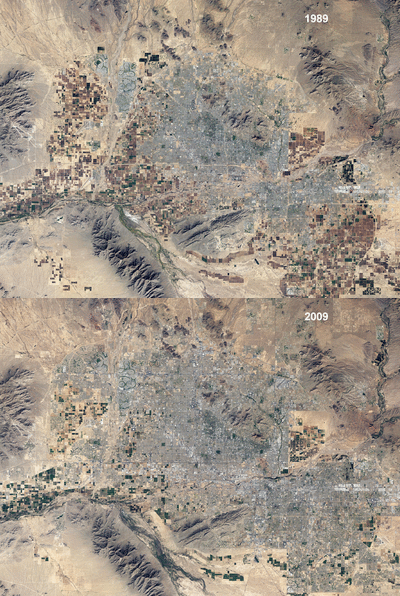
The implications of this growth are noteworthy from an urban planning perspective. While I've heard that US Southwest cities are not growing as fast today (due to a slower real estate market among other reasons), interactive maps like these really demonstrate years of suburban growth when developers took advantage of a relatively stable real estate market, good housing demand and inexpensive (and highly undervalued) water supplies. The sad reality is that such suburbs today (particularly in the US Southwest) are really not practical to live in due to the disadvantages of urban isolation and the growing scarcity of water.
Friday, July 8, 2011
A scathing critique of Glaeser's article on the locovore's dilemma
Further to Darlene's well-thought out and well-written response to Edward Glaeser's article, Colin Cureton, a graduate student in Food and Energy Policy at the University of Minnesota’s Humphrey School of Public Affairs, offers a critical response on how urban farms do not displace people, decrease density, or increase emissions as much as people think or as much as Glaeser suggests.
Here is an excerpt from his post:
"The biggest assumption is the simplistic (and false) choice between urban land for people and urban land for food. While land is a scarce resource, most urban ag is thriving on what was or otherwise would be vacant urban land. The amount of vacant urban land is vast in cities across the country. For example, the New York City’s Department of City Planning figures show that 6% of NYC is considered vacant. In Detroit, this figure is an astonishing 25-30% (anyone wonder why a revolutionary urban food system is emerging there?). Chicago has 70,000-80,000 vacant lots. This list goes on.
Also, much of urban ag is practiced in spaces that does not disrupt nor would it disrupt urban development. Think boulevards, side yards, public parks, rooftops, and so on. These are the spaces where urban ag thrives. As an urban agriculturalist, all four of my farms are on previously vacant or underutilized land. Two are vacant lots, one is at a church, and one is in a public park. Are my urban farms displacing anyone?"
You can read the full post here.
Here is an excerpt from his post:
"The biggest assumption is the simplistic (and false) choice between urban land for people and urban land for food. While land is a scarce resource, most urban ag is thriving on what was or otherwise would be vacant urban land. The amount of vacant urban land is vast in cities across the country. For example, the New York City’s Department of City Planning figures show that 6% of NYC is considered vacant. In Detroit, this figure is an astonishing 25-30% (anyone wonder why a revolutionary urban food system is emerging there?). Chicago has 70,000-80,000 vacant lots. This list goes on.
Also, much of urban ag is practiced in spaces that does not disrupt nor would it disrupt urban development. Think boulevards, side yards, public parks, rooftops, and so on. These are the spaces where urban ag thrives. As an urban agriculturalist, all four of my farms are on previously vacant or underutilized land. Two are vacant lots, one is at a church, and one is in a public park. Are my urban farms displacing anyone?"
You can read the full post here.
Sunday, July 3, 2011
Guest Entry: Beyond the locovore's dilemma, urban farming for the 21st century
A couple of weeks ago, I read an OpEd article by Edward Glaeser titled "The locovore's dilemma". Glaeser is one of my favourite urban scholars and we have blogged about his ideas a number of times on this blog. However, I didn't agree with many of his points in his OpEd. I passed along the article to my friend, Darlene Seto, to gather her thoughts about the article. She wrote a response to it, which you can view below.
Beyond the locovore's dilemma, urban farming for the 21st century
By: Darlene Seto
As a general admirer of Edward Glaeser’s work, I was most dismayed to see his recent June 16th OpEd for The Boston Globe, where he proclaimed, most erringly, that urban farms do more harm than good to the environment. I disagree.
Glaeser’s principal case against urban farming lies in the carbon output linked to such farms; he equates increasing urban farmland with an automatic reduction in living density, thereby increasing metropolitan sprawl. Yet his homogeneous use of ‘cropland’ fails to differentiate between the more intensive cultivation of vegetables, as more commonly found in urban areas, and the sprawling land involved in the production of commodities like corn, the crop which he uses to cite as a resource intensive no-no for urban agriculture. But not all farming is equal – and Glaeser’s assertions about land density might look a lot different were he to parse out those vast monocultures from his analysis, and especially were he to include the entire carbon life of much industrial corn, which then includes the methane emissions of feedlot cattle and petrochemical plastics.
Glaeser’s main failing, however, is not being able to see beyond the current agricultural paradigm. What agriculture looks like now – in a rural setting - is assumed to be what agriculture is in an urban one. Urban farms, however, are not large crop monocultures plopped down in the middle of a busy and well-utilized urban space.
Here in Vancouver, British Columbia, where I am writing from, a number of urban farms make their existence using vacant land or under-utilized land – spaces such as parking lots, individuals’ backyards (or frontyards!) and similar space. Food is grown in these smaller pieces of land, sometimes solely in hundreds of planters or boxes. By piecing together the yards of cooperative landowners around the city, these entrepreneurial farmers are using the urban context to re-imagine traditional conceptions of agriculture, creating new and vital landscapes in our neighbourhoods. And given the administrative and institutional challenges in which most urban farmers already face in dense urban areas, urban farming hardly imperils the urban densification or the commercial use of prime urban real estate, but rather puts other space into productive use.
Finally, while Glaeser does fleetingly mention some of the other benefits of urban agriculture – such as its educational value to children – such instances do not seem to hold any effective value in his argument. The benefits of having localized food initiatives such as urban farms, however, reach far beyond mere carbon mileage – and indeed are much more important and difficult to quantify. Glaeser’s greenhouse gas focus does not look at the broader environmental impacts of urban food (understanding that the environment is the area in which we live, work and play; another point I would contest in Glaeser’s piece). Increasing food assets in a city through things such as urban farming not only reduces food insecurity and better health outcomes, but promotes greater resiliency in an era of increasing climactic uncertainty, supports local economic activity, and contributes to community development and capacity building.
Take note: If anything, I would agree that the most important benefits to localized food systems are not at all in carbon savings from transportation. But it is through OpEds such as the one to which I am responding, that create an erroneous understanding of the potential for urban agriculture. This is a time where most cities should be attempting to retain all the green space and food assets that they can get. We should be working to understand and support the committed individuals and organizations working in this sector.
Darlene Seto is a graduate student at the Institute for Resources, Environment and Sustainability at the University of British Columbia, Canada. A keen student of environment policy and governance, her current graduate work revolves around diversity and engagement in alternative food systems.
Beyond the locovore's dilemma, urban farming for the 21st century
By: Darlene Seto
As a general admirer of Edward Glaeser’s work, I was most dismayed to see his recent June 16th OpEd for The Boston Globe, where he proclaimed, most erringly, that urban farms do more harm than good to the environment. I disagree.
Glaeser’s principal case against urban farming lies in the carbon output linked to such farms; he equates increasing urban farmland with an automatic reduction in living density, thereby increasing metropolitan sprawl. Yet his homogeneous use of ‘cropland’ fails to differentiate between the more intensive cultivation of vegetables, as more commonly found in urban areas, and the sprawling land involved in the production of commodities like corn, the crop which he uses to cite as a resource intensive no-no for urban agriculture. But not all farming is equal – and Glaeser’s assertions about land density might look a lot different were he to parse out those vast monocultures from his analysis, and especially were he to include the entire carbon life of much industrial corn, which then includes the methane emissions of feedlot cattle and petrochemical plastics.
Glaeser’s main failing, however, is not being able to see beyond the current agricultural paradigm. What agriculture looks like now – in a rural setting - is assumed to be what agriculture is in an urban one. Urban farms, however, are not large crop monocultures plopped down in the middle of a busy and well-utilized urban space.
Here in Vancouver, British Columbia, where I am writing from, a number of urban farms make their existence using vacant land or under-utilized land – spaces such as parking lots, individuals’ backyards (or frontyards!) and similar space. Food is grown in these smaller pieces of land, sometimes solely in hundreds of planters or boxes. By piecing together the yards of cooperative landowners around the city, these entrepreneurial farmers are using the urban context to re-imagine traditional conceptions of agriculture, creating new and vital landscapes in our neighbourhoods. And given the administrative and institutional challenges in which most urban farmers already face in dense urban areas, urban farming hardly imperils the urban densification or the commercial use of prime urban real estate, but rather puts other space into productive use.
Finally, while Glaeser does fleetingly mention some of the other benefits of urban agriculture – such as its educational value to children – such instances do not seem to hold any effective value in his argument. The benefits of having localized food initiatives such as urban farms, however, reach far beyond mere carbon mileage – and indeed are much more important and difficult to quantify. Glaeser’s greenhouse gas focus does not look at the broader environmental impacts of urban food (understanding that the environment is the area in which we live, work and play; another point I would contest in Glaeser’s piece). Increasing food assets in a city through things such as urban farming not only reduces food insecurity and better health outcomes, but promotes greater resiliency in an era of increasing climactic uncertainty, supports local economic activity, and contributes to community development and capacity building.
Take note: If anything, I would agree that the most important benefits to localized food systems are not at all in carbon savings from transportation. But it is through OpEds such as the one to which I am responding, that create an erroneous understanding of the potential for urban agriculture. This is a time where most cities should be attempting to retain all the green space and food assets that they can get. We should be working to understand and support the committed individuals and organizations working in this sector.
Darlene Seto is a graduate student at the Institute for Resources, Environment and Sustainability at the University of British Columbia, Canada. A keen student of environment policy and governance, her current graduate work revolves around diversity and engagement in alternative food systems.
Tuesday, May 17, 2011
Electric Trolley Buses in Winnipeg

Image credit: http://bc.transport-action.ca/images/TL_2007_NFI_E60LF_2533.jpg
A recent visit to Vancouver had me riding public transit nearly every day. Much of Vancouver's bus system is actually an electric trolley bus system, where normal looking buses are powered by overhead wires delivering electricity. Tim, somewhat of a growing expert in these things, told me this has a lot to do with the abundance of cheap and 'green' electricity available to Vancouver from British Columbia's massive hydroelectric resources. Which got me thinking: could this work in Winnipeg?
Winnipeg is by far the largest centre in Manitoba, a province that generates nearly every kilowatt from hydroelectric resources. Like in B.C., a government monopoly, Manitoba Hydro, owns and operates the electricity system, keeping prices low and even generating more electricity than is needed in the province. It is a low-emissions and plentiful resource. Nearly all the public transit in the city is made up of buses and receives moderately popular ridership, particularly in those parts of the population -- a significant number in Winnipeg -- with lower incomes. And as oil and gas prices continue to climb, why not take advantage of the plentiful hydro resource?
Some of it might be explained by looking at Winnipeg's public transit history. Like many cities in North America, its public transit system emerged at the end of the 19th century primarily made up of horse-drawn carriages. Spurred on by the loss of its horse fleet to a fire and the inevitable progress of technology, the city began incorporating electric streetcars (trolleys) into the system, a network that would look somewhat similar to the trolley bus system described earlier. This would eventually be scrapped in the 1960s when cost overruns and competition gave way to taxis, cars and bus service, which Winnipeg has largely relied on ever since. The infrastructure of overhead wires was removed and little remains of the old trolley system.
Winnipeg has benefited from the evolution of other cities' transit systems. Throughout the 1980s, Winnipeg snagged 50 diesel-powered buses from Calgary and Edmonton as the cities expanded their light rail systems. More recently, the city has upgraded its fleet and flirted with the expansion to diesel-electric hybrid buses. With an already large and upgraded fleet, it would seem unwise to invest immediately into an electric trolley bus system.
History aside, how viable might a system like this even be in Winnipeg? The city is painfully cold in the winters and receives considerable snowfall. The former is not as much of a problem, but snowfall has a tendency to knock off the connection between the buses and the wires above. More importantly, heavy snowfall might force buses to reroute and detours can be exceptionally long when you're dependent on an overhead wire. Electric trolley buses, too, are known as particularly advantageous in hilly cities -- like Vancouver and San Francisco -- because of the high torque in electric motors, but in a city which's highest point is a landfill, this isn't quite as much of an issue. And it ain't cheap to install a complex infrastructure of overhead cables.
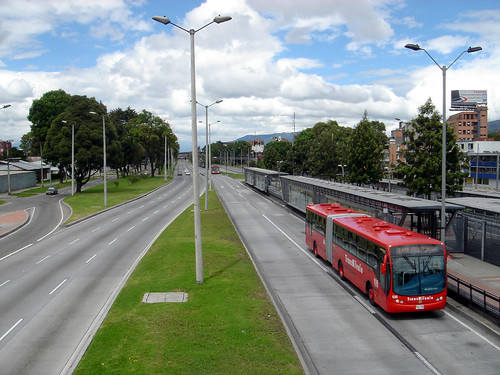
The city's most recent transit developments also help to explain the situation. In an effort to significantly expand and modernize its transit system, the city has begun construction of a Bus Rapid Transit (BRT) system, connecting major corridors throughout the city. BRT systems usually have roads exclusively used by buses for high speed service, frequent service and when having to join regular traffic, transit priority signals and diamond lanes give them a boost. Anyone familiar with Ottawa or Miami's public transit would have an idea as to how this works. It is an expensive ordeal, and in a city whose budget is not outrageously affluent -- a light rail proposal fell by the wayside because of cost -- any new infrastructure, regardless of future savings, could be a real pain in the ass.
With the information above, it is sensible why the electric trolley bus system hasn't taken off in Winnipeg. But with Manitoba's electricity resources at hand, there must be ways to incorporate it into the public transit system. Sure, a full fledged system around the city might be unnecessary, costly and problematic, but the installation of trolley bus systems would make sense on straightforward and popular routes, like the express routes across the city and especially the new BRT routes. The new buses travelling those roads may very well be diesel-electric hybrids, but a simple network of cables overtop these straightforward transitways could pay off in spades in the future.
Sunday, January 23, 2011
Guest Entry: A View from Above: Examining Ottawa’s Greenbelt
By: Liam McGuire
 Photo Courtesy and Copyright of Jason Walton
It takes a view from above to see what is happening below. This past December I was reacquainted with the snow covered landscapes of Ontario, as white terrain stretched out underneath my flight. As we descended, streetlights below illuminated the urban layout of my hometown Ottawa. As I craned my neck to the windowpane for a better look, my view from above told a story of how this city has grown. A large black swath of darkness interrupted the city lights, separating the urban core and the surrounding constellation of suburban communities.
This observation reignited old thoughts about the Greenbelt that surrounds Ottawa’s core urban region. The greenbelt in itself is not a new idea. Among other influences, the idea of an environmental buffer zone comes from the Garden City concept of Ebenezer Howard. In Howard’s time, overpopulation was a huge worry for cities, and the residential communities on the other side of the greenbelt offered relief to the bustling industrial core. Lewis Mumford sums it up well: “the Garden City, as Howard defined it, is not a suburb but the antithesis of a suburb: not a more rural retreat, but a more integrated foundation for an effective urban life.”
 Garden City Plan (Ebenezer Howard)
If urban planners wish to preserve that foundation for an effective urban life, they need to sit down and think about the green belt in a contemporary sense. My view from above observed communities that had leapfrogged, trading density for the greenfield development of former farmland. Abundant green space is by all means necessary to keep a strong ecological balance, however the city’s inability to enforce urban density has allowed exponential amounts of sprawl. Population forecasts for the outer greenbelt communities are high. By 2031, Orlean’s population will grow by 25%, Kanata/Stittsville by 83%, and Riverside South Leitrim by 381%. Inside the Greenbelt, the population will grow a meager 7%. So much for “smart growth.”
 Ottawa's Greenbelt (City of Ottawa)
 Ottawa in 1955 (Natural Resources Canada)
 Ottawa in 2002 (Natural Resources Canada)
Inevitably this will place huge pressures on the infrastructure of the city. Jobs will continue to be located in the urban core, and highways will need to expand rapidly. Judging by Ottawa’s track record with municipal light rail, there will be no mass transit solution anytime soon. It's time to rethink Ottawa’s master plan, and the upcoming National Capital Commission (NCC) greenbelt review is the perfect time to do it. Starting thoughts range from planning for density in the core to speeding up mass transit plans, however my purpose is just to get the conversation started. Ottawa is a beautiful city, and we pride ourselves on it. I’m not advocating tearing down our Greenbelt, I’m advocating that we start to make it a functional part of the city’s ecology. The City of Ottawa and the NCC need to consider the view from above as they plan for the future. This requires an approach of balancing environmental and infrastructural considerations, and finding city officials and community leaders who are up to the challenge.
Liam McGuire is a Master's student in Urban Geography at the University of British Columbia. He completed his Honour's BA at Trent University in 2009 in Human Geography and Political Science. Liam is very passionate about cities; their development, spatial growth and demographics. He has many opinions and insights about how cities should develop and could be contacted at: liam.mcguire@geog.ubc.ca
 Photo Courtesy and Copyright of Jason Walton
This observation reignited old thoughts about the Greenbelt that surrounds Ottawa’s core urban region. The greenbelt in itself is not a new idea. Among other influences, the idea of an environmental buffer zone comes from the Garden City concept of Ebenezer Howard. In Howard’s time, overpopulation was a huge worry for cities, and the residential communities on the other side of the greenbelt offered relief to the bustling industrial core. Lewis Mumford sums it up well: “the Garden City, as Howard defined it, is not a suburb but the antithesis of a suburb: not a more rural retreat, but a more integrated foundation for an effective urban life.”
 Garden City Plan (Ebenezer Howard)
If urban planners wish to preserve that foundation for an effective urban life, they need to sit down and think about the green belt in a contemporary sense. My view from above observed communities that had leapfrogged, trading density for the greenfield development of former farmland. Abundant green space is by all means necessary to keep a strong ecological balance, however the city’s inability to enforce urban density has allowed exponential amounts of sprawl. Population forecasts for the outer greenbelt communities are high. By 2031, Orlean’s population will grow by 25%, Kanata/Stittsville by 83%, and Riverside South Leitrim by 381%. Inside the Greenbelt, the population will grow a meager 7%. So much for “smart growth.”
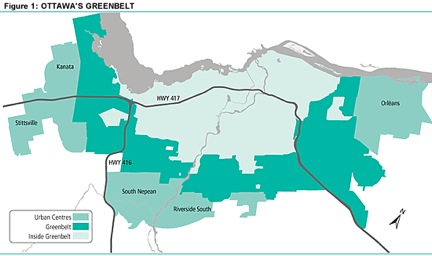 Ottawa's Greenbelt (City of Ottawa)
 Ottawa in 1955 (Natural Resources Canada)
 Ottawa in 2002 (Natural Resources Canada)
Inevitably this will place huge pressures on the infrastructure of the city. Jobs will continue to be located in the urban core, and highways will need to expand rapidly. Judging by Ottawa’s track record with municipal light rail, there will be no mass transit solution anytime soon. It's time to rethink Ottawa’s master plan, and the upcoming National Capital Commission (NCC) greenbelt review is the perfect time to do it. Starting thoughts range from planning for density in the core to speeding up mass transit plans, however my purpose is just to get the conversation started. Ottawa is a beautiful city, and we pride ourselves on it. I’m not advocating tearing down our Greenbelt, I’m advocating that we start to make it a functional part of the city’s ecology. The City of Ottawa and the NCC need to consider the view from above as they plan for the future. This requires an approach of balancing environmental and infrastructural considerations, and finding city officials and community leaders who are up to the challenge.
Liam McGuire is a Master's student in Urban Geography at the University of British Columbia. He completed his Honour's BA at Trent University in 2009 in Human Geography and Political Science. Liam is very passionate about cities; their development, spatial growth and demographics. He has many opinions and insights about how cities should develop and could be contacted at: liam.mcguire@geog.ubc.ca
Saturday, January 22, 2011
Jamie Lerner and Curitiba
In the video above, Jamie Lerner, a former mayor of Curitiba, Brazil, shares his thought about how we can achieve a sustainable city. Enviro Boys has blogged about Curitiba in the past highlighting the city's success with its bus rapid transit (BRT) system. Through innovative urban planning the city has become a much more compact urban form. The BRT system was initiated in 1974 and at the time had 25,000 passengers per day. With Jamie Lerner's leadership and continuous influence on the city, there are now close to 2 million passengers using it every day.
For years children have been learning how to separate their garbage and have taken the initiative to teach their parents. As a result, a significant percentage of the city' waste is separated.
Check out the video to learn more.
Thursday, January 13, 2011
Cycling Success in Copenhagen
My friend, EP, shared this link about Copenhagen's immense success with its cycling culture, planning and infrastructure.
From the article:
"Copenhagen has almost 40% of all their overall trips by bike, a staggering figure that is already the best in the world. And yet they're not satisfied.... their goal is to raise that to 50%, and they've got aggressive strategies to do it. This is a lesson to cities that think it’s too hard to double their mode bike mode share, from, say, 2% to 4%"
"In Copenhagen, cycling has become "hip" and trendy. This is not accidental. A significant part of the traffic department's work is to promote this trendiness, through awareness campaigns, promotions and branding/ marketing (you can picture the traffic director getting the Crown Prince of Denmark to be out seen more on his bike). They use the media and popular culture vigorously, feeling that "if the media is talking about cycling, then politicians are, and if politicians are, then the media is."
From the article:
"Copenhagen has almost 40% of all their overall trips by bike, a staggering figure that is already the best in the world. And yet they're not satisfied.... their goal is to raise that to 50%, and they've got aggressive strategies to do it. This is a lesson to cities that think it’s too hard to double their mode bike mode share, from, say, 2% to 4%"
"In Copenhagen, cycling has become "hip" and trendy. This is not accidental. A significant part of the traffic department's work is to promote this trendiness, through awareness campaigns, promotions and branding/ marketing (you can picture the traffic director getting the Crown Prince of Denmark to be out seen more on his bike). They use the media and popular culture vigorously, feeling that "if the media is talking about cycling, then politicians are, and if politicians are, then the media is."
"To make cycling, which can be a somewhat solitary experience, more social, they have schedules posted along the routes for unplanned biking groups to meet and cycle together, like a bus schedule.... A "cycle-bus" of sorts. This is fascinating, as I've often heard in North America one of the perceived attractions of cycling over transit is that it is seen as "individual" and at your own schedule, and thus closer to the "freedom" of the car than transit. The Danes, though, apparently will wait to commune with strangers on bikes, once again illustrating how much more social they are than we. Niels is quick to point out that it wasn't always this way though, and that any city can achieve it if the will is there."
Read more about the city's biking creativity and success here.
Monday, January 10, 2011
Beijing's new subway lines
Just last week Beijing opened up five new subway lines and 108 kilometres of new track. The new subway lines cost $9.4 billion to build and were not supposed to be completed until 2012. The Chinese however, have an impressive track record for completing large scale urban infrastructure projects ahead of schedule.
From the Toronto Star:
“We intend to bring on more new track every year for the next five years,” says Jia Peng, chief spokesman for the transit corporation. “We have the technology, we have the funds; the only thing we don't have much of is time — and time is crucial.
These new subway lines will undoubtedly ease traffic congestion both inside and outside of the urban core. Both congestion and pollution (air and noise) in Beijing have hitherto been an egregious problem with multiple social costs for the populace.
"Last year more than 2,000 new cars flooded into Beijing's streets and highways each day, for a total of nearly 800,000 new vehicles in 2010."
From the Toronto Star:
“We intend to bring on more new track every year for the next five years,” says Jia Peng, chief spokesman for the transit corporation. “We have the technology, we have the funds; the only thing we don't have much of is time — and time is crucial.
These new subway lines will undoubtedly ease traffic congestion both inside and outside of the urban core. Both congestion and pollution (air and noise) in Beijing have hitherto been an egregious problem with multiple social costs for the populace.
"Last year more than 2,000 new cars flooded into Beijing's streets and highways each day, for a total of nearly 800,000 new vehicles in 2010."
"Desperate to curb congestion in the city, the government announced it will restrict new car sales in Beijing this year to just 20,000 per month, holding a monthly public lottery for the privilege of buying one. Annual sales in the capital in 2011 will be capped at 240,000."
Sounds bold and progressive but is certainly doable in China.
The point of the Toronto Star article was to compare Beijing's remarkable progress in public transit expansion with Toronto's abysmally slow progress with new subways, light-right etc. While I commend the Beijing Mass Transit Railway Operation Corp with its success thus far, it operates in a jurisdiction that has much less stringent planning and environmental processes. Indeed, environmental impact assessments for such urban infrastructure projects in Canada can take months if not years.
In Canada, the public input alone is invaluable but incredibly time-consuming. Interest groups, community associations, business organizations, system users and concerned citizens might have reservations or suggestions about the transportation project. They are all important stakeholders and our elected officials must respond to them. It is therefore unfair do compare the two cities simply based on their planning processes.
In Toronto, for example, the urban transportation planning process might establish a vision of what a community wants to be and how the transportation systems fits into this vision. As you can imagine, in Toronto, with such a diversity of people, needs and interests, this process can take eons to complete thus delaying the building of the project be it subway or light-rail.
But, the urgency around public transportation in Beijing -- notwithstanding the limited planning and public involvement -- still showcases the commitment of the Beijing government to reduce traffic congestion and bring about a healthier and more efficient metropolis.
As the article writes, in Beijing "The government is planner, builder and arbiter all in one."
Read the full version of the Toronto Star article here.
Sunday, December 12, 2010
City Planning: Melbourne and Toronto
I was reading an article in the Globe and Mail yesterday that discussed contemporary city planning issues in Melbourne, Australia and Toronto, Canada. The article, structured in a question and answer format, featured two urban experts discussing what their cities have done and what their cities need to do on the urban planning front. Robert Adams, director of city design for Melbourne is a huge proponent of pedestrian traffic and bike lanes (Don Cherry would call him a pinko). Mr. Adams vehemently lobbied to make public transit in Melbourne free before 7 am and cars were banned from the city's busiest street. A really progressive and visionary leader who has made Melbourne the third most livable city in the world, according to The Economist.
The urban expert interviewed from Toronto is Gary Wright, the current chief planner for the City of Toronto. In my undergrad, Gary spoke as a guest lecturer in one of my geography courses (summary of that lecture found here). Gary is very proud of what the Dundas Square has become (under his leadership) in terms of a public open space in which people can appreciate and gather together to enjoy the city's culture, night life and artistic events. This is what some would call experiential consumption whereby citizens and tourists can experience and enjoy the culture and vitality of the city through public spaces and not through shopping and material consumption.
He also commented on the planning of the forthcoming Pan Am Games in Toronto in 2015. He says that the athletes' village is going to require close collaboration with developers to ensure that everything goes well. The city's waterfront reinvention plan is underway and will have many implications for waterfront development in the coming years. In sum, he supports greater involvement of the developers because of their knowledge and expertise. Last and unsurprisingly, he is a big advocate for better transit in Toronto. Transit is a very salient issue these days but in a time of financial uncertainty, and with a new mayor, we'll have to wait and see how things play out on the transit agenda.
The rest of this post will focus on the great city planning work of Robert Adams and what other cities could learn from him. To begin, as a design enthusiast and supporter for greater pedestrian traffic, Adams recognized the importance of widening sidewalks. Trees were planted along the widened sidewalks which eventually led to a proliferation of sidewalk cafes.
From the Globe: "Adams closed Melbourne's main thoroughfare, Bourke Street, to cars before 7 p.m., transforming it into wide lanes for pedestrians, bikes, streetcars and buses. More than 35,000 pedestrians now walk the street each day, up from 12,000 ten years ago and businesses have returned as well."
Adams says we need more residential development around existing transit lines (something Hong Kong has mastered). He also thinks that municipal plans are too technical and thus non-transparent to the public. Plans need to have more visual components to show people how their communities are going to change in the coming years due to urban development and population growth. Finally, Adams, as a designer and planner, is really effective and engaging and leveraging public sentiment. One example from the article is a time when he announced his desire to pull down a freeway standing between the city centre and the Yarra River. Many thought this was not possible. He slowly developed green spaces around the freeway and Melbourne's citizens, quite some time later, saw the benefits of this and demanded that the road be pulled down.
City planning can drastically transform our cities into healthier, more transit friendly and enjoyable places. Both Adams and Wright have done remarkable things for their respective cities. Planning is inherently a political process with multiple stakeholders and multiple perspectives. This mix of interests is healthy but challenging for the planner who must consult and facilitate disparate and contested views.
Finally, Melbourne and Toronto are unique in that they have historic streetcar systems. Personally, I have come to appreciate streetcars not only because they have contributed to Toronto's identity, but also because they effectively complement other transit forms such as subways, buses and walking. For you transportation nerds out there, I would encourage you to read a paper by Currie and Shalaby on the successes and challenges in modernizing streetcar systems in Melbourne and Toronto. For the paper, click here.
The urban expert interviewed from Toronto is Gary Wright, the current chief planner for the City of Toronto. In my undergrad, Gary spoke as a guest lecturer in one of my geography courses (summary of that lecture found here). Gary is very proud of what the Dundas Square has become (under his leadership) in terms of a public open space in which people can appreciate and gather together to enjoy the city's culture, night life and artistic events. This is what some would call experiential consumption whereby citizens and tourists can experience and enjoy the culture and vitality of the city through public spaces and not through shopping and material consumption.
He also commented on the planning of the forthcoming Pan Am Games in Toronto in 2015. He says that the athletes' village is going to require close collaboration with developers to ensure that everything goes well. The city's waterfront reinvention plan is underway and will have many implications for waterfront development in the coming years. In sum, he supports greater involvement of the developers because of their knowledge and expertise. Last and unsurprisingly, he is a big advocate for better transit in Toronto. Transit is a very salient issue these days but in a time of financial uncertainty, and with a new mayor, we'll have to wait and see how things play out on the transit agenda.
The rest of this post will focus on the great city planning work of Robert Adams and what other cities could learn from him. To begin, as a design enthusiast and supporter for greater pedestrian traffic, Adams recognized the importance of widening sidewalks. Trees were planted along the widened sidewalks which eventually led to a proliferation of sidewalk cafes.
From the Globe: "Adams closed Melbourne's main thoroughfare, Bourke Street, to cars before 7 p.m., transforming it into wide lanes for pedestrians, bikes, streetcars and buses. More than 35,000 pedestrians now walk the street each day, up from 12,000 ten years ago and businesses have returned as well."
Adams says we need more residential development around existing transit lines (something Hong Kong has mastered). He also thinks that municipal plans are too technical and thus non-transparent to the public. Plans need to have more visual components to show people how their communities are going to change in the coming years due to urban development and population growth. Finally, Adams, as a designer and planner, is really effective and engaging and leveraging public sentiment. One example from the article is a time when he announced his desire to pull down a freeway standing between the city centre and the Yarra River. Many thought this was not possible. He slowly developed green spaces around the freeway and Melbourne's citizens, quite some time later, saw the benefits of this and demanded that the road be pulled down.
City planning can drastically transform our cities into healthier, more transit friendly and enjoyable places. Both Adams and Wright have done remarkable things for their respective cities. Planning is inherently a political process with multiple stakeholders and multiple perspectives. This mix of interests is healthy but challenging for the planner who must consult and facilitate disparate and contested views.
Finally, Melbourne and Toronto are unique in that they have historic streetcar systems. Personally, I have come to appreciate streetcars not only because they have contributed to Toronto's identity, but also because they effectively complement other transit forms such as subways, buses and walking. For you transportation nerds out there, I would encourage you to read a paper by Currie and Shalaby on the successes and challenges in modernizing streetcar systems in Melbourne and Toronto. For the paper, click here.
Wednesday, October 13, 2010
Bike Lane Debate in Vancouver
Urban bike lanes always face opposition. People say they hurt businesses, they take space away from motorists, they are too expensive etc etc. We had a guest post in the summer from the Executive Director of the Toronto Cyclists Union that challenged many of the conventional arguments made against bike lanes.
On a separate note, I was speaking with a physicist who argued that bike lanes make cyclists less conscious of their surrounding environment and are thus more at a risk of colliding into a motorist. He suggested that bike lanes have rumble strips to make both cyclists and motorists more attentive and aware of their lanes.
My friend and classmate, William Dunn, recently wrote a short and excellent story about a new bike lane in Vancouver that has generated a lot controversy. In short, City Council recently approved the Hornby bike trial which is a protected cycling track in downtown Vancouver.
Will writes:
"The City’s decision to re-appropriate public streets for the creation of a protected cycling track has been one of the most divisive civic issues in memory. News1130 and other media have labeled it a misappropriation of public space and funds, business owners along the routes are furious, and motorists grow increasingly frustrated. With City Council’s October 5 decision to approve the Hornby bike trial, the debate seems destined to intensify".
Read more here.
On a separate note, I was speaking with a physicist who argued that bike lanes make cyclists less conscious of their surrounding environment and are thus more at a risk of colliding into a motorist. He suggested that bike lanes have rumble strips to make both cyclists and motorists more attentive and aware of their lanes.
My friend and classmate, William Dunn, recently wrote a short and excellent story about a new bike lane in Vancouver that has generated a lot controversy. In short, City Council recently approved the Hornby bike trial which is a protected cycling track in downtown Vancouver.
Will writes:
"The City’s decision to re-appropriate public streets for the creation of a protected cycling track has been one of the most divisive civic issues in memory. News1130 and other media have labeled it a misappropriation of public space and funds, business owners along the routes are furious, and motorists grow increasingly frustrated. With City Council’s October 5 decision to approve the Hornby bike trial, the debate seems destined to intensify".
Read more here.
Saturday, October 9, 2010
Masdar City: Revisted
In May 2009, I blogged about Abu Dhabi's planned Masdar City. It is claimed to be the world's first city powered solely by renewable energy.
The video above is informative and highly promising. However, be critical of the city's viability. On an unrelated note, water consumption per capita will be significantly less than a conventional city. Of course it will be less, they have less water than the average city!
There is no mention of the residents who will be living there. We know that the Masdar Institute of Science and Technology will provide residence space for its students. This is important but they must provide residence space for its students because they do research on the renewable technology. This planned city will cost $22 billion dollars. I am really curious to know what kind of residents it attracts. I suspect wealthier residents who will have the amenities and advanced renewable technologies associated with the city, and continue to live a profligate lifestyle through heavy air conditioning use and frequent visits to places like Dubai.
I don't mean to be too critical, but a city that strives to be sustainable must ensure that it has a diverse population base composed of poor and rich alike. Everyone should be able to benefit from the green technology, sustainable transit options and low-carbon lifestyle. With all of the capital that has been invested into this planned city, I hope that citizens of the country will recognize the merits of a greener lifestyle and adopt more sustainable and green-minded habits.
Sunday, October 3, 2010
Streetcars coming back to Vancouver?
 Photo Credit: Rail forth valley
This past Wednesday I attended a symposium titled “Streetcars: The Missing Link?” It was a symposium put together by UBC’s School of Environmental Health and the UBC School of Community and Regional Planning. I attended it with a number of my classmates.
The purpose of the symposium was to explore the historical role of streetcars in Vancouver, how much it would cost to bring them back to the city, streetcar impacts on urban form and mobility, urban design and how the streetcar can complement others forms of transit such as buses or Vancouver's Skytrain system.
As a part of the 2010 Vancouver Olympics, a demonstration section of the Downtown Streetcar was available for public use. The Downtown Streetcar was a 60-day demonstration period (January 21 to March 21, 2010) and ran between Granville Island and the new Canada Line Olympic Village Station on 1.8 km of newly constructed dedicated track. This demonstration project was successful; it provided reliable transportation for athletes, visitors and residents as often as every seven minutes and decreased the number of private vehicles, motor coaches and transit diesel buses to and from Granville Island.
Bombardier built the streetcar (as seen in the image) and would provide a fleet of them if Vancouver decided to go that route. I learned that Toronto is going to upgrade its streetcar system with a new fleet from Bombardier. There will be 200 new streetcars in Toronto between 2012 and 2018. This decision has also tempted Vancouver to bring streetcars back. The biggest issue is money. Research has shown that streetcars can help promote neighbourhood development and street life. They can help provide an urban identity too.
According to a speaker at the symposium, Vancouver was one of the first places on the planet to really embrace streetcars, in the year 1890. For almost 70 years, Vancouver had an extensive streetcar network. Don’t think of streetcars as a substitute to city buses, but instead as complementary form of transit that can help create higher density and move people easily within the downtown. Transit demand has increased 30% in Vancouver. This reason alone justifies some sort of public transit expansion.
By taking city buses a couple of times a week, it has become quite evident that buses are running at capacity. Streetcars have a longer life span and lowering operating costs than buses. They run on electricity and not fuel which is more environmentally-friendly. Again, they are not meant to replace but complement them.
While some Torontonians might think streetcars are a terrible form of public transit, they are beginning to take off all over the U.S. (especially in Portland) with 45 systems planned. A major impetus for bringing them back is that they can fulfill the transit hierarchy. By helping complete the transit hierarchy, Vancouverites would have every reason not to use their car.
In Vancouver, the streetcar would be connected to the Canada line, Skytrain and trolley buses and could take Vancouverites to work, errands etc. It would also connect tourists to Vancouver’s top attractions i.e. Stanley Park and Granville Island.
A former graduate student in my program conducted his thesis research on the Olympic streetcar. The results were overwhelmingly positive and the city is now looking at finance options.
Oh, one more thing. Many people I have talked to have negative attitudes toward streetcars, especially Torontonians. Let me tell you though, new streetcars would be grade separated meaning that the rail lines are elevated on a platform from the street so cars cannot drive in front of them. They would have right of way and allow for much smoother traffic flow.
More to come on streetcars and Vancouver’s impending decision on whether to re-implement them.
Wednesday, August 18, 2010
Matt Kahn's new book: Climatopolis
Matt Kahn, who blogs at Environmental and Urban Economics, has written a new book called Climatopolis. The book is going to be released in September 2010. Based on some reviews that I have read, and a presentation that Kahn delivered at a February 2010 USC Conference on Cities and Urban Growth, the book seems to be quite informative and highlights the significance of human adaptation to climate change in urban environments.
Many professionals studying climate change (scientists, geographers, economists) have discussed climate change mitigation i.e. driving less, carbon pricing to reduce our emissions, decreasing electricity consumption etc. We don't hear as much about adaptation which is a more risky subject because of the uncertainty surrounding climate change. But emissions are likely going to continue to rise so adapting to the consequences and/or preparing for them will be of utmost importance.
Kahn says "Many people are fixated on how we can reduce greenhouse gases, and acting like adapting to a warmer climate is still in the sci-fi future. But we've passed the point of no return. Certain urban places — like Los Angeles — will suffer. But I'm optimistic that Los Angeles will also adapt."
On water: "Climate change is going to make water both scarcer and more in demand, but charging so little for water is actually exacerbating the water shortage problems. "People need pricing signals or they won't respond to shortages."
I couldn't agree more.
I'll provide a review when I read the book. With 60 percent of the world's population living in cities by 2030, it is fair to say that cities will have to make the critical adaptations to avoid catastrophe and to plan for posterity.
Check out the following links for more information about his book:
Climatopolis Webpage
Kahn's preview of his book
Kahn's presentation at the USC conference where he introduces themes from the book. It's 35 minutes long but really funny.
A review from Publishers Weekly on Climatopolis
Capitalism is our best defense against climate change
Many professionals studying climate change (scientists, geographers, economists) have discussed climate change mitigation i.e. driving less, carbon pricing to reduce our emissions, decreasing electricity consumption etc. We don't hear as much about adaptation which is a more risky subject because of the uncertainty surrounding climate change. But emissions are likely going to continue to rise so adapting to the consequences and/or preparing for them will be of utmost importance.
Kahn says "Many people are fixated on how we can reduce greenhouse gases, and acting like adapting to a warmer climate is still in the sci-fi future. But we've passed the point of no return. Certain urban places — like Los Angeles — will suffer. But I'm optimistic that Los Angeles will also adapt."
On water: "Climate change is going to make water both scarcer and more in demand, but charging so little for water is actually exacerbating the water shortage problems. "People need pricing signals or they won't respond to shortages."
I couldn't agree more.
I'll provide a review when I read the book. With 60 percent of the world's population living in cities by 2030, it is fair to say that cities will have to make the critical adaptations to avoid catastrophe and to plan for posterity.
Check out the following links for more information about his book:
Climatopolis Webpage
Kahn's preview of his book
Kahn's presentation at the USC conference where he introduces themes from the book. It's 35 minutes long but really funny.
A review from Publishers Weekly on Climatopolis
Capitalism is our best defense against climate change
Subscribe to:
Posts (Atom)