My good friend, Marc Schutzbank, recently published an article titled "revival of urban agriculture". His article provides a very informative and educational overview of the history of urban agriculture (or urban farming which can be used interchangeably) in North America and why it is a salient topic of discussion today. He discusses four principal reasons why urban agriculture is important which include its potential to alleviate obesity, assist cities with food safety, help mitigate the burden of high international food prices and its benefits in creating an environmentally focused local food system.
Marc is a Master's student in the Faculty of Land and Food Systems at UBC. His research is focused on evaluating the feasibility of urban farming in Vancouver, particularly how urban farming businesses contribute to both the economic and social fabric of Vancouver’s growing local food movement.
Here is an excerpt from his article:
"Canadians are witnessing increasing rates of obesity, heightened risk of food contamination, and inflated food prices. As a result, many people are starting to seriously consider the question of how to feed themselves for the first time since the 1950’s. One of the answers is the rejuvenation of urban agriculture, dusting off pitchforks and turning soil in a new grow-your-own food culture.
In this article, we will explore four modern motivations for urban agriculture in Canada: an increasing obesity epidemic, fear of food insecurity, heightened food prices, and a desire to make environmentally sound food choices. Canadian urban agriculture organizations are beginning to address these massive problems. We will highlight their work, concluding with a discussion of a new urban farm that we helped to initiate".
"Urban farmers are developing local food markets and producing food choice just by showing up at the market. Both local rural and urban farms build a market where citizens can use dollars to vote for local businesses over national chains, environmentally sustainable food over conventional agriculture, and a food culture that values its producers".
Please find his article here.
Showing posts with label Agriculture. Show all posts
Showing posts with label Agriculture. Show all posts
Wednesday, August 3, 2011


Sunday, July 10, 2011
A great example of Bootleggers and Baptists
I finished reading David Zetland's End of Abundance a couple of weeks ago. A review of his book will come shortly. I first wanted to share an instructive example David uses to illustrate the Bootleggers and Baptists problem (also referred to as "Baptists and Bootleggers"). David refers to this term in different parts of his book.
Bootleggers and Baptists defined: a slang term for an unholy alliance that combines moral righteousness with selfish greed to stop a reform that would benefit degenerates (according to Baptists) and/or the competition (according to the Bootleggers). A Baptists and Bootleggers coalition may also support a harmful change; one example is the coalition of environmentalists and corn-processors that supported a requirement that gasoline contain a minimum share of corn ethanol.
The definition above is derived from the glossary of his book. Using the example of U.S. corn ethanol, here is an excerpt from his book:
"The US corn ethanol program offers a useful example of a Baptists and Bootlegger confluence of greed, corruption and moral superiority. Greed can be traced to big agro-processing companies (ADM, Cargill and others) that make money by trading corn and ethanol. Corruption is connection to congressman who want campaign donations (legal bribes) from these companies and farmers benefit from congressionally induced demand, via per gallon subsidies, mandated corn ethanol fuel blends and tariff barriers that block imports of cheaper, sustainable sugarcane ethanol from Brazil.
The moral superiority component comes from the environmentalists who demand that Americans use more renewable fuels and patriots who want energy independence from dodgy foreigners. Their clamor for renewables gave farmers, processors and politicians the cover they needed to start another program designed to transfer money from taxpayers and car drivers to the agricultural and political sectors. The worst irony is that this "green fuel" may have done nothing to reduce C02 emissions.
In this Baptists and Bootleggers alliance, environmentalists are happy to have more renewable fuel. Farmers and agro-businesses are happy to sell more fuel in the gasoline market. Taxpayers lose and drivers get lower-quality fuel. Politicians win twice, since they can claim to protect the environment at the same time as they collect brides from the corn industry. But there's an additional twist: corn ethanol uses a lot of free water, simultaneously increasing scarcity and pollution. Ethanol production would fall if we priced water for scarcity and purity".
Interpret the example above however you would like, I think it is instructive and insightful because it reveals how groups with potentially different opinions, perspectives and values can lobby for the same end goal and think that the outcome has served their mandate. Unfortunately, this may be a case of unintended consequences not least for the volatility it has brought to the price of corn, but worse yet, to the egregious overuse of cheap and in some cases, free water. Corn ethanol does have its problems and I have become more neutral about its merits as an alternative fuel. But the very fact that it does use copious amounts of cheap water for production is worrisome in an era of increased scarcity.
There are many examples where one can apply the Baptists and Bootlegger model. I think it's pretty fascinating in the case of corn-based ethanol and gets you to think about how and why we advocate for policies that seem to be good on the surface, but can be disastrous in reality.
Friday, July 8, 2011
A scathing critique of Glaeser's article on the locovore's dilemma
Further to Darlene's well-thought out and well-written response to Edward Glaeser's article, Colin Cureton, a graduate student in Food and Energy Policy at the University of Minnesota’s Humphrey School of Public Affairs, offers a critical response on how urban farms do not displace people, decrease density, or increase emissions as much as people think or as much as Glaeser suggests.
Here is an excerpt from his post:
"The biggest assumption is the simplistic (and false) choice between urban land for people and urban land for food. While land is a scarce resource, most urban ag is thriving on what was or otherwise would be vacant urban land. The amount of vacant urban land is vast in cities across the country. For example, the New York City’s Department of City Planning figures show that 6% of NYC is considered vacant. In Detroit, this figure is an astonishing 25-30% (anyone wonder why a revolutionary urban food system is emerging there?). Chicago has 70,000-80,000 vacant lots. This list goes on.
Also, much of urban ag is practiced in spaces that does not disrupt nor would it disrupt urban development. Think boulevards, side yards, public parks, rooftops, and so on. These are the spaces where urban ag thrives. As an urban agriculturalist, all four of my farms are on previously vacant or underutilized land. Two are vacant lots, one is at a church, and one is in a public park. Are my urban farms displacing anyone?"
You can read the full post here.
Sunday, July 3, 2011
Guest Entry: Beyond the locovore's dilemma, urban farming for the 21st century
A couple of weeks ago, I read an OpEd article by Edward Glaeser titled "The locovore's dilemma". Glaeser is one of my favourite urban scholars and we have blogged about his ideas a number of times on this blog. However, I didn't agree with many of his points in his OpEd. I passed along the article to my friend, Darlene Seto, to gather her thoughts about the article. She wrote a response to it, which you can view below.
Beyond the locovore's dilemma, urban farming for the 21st century
By: Darlene Seto
As a general admirer of Edward Glaeser’s work, I was most dismayed to see his recent June 16th OpEd for The Boston Globe, where he proclaimed, most erringly, that urban farms do more harm than good to the environment. I disagree.
Glaeser’s principal case against urban farming lies in the carbon output linked to such farms; he equates increasing urban farmland with an automatic reduction in living density, thereby increasing metropolitan sprawl. Yet his homogeneous use of ‘cropland’ fails to differentiate between the more intensive cultivation of vegetables, as more commonly found in urban areas, and the sprawling land involved in the production of commodities like corn, the crop which he uses to cite as a resource intensive no-no for urban agriculture. But not all farming is equal – and Glaeser’s assertions about land density might look a lot different were he to parse out those vast monocultures from his analysis, and especially were he to include the entire carbon life of much industrial corn, which then includes the methane emissions of feedlot cattle and petrochemical plastics.
Glaeser’s main failing, however, is not being able to see beyond the current agricultural paradigm. What agriculture looks like now – in a rural setting - is assumed to be what agriculture is in an urban one. Urban farms, however, are not large crop monocultures plopped down in the middle of a busy and well-utilized urban space.
Here in Vancouver, British Columbia, where I am writing from, a number of urban farms make their existence using vacant land or under-utilized land – spaces such as parking lots, individuals’ backyards (or frontyards!) and similar space. Food is grown in these smaller pieces of land, sometimes solely in hundreds of planters or boxes. By piecing together the yards of cooperative landowners around the city, these entrepreneurial farmers are using the urban context to re-imagine traditional conceptions of agriculture, creating new and vital landscapes in our neighbourhoods. And given the administrative and institutional challenges in which most urban farmers already face in dense urban areas, urban farming hardly imperils the urban densification or the commercial use of prime urban real estate, but rather puts other space into productive use.
Finally, while Glaeser does fleetingly mention some of the other benefits of urban agriculture – such as its educational value to children – such instances do not seem to hold any effective value in his argument. The benefits of having localized food initiatives such as urban farms, however, reach far beyond mere carbon mileage – and indeed are much more important and difficult to quantify. Glaeser’s greenhouse gas focus does not look at the broader environmental impacts of urban food (understanding that the environment is the area in which we live, work and play; another point I would contest in Glaeser’s piece). Increasing food assets in a city through things such as urban farming not only reduces food insecurity and better health outcomes, but promotes greater resiliency in an era of increasing climactic uncertainty, supports local economic activity, and contributes to community development and capacity building.
Take note: If anything, I would agree that the most important benefits to localized food systems are not at all in carbon savings from transportation. But it is through OpEds such as the one to which I am responding, that create an erroneous understanding of the potential for urban agriculture. This is a time where most cities should be attempting to retain all the green space and food assets that they can get. We should be working to understand and support the committed individuals and organizations working in this sector.
Darlene Seto is a graduate student at the Institute for Resources, Environment and Sustainability at the University of British Columbia, Canada. A keen student of environment policy and governance, her current graduate work revolves around diversity and engagement in alternative food systems.
Wednesday, March 2, 2011
Groundwater challenges in Punjab, India
I delivered a presentation today in one of my classes called "Planning for Water Resource Management". My groupmate and I specifically discussed a participatory groundwater management project in the state of Andhra Pradesh located in South-Eastern India. I'll post a summary of our topic along with our presentation shortly. The video below discusses the contemporary challenges around groundwater overuse in the state of Punjab, India.
Farmers in Punjab are pumping groundwater beyond levels that are sustainable levels for their economic livelihood and for posterity. Farmers pump groundwater at profligate rates because they receive very generous water and electricity subsidies from the government. These subsidies do not give the farmers the proper signals of the value and true cost of these goods. While Punjab faces such challenges, states like Haryana, Rajasthan and Gujarat have also seen water tables drop due to excessive overpumping.
Our case study of Andhra Pradesh offers a contrast to the aforementioned through the utilization of a number of participatory methods that have engaged farmers to better understand the science of groundwater dynamics and strives toward behavioural change through groundwater conservation. More to come on this. In the meantime, please see the video below and understand that India's water challenges have several implications for the world including the international food market.
For more, see here.
Monday, February 21, 2011
Vertical Farming
The Economist discusses the market implications of vertical farming in our global economy. The article has three videos as well which are informative and explain the concepts and science very clearly.
Right from the Economist:
"Such is the thinking behind vertical farming. The idea is that skyscrapers filled with floor upon floor of orchards and fields, producing crops all year round, will sprout in cities across the world. As well as creating more farmable land out of thin air, this would slash the transport costs and carbon-dioxide emissions associated with moving food over long distances. It would also reduce the spoilage that inevitably occurs along the way, says Dickson Despommier, a professor of public and environmental health at Columbia University in New York who is widely regarded as the progenitor of vertical farming, and whose recently published book, “The Vertical Farm”, is a manifesto for the idea".
"Indeed, even in today’s single-storey glasshouses, artificial lighting is needed to enable year-round production. Thanet Earth, a 90-hectare facility which opened in Kent in 2008 and is the largest such site in Britain—it provides 15% of the British salad crop—requires its own mini power-station to provide its plants with light for 15 hours a day during the winter months. This rather undermines the notion that vertical farming will save energy and cut carbon emissions, notes Mr Head, who has carried out several studies of the idea. Vertical farming will need cheap, renewable energy if it is to work, he says."
Time and time again we hear from the UN that the world’s population is expected to increase to about 9 billion by 2050. To feel such a population will mean increasing food production by 70% according to the FAO. This will undoubtedly require a combination of higher crop yields and an expansion of the area under cultivation. This could take the form of more agricultural land (which is unevenly distributed across the world). 60% of the world's population is expected to live in cities by 2030. This could translate into more innovation in the form of vertical or urban farming to feed such populations locally.
Sunday, November 7, 2010
Zetland's keynote address...
in Washington DC at a conference called "Bridging Knowledge Gaps in Water Management" at the Center for Strategic and International Studies. David Zetland wrote a guest post for us back in June about the importance of good local water management. He continues this discussion --building on points in his new book "The End of Abundance" -- and what policymakers need to pay attention to. Water is not priced correctly in the U.S. Zetland says, and information on water is lacking. Zetland's keynote starts at the 10 minute mark in the clip below.
People don't always know the cost of tap water in their household. Sure, if you are paying based on how much you consume (volumetric pricing) than you probably have an idea. But flat rates (all you can eat) don't tell the person the information they should know about how much their water costs per unit of consumption. Zetland thinks the U.S. Federal government should take action in assembling this information to make water management and water pricing more transparent.
People in the U.S. are attuned to markets and not community. Australia and Singapore have brought about stringent measures on water conservation. Yes, they don't have a lot of water, but residents of these countries have collectively decided to change their lifestyles based on water limits. They have adapted. In the U.S., price is what changes peoples' behaviour says Zetland. If water was priced based on scarcity, then prices would soar especially in places like Nevada, California and Arizona for example. The fact that the U.S. population is hovering around 308 million people, and in a time when water scarcity is becoming more rampant, the need for good water management, education and information is more critical than ever.
His bottom line is that we need to first understand our water systems, seek information about it, understand its fragility and start to price our water equitably and effectively. This also means that if farmers (or the agricultural sector) are allotted more water than residents living in cities and if they don't use up their allotted amount, then a market should be created for the farmers to sell that excess water at a price that reflects its value to other water users.
When I leave graduate school, my ideal first job would be to work as a water educator/planner disseminating information about water systems and water management and engaging citizens in this salient topic. Ultimately, the more information we produce on this matter, the more we can pressure our policymakers to get it right. Canada, like the U.S., has a long way to go in terms of water education and pricing of water.
Sunday, April 18, 2010
Guest Entry: Does anyone know about Bill C-474?
By: Emmalea Davis
Does anyone know about Bill C-474, because it just broke a record in Parliament this past Wednesday, when it passed its second reading in the House? The Bill is a Private Members Bill, proposed by an NDP representative from British Columbia’s Southern Interior, Alex Atamanenko. Titled “An Act respecting the Seeds Regulations”, it proposes that all genetically engineered organisms are subject to a market analysis as part of the approval process undertaken by the Canadian Food Inspection Agency (CFIA) under the Seeds Act. On Wednesday after a close – 153 to 134 – vote, the Bill became the first proposing changes to the rules regarding genetically engineered (GE) organisms to make it past a second reading in the House.
Since 2001, more than ten Private Members Bills have been set before the House of Commons, with only two even being selected for debate (2001 and again in 2008). Both of these were regarding mandatory labelling of GE foods, and both were defeated (126-91 and 156-101, respectively). Wednesday was the first time a Bill regarding GE foods was voted on, and supported, twice. It has now moved on to the Agriculture Committee, for study and likely amendments, before it will once again be voted on in the House.
If approved, the Bill would move onto the Senate for review and voting, and hopefully pass into law. Fingers crossed that Parliament doesn’t get prorogued again, before the House has time to consider the final draft coming out of the Agricultural Committee, which is what happens to far too many Bill these days.
Whether you are for or against, or don’t even care, about GE organisms, this Bill should interest you. Not only is it breaking Parliamentary records, but it is also the first time Parliament has acknowledged (through their support for a Bill like this) that perhaps Canada’s regulatory system regarding these “Novel Foods” isn’t perfect.
The call for a market analysis before approving these new organisms comes out of the current problems faced by Canadian flax farmers. In September of 2009, Germany discovered GE contamination in flax shipped from Canada. By November over 34 countries were reporting contamination from our flax, and Europe and Japan (our largest and third largest flax export markets – with the US in second) closed their markets. Today, though the markets are open again, farmers have to pay for 3-tier testing, once in Canada and then again when the shipment gets to Europe. If any contamination is detected, the shipment is sent back. Canada is the world’s largest flax exporter, and flax farmers have seen prices drop over 1/3, while at the same time are having to pay for multiple tests to certify their seeds and harvest are contamination-free.
Even worse, 2009 was a record year, and Canada now has a ridiculous surplus of flax which no one (aside from the US) wants. This same scenario played out in 1998 for Canadian canola farmers, and due to huge contamination issues Canadian organic canola farmers lost their certification – for good.
The scariest piece about the flax issue is that the source of contamination (CDC Triffid Flax) was deregistered and thought to be entirely destroyed in 2001, when flax farmers protested its approval for sale in Canada due to fears that just this sort of scenario might take place. Though the flax was determined to be “substantially equivalent” (and therefore safe) to conventional flax, flax farmers were so upset that its creator, the University of Saskatchewan, agreed to its deregistration. (Call me cynical, but if it had been Monsanto or Dupont the farmers would likely have had a much bigger fight on their hands.) Regardless, eight years later, no one knows how the contamination by a strain thought to be eliminated has managed to ‘infect’ so many farmers’ fields – especially considering the seed was never sold commercially.
Bill C-474 is not about opposing GE technology, nor placing unnecessary red-tape in the approval process. It is about ensuring that farmers will be protected from this happening again, by forcing the CFIA or the proponent of the new organism to ensure that there will be a market for both crops (conventional and engineered), even if contamination occurs. If this assessment had been done in the case of flax, it is likely it would never have been approved for field testing (in open fields in Saskatchewan from 1989-1995).
We know that pollen and seeds can’t be contained. We know that Canada is far more permissive with this technology than most of our trading partners, and we know that we are likely not going to change either of those facts anytime soon. The most important thing we can do, at this point, is to make sure our farmers, who are already under severe economic burdens, are protected. And that they no longer are responsible for paying the price when our technology gets away from us.
For anyone interested in seeing how their MP voted on Wednesday, click here. And you can find out more about the Bill and the flax issue here or from a more anti-GE perspective here.
Monday, March 15, 2010
The Percy Schmeiser Case...
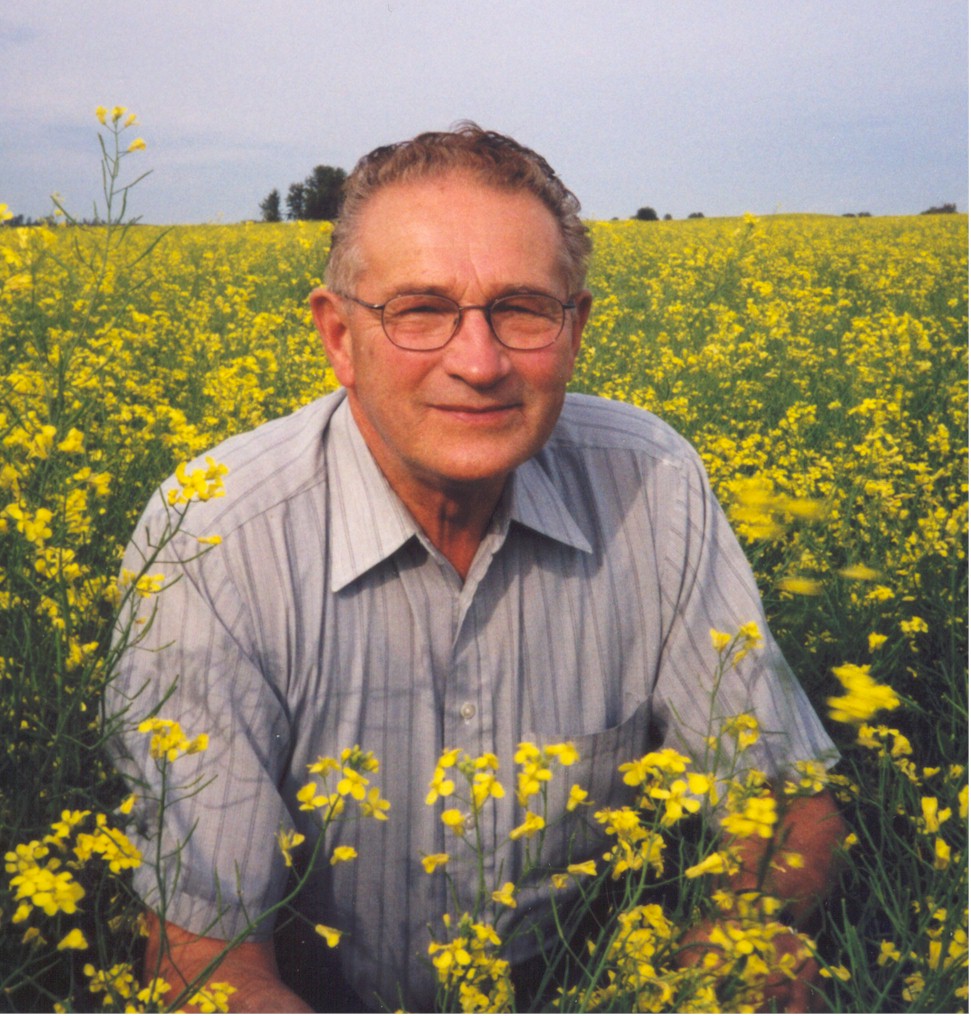
In the mid-90s, the biochemical leviathan Monsanto developed a genetically modified canola seed that is resistant to its Roundup brand of herbicide, which became known as Roundup Ready Canola. Farmers are required to purchase a license in order to use the seed. After only two years in use, it quickly constituted one quarter of Canada's canola production.
Percy Schmeiser was a canola farmer in Saskatchewan with a 1,000 acre farm and a custom strain of canola. He did not use Roundup Ready Canola, but found in 1997 that a portion of his crops were resistant to Roundup herbicide, which he used to kill weeds even though his canola plants typically die. But this time, many of them survived. A farmhand later saved the seeds from the resistant plants and they were planted the following season and later sold for feed. When it was revealed that the seeds being used by Schmeiser were the Roundup Ready variety, Monsanto sued Schmeiser for patent infringement.
Schmeiser, a former mayor and former member of the provincial legislature, fought the allegations, claiming that his actions were accidental and that the seeds came onto his property without his knowledge or consent. Although Monsanto admitted this was possible, the federal judge found that it was extremely unlikely and ruled in favour of Monsanto, citing Schmeiser's patent violations. It still remains unclear how the seeds got onto Schmeiser's farm.

Schmeiser, who had received a lot of publicity and (financial) help from environmental & anti-genetic groups, appealed the decision, but it was upheld by the Federal Court of Appeal. Schmeiser then tried the Supreme Court, which in a 5-4 decision, also ruled in favour of Monsanto. It did, however, also decide that Schmeiser did not have to pay Monsanto the nearly $20,000 he had received from sale of the modified canola. More importantly, he also did not have to pay for Monsanto's legal fees, which were well over $500,000.
As a result of the judgements, Schmeiser had to destroy all trace of his custom-bred strain, which he had been using for several decades. He also had a legal bill of approximately $400,000 to deal with. He now travels the world as a speaker telling his story and raising awareness of genetically modified plants, as well as the tactics of major companies like Monsanto. Indeed, many predict that the judge's decision on the poor likelihood of Monsanto's seed spreading accidentally is a reflection of the lack of knowledge we have on genetically modified plants, which have since been shown to spread very rapidly.
Schmeiser did, however, sue Monsanto in 2007 for the clean up costs after more Roundup Ready Canola made its way onto his property. An out of court settlement was agreed upon in 2008. Although it was only for a few hundred dollars, it demonstrates that the danger of seeds spreading is very real.
What is particularly interesting about the case is that none of the three federal courts approached it as an issue over the spread of the seed -- as Schmeiser did in 2008 -- but rather the patent violation. It set a protective precedent for large companies like Monsanto in that it recognizes patent violations as priority over the accidental spread of product, a problem that is sure to increase over the coming years.
Friday, November 27, 2009
A talk on how the economic crisis impacted food security....
The World Affairs Colloquium is hosting a talk next Wednesday (December 2nd) at 3pm in Trent's Alumni house. For those of you who have not been to the Alumni house, I would say it is the most prestigious building on campus so you should check it out. It is located in Champlain College next to the residence staircases.
The title of the talk is "Local Insight, Global Outlook" - How the Economic Crisis has Impacted Food Security on a Local, National, and Global Level. This talk will feature a panel of three speakers. For the local perspective, our panelist is Dave Ralph from the Kawartha Food Share. Our speaker on the national perspective is Paula Anderson from Peterborough Green-Up. Finally, Professor Tom Hutchinson will speak to the consequences that the economic crisis produced on the global scale.
More information about the speakers:
Prof. Emeritus Tom Hutchinson, Department of Environmental and Resource Studies, Trent University, is one of Canada's leading ecologists. Tom has extensive knowledge of sustainable agricultural systems and the biodiversity of old-growth forests. His distinguished international reputation is rooted in his extensive expertise and research as an ecologist.
Paula Anderson is the Waste Reduction Manager for Peterborough Green-Up, a local environmental charitable organization. Paula also teaches an undergrad course at Trent entitled "The Canadian Food System: A Community Development Approach".
Dave Ralph is the Chair of Kawartha Food Share, a broad-based community effort that coordinates community resources to provide emergency food in the City and Country of Peterborough.
Sunday, August 9, 2009
The importance of the potato in the 18th century...
How do places urbanize? Usually people migrate to cities because of the multiplicity of choice… You have quick and easy access to public transportation, numerous urban amenities and tonnes of housing options to choose from. When places urbanize, the population concomitantly increases… naturally. For hundreds of years we have been studying population growth examining factors that depopulate and populate areas. This has always been a curious humanitarian question and it is only gaining more research interest as our population surpasses the 6.8 billion mark.
Over the course of civilization, diseases like Black Death, malaria and other deadly epidemics have obliterated populations. However, we have also seen tremendous population growth since the 1950s particularly in India, China, Brazil, the United States and Europe. What exactly has been the cause of such population growth? Is it natural resources, is it the aforementioned urban amenities or is it something else?
The contemporary population question is being studied widely across the world. Interestingly, if we look at the world in the 18th and 19th century, the discovery of the potato not only led to a 22% rise in population, but a 47% rise in urbanization. Nathan Nunn and Nancy Qian have done research on the importance of nutrition to economic development. Their findings on the potato are fascinating.
The discovery of the potato was interconnected through geography, the environment, economics and health. After all, potatoes are an inexpensive crop to cultivate and subsequently eat, highly nutritious and are geographically suitable to be cultivated in many parts of the world including Northern Europe, Asia and even Northern Africa.
The discovery of potatoes led to population growth and urbanization in the 18th and 19th century. In the 21st century there are numerous factors contributing to population growth and decline. It seems however, that the discovery of natural resources are far more important today than any one nutritional crop like potatoes.
This is because natural resources have much more economic value and wealth today because of scarcity issues - oil, water and timber just to name a few examples. But natural resource discovery has at times --both historically and contemporarily-- led to conflict and war… factors that lead to depopulation. I wonder if there will be a study that shows the correlation between natural resource discovery and depopulation. Anyway, see Nathan Nunn and Nancy Qian's study on the discovery of the potato and urbanization.
Tuesday, July 7, 2009
A battle of solar proportions...
The promising future for solar energy in Ontario is in danger of taking a solid knock backwards in the next few months. A powerful lobby from the agricultural sector is trying to ban solar power development on prime agricultural land. This could very well sink the solar industry in Ontario.
Under the province's ambitious new green legislation, the Green Energy Act, solar energy is being provided with large subsidies under the Feed-In Tariff program. Solar power can be sold back to the electricity grid for nearly eight times the price of normal electricity, making them quite an economical option. Connecting to the grid, a traditionally difficult achievement, is also streamlined and made easier for producers of solar energy.
But one of the best ways to produce significant levels of solar electricity is by building large, dense solar farms. These solar farms, which typically consist of several hundred solar panels, require large pieces of land, usually over 100 acres. Often, the most attractive type of land for these farms are land designated as prime agricultural land: farms.
Farmers and others in the agricultural industry argue that this type of land should only be used for growing food. Concerns over the spoilage of the wonderful, but lessening topsoil from things like stray voltage also add fuel to the fire.
In Canada, and Ontario especially, agriculture often gets the ear of big politicians when it beckons it. In this case, members of the Ontario government, after hearing the case of Ontario farmers, are considering the option of banning all solar development on prime agricultural land in the province. Since these areas are often some of the only economical options, solar developers are cringing at the thought of being banned from these lands.
In response, solar proponents have argued that in order to meet the goals of the Ontario government, only 1/10th of 1% of the province's prime agricultural land would be needed for solar. It is true, this might not be very much land, but food is important and with a growing global population, we'll need to produce as much as we can. Furthermore, the billions of dollars being put towards corn-based ethanol subsidies are already encouraging many farmers to move away from food-intended crops.
With a climate change-focused future, we'll have to make a lot of mutually-exclusive decisions. In this case, it's food vs. green energy. Each option will not be simple. Each will have social and political implications that will always have to be recognized. I guess we'll have to figure out where our priorities really sit.
Thursday, May 7, 2009
Tsk Tsk, Mr. Gates...
A brief tidbit in the journal from the very leftist, progressive Canadian Centre for Policy Alternatives (CCPA) reports that The Bill and Melinda Gates Foundation--the multibillion dollar charity funded through Bill's not-so-modest stake in Microsoft--has given $5.4 million to a technology firm funded by Monsanto.
The money is to be put towards lobbying African governments and promote the entry of genetically modified crops (GMOs) to the continent, which, in all likelihood, will largely be provided by Monsanto. As I've blogged about before, GMOs can be beneficial. But as I also mentioned, it is the nature of the GMO industry that should be very concerning for the world's population and Monsanto's presence in this group is quite worrying.
Although I did not have incredibly detailed knowledge about the Gates' foundation, I did think of it as a wonderfully beneficial group. Their work in the prevention and treatment of HIV/AIDS and other diseases has been particularly notable. But this new donation strikes them down a few notches on the 'awesome pole'.
The trouble with such a situation is the deep respect, resources and connections the Gates' foundation has. Warren Buffett (now the world's third richest man, but last year topped the list) provided the foundation with nearly $30 billion worth of shares (paid over time) from his investment company, Berkshire Hathaway. That'll be one hell of a tax receipt. But I can't think of any other charity in the world that would be getting anything close to $30 billion.
So if people think the Gates' foundation is doing good in the world, then they're sure to follow suit. In this case, they're following in the wrong direction. As the CCPA said, the floodgates could open up wide. Very wide.
Wednesday, April 15, 2009
The unfortunate truth of GMOs...
GMO: Genetically modified organism. A GMO is any animal, plant or other living thing that has had its genetics permanently altered, generally intentionally by humankind (although this definition is slightly up for debate). GMOs can be found in a wide range of products, but their presence is most pronounced and controversial in food.
Theoretically, GMOs could solve a wide range of the world's food production problems. The potential to improve the shelf life of foods, crop resistance to pests and bad weather and make foods grow quicker and in greater quantities are all benefits of genetic alteration. Concerns over fruits being bruised during transport, whole harvests being lost due to an early frost and drought-prone areas not being able to grow food could very well all be concerns of the past. What a wonderful world it could be.
But as Yogi Berra said, "in theory there is no difference between theory and pratice. In practice there is."
GMOs are not living up to the hype. The reason? A mercilessly oligopolistic industry. The majority of research and funding is provided by the private sector, which (despite what their spokespeople say) is not developing GMO foods for the public good. A small handful of companies have ownership title of almost all the GMO crops. Canadians will be familiar with the corporation Monsanto.
Having so few companies dominate one industry is rarely a good thing. Prices of GMO seeds and the products needed to grow the seeds (which are conveniently supplied by the same companies) are outrageously high and often are only applicable to cash crops consumed in the "rich" world. Some companies have even developed specific seeds that only work once, removing the ability for farmers to "save seeds" (a popular practice among farmers) and leaving farmers dependent on that company.
GMOs have environmental risks, too. As you make crops more resistant to pests, the pests adapt. As a result, increasingly potent levels of resistance are required and in all likelihood pests will continue to adapt. This resistance arms race could go on forever will devastating consequences (picture Mothra, the giant moth monster from Godzilla movies).
Furthermore, seeds tend to mix fairly easily, which is a natural occurrence on the planet. The natural ecosystems of the world have tended to adapt and often flourish with seed mixtures. But when genetically modified seeds start getting transplanted and mingle with everything, trouble brews very quickly. Several studies have confirmed that butterfly populations have fallen significantly after coming into contact with GMO crops. The ripple effects could be very large and a reduction in overall biodiversity would be a very bad thing.
I highly recommend everyone read Brian Halweil's "The Emperor's New Crops". It's short and is one of the best descriptions of the way GMO industries work, although it is slightly dated.
The question I ask is where we should go next with GMOs? The private sector will continue to exploit the industry. After all, it's a huge money maker. But governments in Europe require labelling of GMO products, which is sure to batter the industry. Canada doesn't have such a requirement, so perhaps we should start there.
Education is also a key. Very few people know the true nature of the industry, which can probably be chalked up to marketing campaigns from the company themselves.
But from a grander fundamental point of view, are GMOs something that we should even pursue?
We're able to grow our food in a sustainable manner (ex. organic, local farming), which could theoretically be applied throughout the world. Moreover, a great share of experts argue that the world's hunger problems are not an issue of food production (the world produces 1.5 times more food than needed for the world's population), but rather an issue of access and distribution. Considering GMOs might draw us away from considering the solutions to those problems and may, as the industry currently stands, actually exacerbate those access problems as farmers have less money to buy food after paying for the high-priced seeds.
Regardless of how difficult it would be from a realistic standpoint, should we simply ban GMOs altogether? I think it could be something to consider.
Wednesday, April 8, 2009
Drip Irrigation has its place…
I am reading more these days on the latest technological innovation for water conservation. Specifically, I am looking at the agricultural sector of Canada and California. Agriculture accounts for ~ 70% of Canada’s water supply which means that a vast amount of water withdrawals are from farmers mostly for irrigation purposes. However, water is more abundant in Canada than California and shortages in this populated state have driven technological innovation in the area of water conservation.
In California, irrigation use constitutes a massive share of the water withdrawals from the Delta and San Joaquin River - the Delta and San Joaquin river make up the biggest water distribution system for the state. In fact, it provides drinking water for 25 million people and supports California’s trillion dollar economy and $27 billion agricultural sector. With current water shortages in southern California, the importance of actually conserving water has become an omnipresent reality. Farmers are looking at ways in which they can optimally conserve their water resources to maintain adequate supply. A quick solution: drip irrigation.
The conventional methods of water irrigation include flood and sprinkler irrigation. However, the irrigation efficiency for both methods ranges from ~ 40-65% because some water is lost in this process as runoff occurs through percolation and evaporation because the surfaces or soil cannot drain vast amounts of water at a single time. But generally, flood irrigation is inefficient because a lot of water is used and not all of it is drained or absorbed by the soil but instead runs off into rivers and is lost. By contrast, drip irrigation systems reduce percolation below the root zone and increase soil absorption of water. Water is delivered closer to the soil and plant roots and this reduces evaporation losses that would normally be lost in a flood irrigation process.
It saves ~ 25-95% of water compared with flood irrigation. How does it work? It requires rigid plastic pipes that are laid on the surface or buried below ground in each crop row at the root line. Small holes allow the water to drip from the pipe directly to each plant root system. The amount of water applied is regulated by the hole size in the distribution tubes and the water pressure in the system. For a diagram, see here.
Places with large agricultural sectors like Israel and California have started using this technology. Tomato farmers in the famous San Joaquin Valley of California have installed drip irrigation systems. Farmers found that yields increased 5.4 tonnes per acre to 10.1 tonnes per acre using drip irrigation technology. Sure it is expensive, but any novel water conservation technology these days ain’t cheap. This is why state governments in the US are allocating more funding and providing subsidies to farmers who use this technology. In sum, drip irrigation allows you to use less water for your crops and plants but allows you to increase your yields because every drop of water is being used and very little is lost.
Key Message: Water conservation requires all stakeholders to be involved. The agricultural sector is an indispensable player and recent initiatives like drip irrigation need to be actively pursued. Conserving water is economically advantageous but requires some initial investment to get the ball rolling.
In California, irrigation use constitutes a massive share of the water withdrawals from the Delta and San Joaquin River - the Delta and San Joaquin river make up the biggest water distribution system for the state. In fact, it provides drinking water for 25 million people and supports California’s trillion dollar economy and $27 billion agricultural sector. With current water shortages in southern California, the importance of actually conserving water has become an omnipresent reality. Farmers are looking at ways in which they can optimally conserve their water resources to maintain adequate supply. A quick solution: drip irrigation.
The conventional methods of water irrigation include flood and sprinkler irrigation. However, the irrigation efficiency for both methods ranges from ~ 40-65% because some water is lost in this process as runoff occurs through percolation and evaporation because the surfaces or soil cannot drain vast amounts of water at a single time. But generally, flood irrigation is inefficient because a lot of water is used and not all of it is drained or absorbed by the soil but instead runs off into rivers and is lost. By contrast, drip irrigation systems reduce percolation below the root zone and increase soil absorption of water. Water is delivered closer to the soil and plant roots and this reduces evaporation losses that would normally be lost in a flood irrigation process.
It saves ~ 25-95% of water compared with flood irrigation. How does it work? It requires rigid plastic pipes that are laid on the surface or buried below ground in each crop row at the root line. Small holes allow the water to drip from the pipe directly to each plant root system. The amount of water applied is regulated by the hole size in the distribution tubes and the water pressure in the system. For a diagram, see here.

Places with large agricultural sectors like Israel and California have started using this technology. Tomato farmers in the famous San Joaquin Valley of California have installed drip irrigation systems. Farmers found that yields increased 5.4 tonnes per acre to 10.1 tonnes per acre using drip irrigation technology. Sure it is expensive, but any novel water conservation technology these days ain’t cheap. This is why state governments in the US are allocating more funding and providing subsidies to farmers who use this technology. In sum, drip irrigation allows you to use less water for your crops and plants but allows you to increase your yields because every drop of water is being used and very little is lost.
Key Message: Water conservation requires all stakeholders to be involved. The agricultural sector is an indispensable player and recent initiatives like drip irrigation need to be actively pursued. Conserving water is economically advantageous but requires some initial investment to get the ball rolling.
Subscribe to:
Posts (Atom)