Showing posts with label Bicycles. Show all posts

Saturday, November 5, 2011

Bicycle friendly cities

The Copenhagen Index for the World's most bike-friendly cities has been released for 2011. Here is a bit context about the index:
Image Credit: mindbodygreen.com

"Early in 2011 a discussion arose at Copenhagenize Consulting about what cities really are the best cities for urban cycling. Over a period of six months our team has gathered information and statistics and developed an index with which we could rate cities for bicycle friendliness. It was originally meant to be a tool for internal use in the company but after a period of time we realised that the index was perhaps worth releasing on the internet".

The index is based on 13 criteria including bicycle culture, infrastructure, bike facilities, bike share programs, gender split, perception and safety and more.

Amsterdam took 1st place followed by Copenhagen and Barcelona. For North American cities, Montreal took first followed by Portland. Way to go Montreal!

Here is more information about how the index was created.

Tuesday, July 12, 2011

Metro Vancouver Bikeability Index


A team of researchers at UBC recently released the Metro Vancouver bikeability index. The map above shows the availability of bike facilities, bike route density, topography and land use.

"If you make cycling and walking the easier choice, then people will be more likely to choose it because it’s faster to get [somewhere] than sitting in traffic,” said lead researcher Meghan Winters. “Then people will be less likely to choose their cars, they’ll be more likely to engage in physical activity, and that will reduce congestion in the city.”

I have been doing research this summer on active transportation exploring transportation options such as walking and cycling. Both options are becoming more salient forms of sustainable transportation and its refreshing to see a visual representation of such modes in the region. Indeed, the Metro Vancouver walkability index was released in the fall, and the bikeability index just a few weeks ago. Visual representations and maps like these, beyond the benefits of providing more information to residents, also help urban planners determine areas that could use more cycling infrastructure, for example.

Couple of small critiques. 1) I don't think the width of a bike path is measured. I have seen bike paths in Richmond, BC that are very narrow with most of the road space allocated to cars - hence a little less safe and secure.

2) While beyond the scope of the index, it would be neat if there was a qualitative dimension built into it. By qualitative I mean asking cyclists and motorists alike about their perceptions of cycling and perceptions of safety around cycling. For example, I may feel very safe and comfortable cycling in a separated bike lane downtown, however, a motorist may feel incredibly uncomfortable by my presence and less certain of how to interact with me when I leave the separated bike lane. Showing differences in perception of safety, among other things, would be a neat addition, I think.

Overall, this is really fascinating and, according to the Canadian Institute for Health Research:

"The Canadian Institutes of Health Research has provided the team with additional funds so that they can make up bikeability indexes for Victoria, Calgary, Saskatoon, Winnipeg, Toronto, Montreal, Halifax, Charlottetown, Moncton and St. John's by 2012".

Saturday, June 11, 2011

Bike Share System in Hangzhou, China


Following up on Chris' post on the theme of bicycles, I thought I would provide this video (thank you to my friend, DS, for sharing it with me) about a very successful public bike share system in Hangzhou, China that is paving the way for green transportation.

The video above provides all the details, anecdotes and statistics about the system so I'll leave the video to satisfy your curiosity. However, from a planning and development perspective, there are a couple of things worth mentioning.

One, bike share programs are especially useful as an inter-model transit strategy meaning that citizens might rent a bike to travel to a transit station where they could then park the bike at the bike share parking facility located at the transit station,  hop on transit and walk to their final destination. The bike share parking stations are meant to be close to other transit modes to help people effectively transition when making a journey. Further, they are also located near residential complexes and busy streets. Bikes in general are wonderful for commuting but bike share programs help alleviate fears about bicycle theft and allow people to integrate them effectively into their traveling.

The Hangzhou story is also promising considering the great fall of cycling China over the past 20 years. Indeed, according to some sources, "just ten years ago there were 500 million cyclists in China. The bike was emperor of the roads. It was the only way to go and the fastest way to get there. But whereas two thirds of families traveled by bike in the 90's, it is only 20% today. Bike ownership in cities has plummeted by 25% in the past five years".

There are researchers in my graduate program who are particularly interested in reviving bicycling in China. You can view their abstract here which focuses on Beijing.  This is a significant problem in China as cycling, a once dominant mode of transportation, is being pushed aside by the car which brings with it a series of factors including convenience, social/economic status, flexibility and more.

It's reassuring to know that some places in China such as Hangzhou and Guangzhou are moving forward with popular and affordable transportation programs to improve the livability and sustainability of their cities.

Thursday, June 9, 2011

Riding Out of the Bike Lane? Watch Out for the 5-0

Bike lanes are great. But just because it's there, doesn't mean you have to ride in it. Especially when stuff is in the way. Or so I thought...

Thursday, January 13, 2011

Cycling Success in Copenhagen

My friend, EP, shared this link about Copenhagen's immense success with its cycling culture, planning and infrastructure.

From the article:

"Copenhagen has almost 40% of all their overall trips by bike, a staggering figure that is already the best in the world. And yet they're not satisfied.... their goal is to raise that to 50%, and they've got aggressive strategies to do it. This is a lesson to cities that think it’s too hard to double their mode bike mode share, from, say, 2% to 4%"

"In Copenhagen, cycling has become "hip" and trendy. This is not accidental. A significant part of the traffic department's work is to promote this trendiness, through awareness campaigns, promotions and branding/ marketing (you can picture the traffic director getting the Crown Prince of Denmark to be out seen more on his bike). They use the media and popular culture vigorously, feeling that "if the media is talking about cycling, then politicians are, and if politicians are, then the media is."

"To make cycling, which can be a somewhat solitary experience, more social, they have schedules posted along the routes for unplanned biking groups to meet and cycle together, like a bus schedule.... A "cycle-bus" of sorts. This is fascinating, as I've often heard in North America one of the perceived attractions of cycling over transit is that it is seen as "individual" and at your own schedule, and thus closer to the "freedom" of the car than transit. The Danes, though, apparently will wait to commune with strangers on bikes, once again illustrating how much more social they are than we. Niels is quick to point out that it wasn't always this way though, and that any city can achieve it if the will is there."

Read more about the city's biking creativity and success here.

Wednesday, October 13, 2010

Bike Lane Debate in Vancouver

Urban bike lanes always face opposition. People say they hurt businesses, they take space away from motorists, they are too expensive etc etc. We had a guest post in the summer from the Executive Director of the Toronto Cyclists Union that challenged many of the conventional arguments made against bike lanes.

On a separate note, I was speaking with a physicist who argued that bike lanes make cyclists less conscious of their surrounding environment and are thus more at a risk of colliding into a motorist. He suggested that bike lanes have rumble strips to make both cyclists and motorists more attentive and aware of their lanes.

My friend and classmate, William Dunn, recently wrote a short and excellent story about a new bike lane in Vancouver that has generated a lot controversy. In short, City Council recently approved the Hornby bike trial which is a protected cycling track in downtown Vancouver.

Will writes:

"The City’s decision to re-appropriate public streets for the creation of a protected cycling track has been one of the most divisive civic issues in memory. News1130 and other media have labeled it a misappropriation of public space and funds, business owners along the routes are furious, and motorists grow increasingly frustrated. With City Council’s October 5 decision to approve the Hornby bike trial, the debate seems destined to intensify".

Read more here.

Thursday, September 30, 2010

Adding bike lanes to new construction projects...

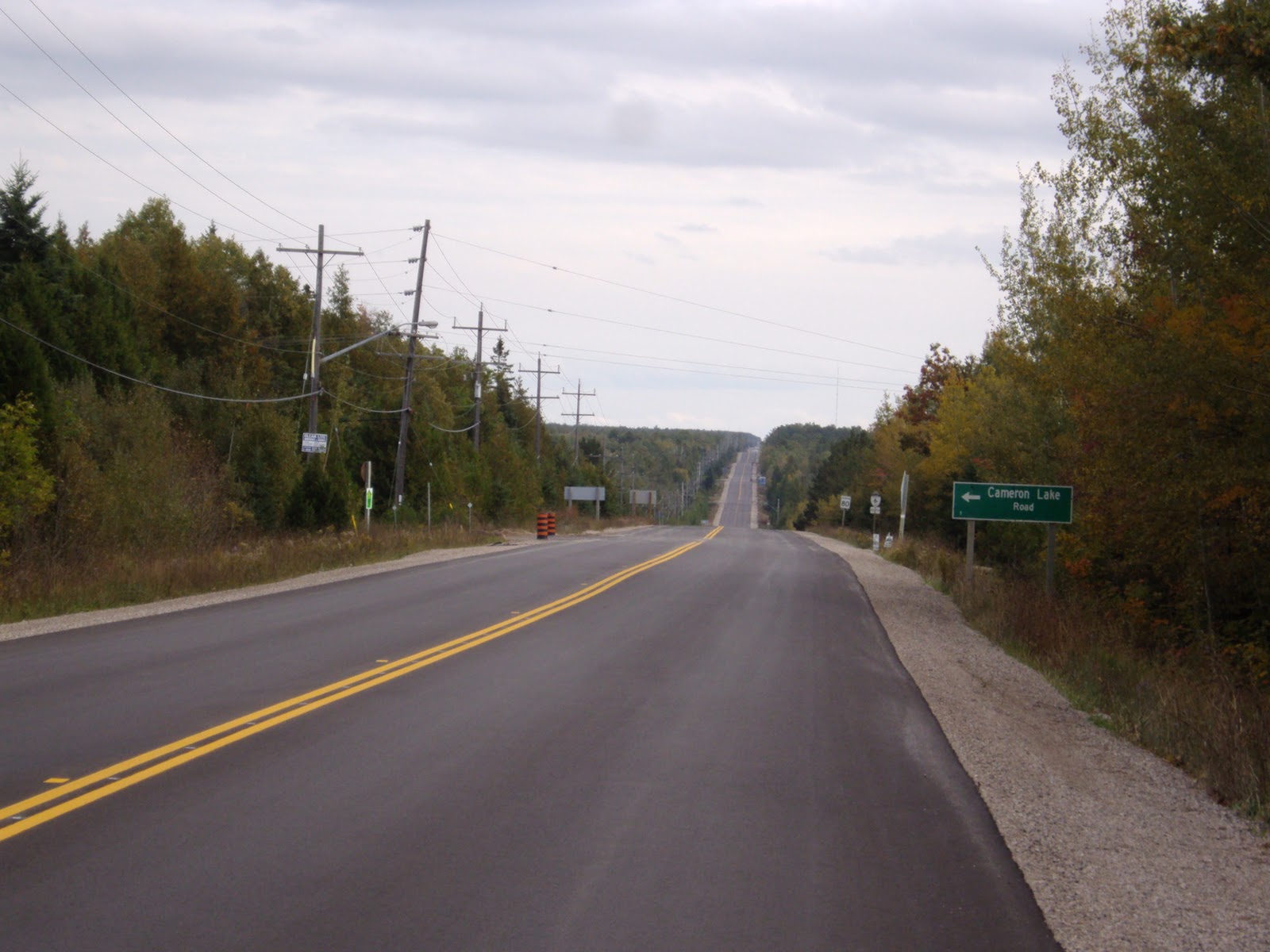
The ferry from Manitoulin Island to Tobermory was cold and windy, but upon landing in the famed and picturesque harbour town, I was regaled with stories of the Bruce Peninsula by Bob, a local dog breeder. After we chatted about my bike trip for a little while I told him I'd be taking Highway 6 south to Owen Sound, the only major highway on the Peninsula.

He told me that major construction had been taking place on the highway for most of the summer and that as a cyclist, I should love it. Instead of adding bike lanes after repaving the highway -- as is a typical way to add bike lanes, but is costly and obstructive, since the highway needs to be shut down for some point of time -- the province, with funds from the federal stimulus bill, decided to add them as it repaved the highway. Two birds. One stone.

And it is fantastic. The lanes -- which at this point are simply paved shoulders -- are very wide and could even accommodate two bikes side by side. And there are many signs that clearly say 'Do Not Drive on the Paved Shoulders', which is very necessary given that the shoulders look like part of the regular car lane.


I'm presuming that they will be painting lines in due time to mark the lanes, although another local I chatted with said they won't be. According to a discussion she had with one of the project's engineers, they may decide not to add painted lines because it could be harmful to cyclists.

Hmm. Sounds a little counter-intuitive. But according to the engineer, once lines are painted, motorists won't pay as much attention when passing cyclists on the road, assuming each vehicle will stay in its assigned lane. Unfortunately, this might lead to cars flying by at full speed within close distance to cyclists, which can be very dangerous. Without the lines though, motorists are forced to notice the cyclists and be more likely to slow down and go around carefully. I'm on the fence about the argument -- the government might just be cheap -- but it's interesting nonetheless.

The incorporation of bike lanes into highway reconstructions is rare in Ontario and the Bruce project is only the first leg in what is supposed to be a much larger highway network, including Manitoulin Island. I wish them all the best.

Thursday, August 19, 2010

Want cheap energy? Get prisoners to generate it...

The new coalition British government is in trouble. They have inherited a massive deficit and are looking to cut as many costs as possible.

The Globe & Mail reports that instead of figuring it out themselves, they have opened the floor to suggestions from members of the public. Among the thousands of options thrown out there are ditching the monarchy, selling off the Queen's swans for meat -- she owns most of the swans in the U.K. -- and even significantly cutting foreign aid. But quite a few suggestions involve using Britain's 100,000 prisoners, specifically getting them to generate electricity on treadmills and rowing machines.

A crazy idea? The Globe thinks so, but I disagree. Using fitness equipment to generate electricity is not a brand new idea. Some gyms throughout Europe and North America have already adapted their cardio machines to generate electricity for the building. After all, there is a lot of energy being used that could be captured as electricity. A hotel in Denmark even offers its guests a $36 food voucher to ride a stationary bicycle for 15 minutes and produce 10 watts of electricity. Sign me up. In comparison, Ontario's feed-in tariff offers less than a dollar for 100 times as much electricity from renewable energy projects. I think I know where the better deal is...

And prisoners typically work out a lot more than most other members of societies, so the potential is there. Whether or not it would produce enough electricity is another issue altogether. And how much would it cost to set up the necessary infrastructure to run a system like this? Another question one might raise is if prisoners are forced and scheduled to work out under this system, or whether working out will remain voluntary?

It is doubtful to get far off the ground, but it's nice to hear that when pursestrings get tight, clean energy get a little cooler.

Wednesday, July 7, 2010

Chris' Bike Trip: 2 Months to go...

I am now only two months away from my somewhat scheduled departure time for my bike tour around the United States. Since my last post on the trip, many different things have taken place.

Much of the progress has come in the form of equipment. A shopping spree on MEC's website eventually led to a smattering of new bags, sleeping/camping equipment and some new bike tools. When I'm finally ready to go I'll post a detailed list/photos of all the equipment I'll be bringing along. By far the most important investment in the past few weeks has been the purchase of a new, custom-built touring bike. I was exceptionally lucky to receive some gifts for convocation that allow me to purchase the new bike.

The bike is a Surly Long Haul Trucker, widely regarded as one of the top touring bikes on the market. After talking to a few friends about theirs, I elected to purchase it from a shop in Cambridge, Ontario called Cycle Cambridge. After providing my measurements, the folks at Cycle Cambridge will take the LHT frame and build it to my sizing with custom parts specific to my needs on the trip. For example, many of the parts will be high quality mountain bike parts, making durability and repairability a priority. I'm not going to pretend to know what makes all the different parts brands better than others, but I'll post a list of everything once I pick up the bike -- which is currently being built.

The route has endured a few changes. Rather than going from Winnipeg to Utah and up to Vancouver, I've elected to just go straight to Vancouver. There are two reasons for this: 1) prevailing winds will make travelling westward longer than is typical and 2) I'd like to beat the weather. I figure once I'm passed the Rockies, I'll be much safer weather wise. I will likely take the less-travelled Crowsnest Highway through southern BC as opposed to Highway #1, largely because I've already driven #1 and would like to see some other spots. If anyone is familiar with BC and some good sites, please let me know. I've already been told to check out the San Juan Islands just off Vancouver Island, although they're technically part of Washington.

The other possible route change might be more major and is one I have been mulling about in my head. I am nervous that come early-mid March, the weather along the Eastern Seaboard of the USA might be less than stellar. What may very well occur is that the trip might have to end around there, in one of the Carolinas. It can still get pretty chilly in the spring on the Atlantic. Of course, it is a long way off, but something I've been thinking about.

In other news, it looks as though Winnipeg will have to wait at least one more year until they get an NHL team, which means I'll get to make a stopover in Phoenix to watch a cheap Jets game. I'll be one of nine fans there. Seeing sports games will be a priority for me during this trip, especially ones in the southern US when the weather is nice. My dad often talks about travelling around the US when he was younger and seeing tons of MLB and NFL games, although tickets were far more affordable back then. Maybe I'll get to see Bosh, Wade (& Lebron?) in Miami when I swing by?

One aspect of the trip I am halfheartedly looking forward to is going to the Gulf Coast. It will still be an awesome spectacle, but for all the wrong reasons. What was once pristine natural land will now be oiled from the BP spill. This in itself will be a sight to see, but a truly sad one. One can only hope the area has had some chance to recover.

The notion that the trip is happening has been growing on my family, some of which have been less than enthusiastic. However, the benefits of the trip are starting to headline their thoughts of it, as opposed to all of the unlikely, yet possible, risks. There is even talk of my meeting up with my parents somewhere down south for their now-annual winter vacation. That would certainly be a treat.

As the date gets closer I will have to plan more carefully and look at specific routes. In chatting with a friend today, he suggested I start making a plethora of Google Map routes complete with documents on accomodations, attractions, roads, food and other things. I'll certainly start looking into that.

On a blogospheric note, I am trying to get the Winnipeg Free Press to host my blog posts on the trip, so it would be located both here and on that site. The most recent thing I've heard is that they are considering it, but could provide no money for it. I will have to rely on the earnings from this blog to get me through the trip. If only Tim would up my allowance...

Once I get closer to the departure date, I will try to provide as financially transparent a blog as possible. People tend to think money matters are taboo, but for others thinking about doing a trip like this, I think it would be extremely helpful to know how much it really costs. Plus, it will help me keep track of my own expenses.

Some people have asked me about training for the trip. I ride my bike almost everywhere I go and am already in very good shape. Later this month I will be making a few weekend bike tours around parts of Ontario and some in Manitoba when I arrive. I already know I can go at least 150 km in a day without killing myself from rides I've previously done, on a loaded mountain bike no less. But my approach will be to 'train as I go', perhaps going farther each day as I get used to the distances and the lifestyle. I'm sure there are far more rigid training regimens for a trip of this nature, but I hate training, so we'll see how it goes.

Friday, May 21, 2010

Guest Entry: Bike Lanes Serve all Torontonians


This guest entry was written by Yvonne Bambrick for the Toronto Board of Trade. With the author's permission, Yvonne was kind enough to share it with us.

By: Yvonne Bambrick

Bike lanes are a non-partisan issue because they serve all Torontonians. These inexpensive pieces of infrastructure are an important component of the changing realities of urban transportation — not, as many attempt to paint them, a pet project for a small number of commuters.

Cities across North America have been transitioning from merely viewing bicycles as a recreational tool, to understanding that cycling is a legitimate and necessary transportation option. Bicycle infrastructure (lanes, sharrows, bike boxes, etc.) and an active cycling culture benefits drivers, pedestrians, transit riders and cyclists alike. However, infrastructure alone will not suffice — it must be paired with public education.

There are many immediate and positive impacts with bike lanes. They create a dedicated space in which cyclists feel safer, and encourage more people to choose cycling as a mode of transportation — they are a boon to local business and the most affordable and sustainable way to grow our road capacity.

More people on bicycles means fewer people taking up precious road space in cars, and a pressure valve for an overburdened peak-hour transit system. Bike lanes add a greater level of predictability to our roads by showing more clearly where we can expect each transportation mode to be traveling.

With more cyclists on our roads, the phrase “safety in numbers” holds true — the greater the number of cyclists, the more visible they become to motor vehicles and pedestrians. One of the greatest impacts of bike lanes is as a tangible expression of the fact that bicycles have a place in our transportation network.

Economy and Taxes

Encouraging and creating space for Torontonians to choose cycling transportation is one of the cheapest, fastest and most effective ways to accommodate our growing population, and to increase the capacity of our roadways to efficiently move people from A to B.

Bike lanes are cheap! A quick look at Portland, a prime example of a North American city that has fully integrated cycling, confirms this. They calculated that their entire complement of cycling related infrastructure — some 300 miles of bike lanes — cost approximately $60million; the equivalent to the cost of 1 mile of new freeway!

We often hear the argument, ‘If cyclists want bike lanes, they should pay for them.’ Cyclists already do pay for them. Anyone who pays rent or property tax in Toronto is paying for our municipal roadways. If you compare the relative impact of cars and bicycles on the roadways themselves, on our collective airspace, and the healthcare costs of pollution and a sedentary life that driving promotes, it is quite apparent that cyclists are actually subsidizing automobile drivers.

Cycling is also good for business. A recent study by the Clean Air Partnership conducted in Bloor West Village counters the popular myth that removing on-street parking is “bad for business.”

Their conclusions include:
•People who arrive by transit, foot, and bicycle visit more often and report spending more money than those who drive
•People who preferred to see street use reallocated for widened sidewalks or a bike lane were significantly more likely to spend more than $100 per month than those who preferred no change
•The majority of people surveyed, merchants included (58%) preferred to see street use reallocated for widened sidewalks or a bike lane, even if on-street parking were reduced by 50%.
•In this neighbourhood, the majority of merchants predicted that reducing on street parking in favour of widened sidewalks or a bike lane would either not impact or increase their daily customer numbers, and therefore do not believe it will negatively affect commercial activity.


Flow & Congestion
The core function of our roadways is to efficiently move people to and from destinations across the city — not simply, as some still believe, to rapidly throughput automobiles. In fact, the broader aim of Toronto’s much delayed 2001 Bike Plan and proposed Bikeway Network that was designed by our city’s transportation experts, is to insure minimum disruptions to motor vehicle traffic, transit and parking, while creating a safer transportation environment for the growing number of tax-paying Torontonians who choose to ride bicycles for getting around the city.

The streets of Toronto, with or without bike lanes, are a shared environment and all road users have a role to play as we negotiate these busy spaces on a daily basis. Predictable, responsible behaviour, indicating ones intentions through verbal and non-verbal communication, and a bit of good old fashion respect are the keys to safely sharing the road and maintaining the flow of all forms of traffic.

Safety
Road safety is everyone’s responsibility, and we could all use a refresher on our responsibilities. Due to the classification of bicycles as vehicles under the Highway Traffic Act, some confusion still exists because of the hybrid nature of bicycles – they are self propelled and human scale, yet mechanical vehicles. While subject to the same rules of the road, bicycles rely on momentum, have no protective shell, and are vulnerable to minor road surface disruptions.

For example, a small pothole or utility cut that might not affect a car could endanger a cyclist. In the absence of clearly designated places for cyclists to ride, the line between pedestrian/vehicular spaces has been blurred. Poor roadway conditions, combined with an often hostile roadway environment, caused in part due to a lack of sufficient infrastructure that would allow all traffic to flow better, and occasional bullying by intolerant drivers has in some cases pushed cyclists onto the sidewalks where they don’t belong.

Ultimately the thing we must all remember is that in a car/bike collision it is always the cyclist that loses – a bit of skin, a week of work, or in the worst circumstance, a life. That loss could be suffered by your neighbour, your child’s schoolteacher, your lawyer, or your brother — we all know and love a cyclist. Bike lanes and public education about road sharing responsibilities and best practice serve all Torontonians regardless of mode. We’re all in this together.

With education in mind, the Toronto Cyclists Union and our partners, have submitted a full update proposal for the Ontario Driver’s Handbook with far more pedestrian & cycling-related road sharing content throughout; we have created the Toronto Cyclists Handbook (soon available in Toronto’s top 17 languages), and we proposed a shorter and more accessible ‘Urban Cycling 101’ course to be added to the City’s Can-Bike cycling skills curriculum.

Leadership
Leadership regarding active transportation is needed from all levels of government in Canada. While we have seen modest improvements at the municipal level in recent years, and the beginnings of active transportation policy implementation at the provincial level via Metrolinx, we have yet to hear anything at all from the federal level.

On this issue, the US is several steps ahead of us so-called ‘progressive’ Canadians with the US Department of Transportation’s Policy statement on bicycle and pedestrian accommodation. This personal blog post from US Secretary of Transportation Ray LaHood’s tabletop speech at the National Bike Summit in March 2010 reflects their new Policy Statement on Bicycle and Pedestrian Accommodation Regulations and Recommendations. Canada, clearly, has some catching up to do.

Strength in Numbers
Those who have thus far been courageous enough, given current conditions, to choose cycling transportation should be supported and encouraged, not made to fight for acceptance and respect against ignorant, politically motivated, fear-mongering rhetoric. More people choosing cycling transportation is of benefit to all.

Yvonne Bambrick is the Executive Director of the Toronto Cyclists Union
Tuesday, May 11, 2010

Cycling in the City of Toronto...

I came across a really interesting study today on cycling in the City of Toronto. The study was undertaken by Ipsos Reid Public Affairs, a survey-based marketing research firm. The study has some pretty fascinating findings many of which are promising for the future of cycling in Toronto, although the City still has a lot of work to do for improving its cycling overall. The sampling size of the survey (a random and representative sample) is (n=1000) pulling an even 250 residents from the four districts of the City including Central Toronto, Etobicoke, North York and Scarborough. The study is quite comprehensive so I will only share the major findings and allow readers to access more of the report if interested.

1) There has been an increase in cycling over the past ten years. The number of cyclists in Toronto has increased 6% between 1999 and 2009 (from 48% to 54%).

2) The increase can be attributed to more people cycling for "practical day-to-day" purposes. The number of cyclists that can be classified as "utilitarian" meaning they commute to work or school by bike or they bike for the majority of their errands or visits to friends increased 9% between 1999 and 2009 (from 20% to 29%).

3) The increase in utilitarian cycling occurred mainly outside of the downtown core, however, the downtown core still houses (unsurprisingly) the highest numbers of utilitarian cyclists at 36%.

4) According to the study, 25% of Toronto's residents classify themselves as recreation cyclists meaning they cycle strictly for leisure or fitness. This number has dropped from 28% (in 1999) because more cyclists have expanded their cycling to include utilitarian cycling.

5) Safety on roads remains the public's principal concern about cycling. While significantly more cyclists are comfortable biking on major roads with and without bike lanes than 10 years ago, still only one-third of cyclists say they are comfortable biking on major roads without bike lanes.

6) One third of cyclists report combining biking and public transportation at some point in time. Secure bike parking at subway stations and bike rental stations close to transit terminals appear to be a means of encouraging this. Bike rentals are also likely to motivate three in ten non-cyclists to cycle somewhat/more often.

The study also found that cyclists are marginally more critical of cycling infrastructure. Cycling infrastructure will have to be significantly ameliorated in Toronto, I am sure many citizens can attest to that.

It's an interesting study and I encourage anyone to read it.

Key message: Good cycling infrastructure is a critical criterion for a vibrant, livable and sustainable city.

Monday, May 10, 2010

The secret to bike-friendly cities...


More bike lanes. Dedicated bike paths. Plentiful and safe bike parking. Showers in the workplace for cyclists commuting to work. Car-free neighbourhoods.

These are some of the basic necessities called for by proponents of "bike-friendly" cities. Without them, cities will continue to be dominated by cars, polluted air and be hazards for commuting cyclists. Cyclists often cite unaware or even antagonistic motorists themselves as being the main cause of difficulty. Even jaywalking pedestrians can pose dangers for cyclists.

But the real secret to a bike-friendly city is friendly bikers. Cyclists -- and in the interest of full disclosure, I am one -- have a tendency to throw all the blame on motorists and pedestrians and identify themselves as the victims. In turn, motorists consistently criticize reckless cyclists that run red lights, ignore stop signs and weave through traffic. And the voice of angry pedestrians is becoming much louder as some cyclists choose to fly along sidewalks like a bat out of hell. Pedestrians and motorists are not even remotely close to forging alliances on most issues, but when it comes to cyclists, they can agree on one thing: some cyclists are jerks.

Until the fantastical car-free world comes to fruition, cyclists, motorists and pedestrians will have to operate in the same environment. As the kindergarten saying goes: treat others the way you want to be treated. So for cyclists, this means following the laws of the road. If there is a red light, you stop at it. If traffic is moving, don't dart in and out of it at your heart's content. And use hand signals when making turns.

I say this not because I'm a stickler for the law, but because of the friction it creates when these rules aren't followed. How do you think motorists feel when a bike flies right in front of them without warning? And when bikes run red lights it certainly sends a mixed message from groups that say bikes have every right on the road that cars do. I don't drive very often, but even I can be found cursing at cyclists who don't wait their turn at a four way stop.

It is not always an easy thing to do. Being on a bike provides you with certain freedoms a car does not, like weaving easily through traffic or transferring from sidewalk to road conveniently. And stopping at every stop sign is considerably more annoying for someone who has to accelerate under their own power each time rather than pressing a gas pedal. I'll admit, I had a tendency to do much of this over the past few years, and still do to a much smaller degree. I vividly remember a cyclist yelling at me for flying through a red light when I was late for something. But I try not to anymore.

A recent column in the New York Times describes a cyclist, Chris Raschka, who believes he is one of a kind because he actually obeys the rules of the road and tries to cooperate with motorists and pedestrians. He frequently receives compliments from cab drivers, other motorists, and even mothers pushing strollers, while other cyclists are happy to decry him as an "amateur" as they fly through the red light.            

The problem is that in most cities, there is a cultural tug-of-war between cyclists, pedestrians and motorists. Each party blames the other, while seeking attention as a victim itself. But the only way a city can become truly bike-friendly is when motorists and pedestrians can themselves come to respect and trust cyclists. And the only way that will happen is when the less cooperative cyclists choose to take the high road and make the road a less tense place.

Photo credit: StreetsBlog.Org

Wednesday, September 16, 2009

Monday, May 11, 2009

Green Cities: Montreal’s Bixi… Not quite the Parisian Model

Montreal, known for its vehement and wild Habs fans, high levels of vandalism and great city life is going to bring about a public bike rental system. Known as bixi, which is a combination of bike and taxi, is going to be implemented with the $15 million made available from the Montreal parking authority. For details see here.

The only difference between Paris’s bike rental system and Montreal’s is that Paris’s system is owned by a private company. Montreal will have a city-owned bike rental system. Paris and other European cities have had great success with such a system in place. Why? Because the streets and urban environments are much more conducive for biking and scooters. Plus, automobiles are not as ubiquitous in European cities as they are in North American ones.

There has always been sufficient demand for bike rental services in Montreal, and the city plans on bringing about 800 kilometres of bike routes by 2013. This city initiative is the epitome of New Urbanism and smart growth. Montreal’s public transit system, albeit popular, is not as established as cities like Curitiba or San Francisco. Nonetheless, having a public bike rental system in place adds to urban amenities, attracts tourists and will undoubtedly mitigate smog and pollution levels in the inner city.

A city-owned bike rental system is good for urban planning as well. Transportation initiatives in cities across the world are sometimes privatized such as a bus system, subways, and even bike rental services. A city-owned system though more expensive, is better from a planning and policy lens. Firstly, accountability with a private company may not be as adequate as a city-owned system. Secondly, policies and incentive programs for encouraging cycling can be easier to implement through municipal government.

Key message: Montreal is en route to becoming one of Canada’s greener cities. Let’s celebrate this new initiative, track and study its development and think about how we can make our very own cities more environmentally-friendly.