Earlier this summer, I read a book called Economic Gangsters: Corruption, Violence, and the Poverty of Nations by Raymond Fisman and Edward Miguel. The book draws on number of correlations between seemingly random things that have important policy implications in economic development.
While Enviro Boys does not directly write about international/economic development, the book reveals important ideas that pertain to climate change which we know is a global issue that requires expertise from several disciplines. I wanted to share one concept from the book that has the highest degree of relevance to this blog. The concept is called Rapid Conflict Prevention Support (RCPS) which is a form of aid that targets countries suffering temporary income drops due to poor weather or commodity price declines. It would provide immediate financial aid to such countries to help stabilize sectors of the economy before conflict erupts.
One of the rationales of this idea stems from Chapter Five titled “No Water, No Peace” where the authors discuss the country of Chad and its complete dependence on rain-fed subsistence agriculture. When the country goes through intense droughts, farmers suffer as their crops die and this affects the entire country's economy. Research from Miguel and his NYU colleagues found that a 5% drop in per capita income due to drought, increases the likelihood of a civil conflict in the following year by nearly one half. Thus when water does not fall from the sky, not only does the economy suffer but there is a risk of greater instability.
To partially remedy this problem, the authors discuss the merits of RCPS as it could provide temporary public work jobs for unemployed young men; the group most likely to participate in armed violence. The authors suggest how donors of RCPS would be able to track rainfall and famine conditions through publicly available websites. As the authors write "Rwanda relies heavily on coffee export earnings to provide for its people, so when the world price of coffee plummets, so do most Rwandans' income. In this way, a sudden drop in key commodity prices acts a lot like a drought, leading to an unexpected decline in income that leaves the population desperate and violence-prone". Miguel explains how potential donors of an RCPS program could track coffee prices on the Chicago Board of Trade and respond to falling prices accordingly.
Similar to large scale environmental issues, the need for prevention is far more critical and cheaper than dealing with the aftermath – floods, droughts, earthquakes or whatever else it may be. Forecasting precipitation, monitoring commodity prices or even an imminent earthquake are not always easy to predict. As such, there is a need for some precautionary mechanism to ensure that matters are not worsened when the event actually happens. Miguel’s RCPS idea would use economic indicators to identify nations most likely to suffer future strife, increasing aid before violence erupts. Such prevention is better than a more costly cure.
Sure, there might be some corruption that takes place through a program such as RCPS, but in a time when droughts are bound to get worse, RCPS can provide immediate funds to help prevent and or alleviate the economic hardship. It could supplement investments in education and infrastructure for long-term sustainability.
If you want to learn more about this topic (and other topics in violence, corruption and poverty) read their book; it's very insightful and a fun read in general. They identify a number of remarkable correlations and provide policy solutions such as RCPS.
Check out Edward Miguel's Bloomberg article here.
Showing posts with label Disasters. Show all posts
Showing posts with label Disasters. Show all posts
Sunday, August 15, 2010


Wednesday, July 28, 2010
Thomas Friedman: The US Senate and the Gulf oil spill
The US Senate has thus far been unremarkable with its response and immediate actions to the Gulf oil spill. Friedman tells us that diminishing America's addiciton to oil and providing insurance against climate change by reducing US carbon emissions have not been very popular topics in the US Senate. Now, the test will be whether the US Senate will provide federal funding to restore America's critical ecosytems.
"The Senate’s failure to act is a result of many factors, but one is that the climate-energy policy debate got disconnected from average people."
More from Thomas Friedman's NY Times article here.
"The Senate’s failure to act is a result of many factors, but one is that the climate-energy policy debate got disconnected from average people."
More from Thomas Friedman's NY Times article here.
Sunday, April 4, 2010
Coal-loaded ship runs aground on the Great Barrier Reef...
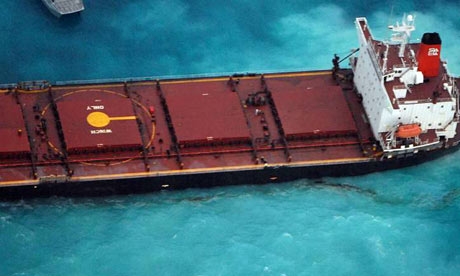
If the rapid development of coal-fired power plants in China wasn't enough to piss off the environmental community, the crashing of a Chinese coal-carrier on the Great Barrier Reef certainly won't help.
The ship ran aground late last night and is carrying 72,000 tons of coal, as well as 1000 tons of oil. Some of the oil has started to leak and local officials are very worried that the ship is on the verge of breaking apart. A break could spell significant environmental disaster on one of the world's most fragile ecosystems.
Australia's Great Barrier Reef is in serious danger from climate change, as rising ocean temperatures tend to cause significant coral bleaching, which, if occurring annually, could very well kill the Reef.
For more information on the story, go here.
This has not been a good week for China's coal industry. In addition to the Reef incident and the constant criticism of its coal plants by environmentalists, 153 miners have been trapped inside a coal mine in China for nearly a week.
Despite all the wonderful economic and energy benefits of coal, there sure are many downsides. Hopefully these downsides start to be taken more seriously before it's too late.
Photo: Guardian Newspaper
Wednesday, January 20, 2010
The Importance of Prevention: Lessons from Haiti...

But you are going to have to forgive my forthcoming cynicism.
As inspiring and necessary as the support is, I was left with a sick feeling in my stomach as soon as the media started publishing all sorts of stories about the rapid deployment of disaster relief complemented by a series of politically-opportunistic photo ops. This is both typical and frustrating, but not my main point of contention. My greater concern is how the world approaches Haiti and its disaster, and more broadly, how we approach the prevention of disasters.
(I will preface this by saying I am by no means an expert on Haiti nor an expert on international development, but have a relatively decent grasp of both subjects). Haiti has been falling apart for decades, if not centuries. Even prior to the disaster, it was among the most impoverished countries in the world with outrageously high rates of infant mortality and disease. A series of brutal dictatorships, coups and interference from influential foreign powers have left the country in political ruin for years and consistently ranks near the top of the world's most corrupt countries. There is very little money for the majority of citizens and the physical infrastructure (roads, well-built houses, emergency services) throughout the country is awful.
And how has the world helped? Some countries have thrown money at them and expected great things, although the success of purely financial foreign aid is far from high. Basically, we turn a blind eye.
But when the country physically starts to fall apart, we run in like the white knight without even thinking about it. Governments throughout the world are pledging hundreds of millions of dollars in support and sending in their militaries to help out as soon as possible. Different workplaces are collecting money to donate and even professional sports leagues like the NHL are reaching into their pockets to help out. I just walked by a booth at Trent where a bake sale is being put on the help quake victims. Again, this is touching and it is nice to see all sorts of people helping out.
But there is only so much help all of this can do right now. Much of the aid can't even get into the country at this point and some donation groups have even been swindling the folks who have trusted them with their money.
As great as all the support is, it could have been considerably more effective if used to prevent much of the devastation rather than clean it up. True, as a friend pointed out to me, you can't predict the future. But natural disasters often wreak similar havoc. The damage may not have been much more different had it been a massive hurricane or flood.
The infrastructure is particularly important. A reporter on the CBC was comparing the damage to that seen in L'Aquila, Italy recently from another strong earthquake. But unlike there, where the buildings were modestly strong and emergency services could easily get to the sites, Haiti's buildings are weak and domestic emergency services essentially non-existent.

Moreover, the amount of support coming in from members of the public is important, but how many of these people really cared about Haiti prior to the quake? Would they have been as willing to stand in the halls selling baked goods if you told them the proceeds might one day prevent such a high level of devastation? Or does the actual event have to take place before people care?
I should also make it clear that my use of prevention is to describe preventing such a high level of devastation. Indeed, you can't prevent an earthquake, and with one of such magnitude, there is inevitably going to be damage, but the amount of damage could have been reduced significantly.
The problem with only helping out once the damage is done is that it is often considerably less effective overall. And it is more expensive. How much do you think it'll really cost to return Haiti to its former self prior to the quake? And how expensive has the entire disaster relief effort been? It certainly isn't cheap and it certainly isn't any cheaper than what might have been needed to prevent such tragedy.
So why is this appearing in an environmentally-related blog?
Because if the climate scientists are right, natural disasters are going to get more frequent and more powerful as the planet warms. True, climate change won't influence earthquakes, but as I said earlier, natural disasters often wreak havoc in a similar fashion. How many more Haitis could we prevent over the next 100 years if we thought about this properly and invested in prevention rather than the clean up?
More broadly, our entire approach to climate change and the environment is centred around this phenomenon. We spend years trying to figure out where to put our waste rather thinking about how to reduce the production of it. If we don't do enough to prevent the damages we're bringing upon ourselves, we could all be screwed. After all, there comes a point when it's impossible to clean up.
Subscribe to:
Posts (Atom)