Showing posts with label Public Policy. Show all posts

Saturday, December 10, 2011

The return of the e-waste discussion

Image credit: veracitystew.com

It has been a while since Enviro Boys has written about the topic of e-waste, or waste management more generally. Like all environmental problems, this one is complicated.

Elisabeth Rosenthal from the NY Times Green Blog reports:

"When Americans turn in their old car batteries for recycling, they probably think they are doing good for the planet. And done well, recycling batteries is certainly environmentally responsible, since lead mining and processing cause far greater emissions of carbon dioxide than extracting lead from old car batteries for re-use."

More:

"But my article from Mexico should remind us that recycling can be “green” or not, depending on how it is done. That is particularly true of electronic waste, including batteries, where one goal of the recycling process is to extract precious metals. In much of the world, recycling is a big business with ties to gangs and organized crime. That is often the case with lead battery recycling plants in Mexico, that country’s officials told me".

I wrote about this topic of couple of years ago. E-waste is electronic waste in the form of batteries, computers and other electronics that are exported from one country to another for informal recycling processes.

My quick assessment pointed to how the US has not signed the Basel Convention on the Control of Transboundary Movements of Hazardous Wastes and Their Disposal. Worse yet, the Resource Conservation and Recovery Act of the US gives the country authority and control over hazardous and toxic wastes.

E-waste is simply a part of the US's waste disposal strategy. These policies surreptitiously cover up their inherent problems, because they appear to be designed to promote E-waste but in actuality, such waste can end up countries such as Mexico (as reported by Elisabeth Rosenthal). E-waste is also a problem within southeast and east Asia causing pollution and serious ecological harm. See here for the article. While the US is guilty, I am sure Canada is just as bad but alas, the lack of transparency with its waste disposal, make it difficult to know where our car batteries end up, for example.

E-waste is a tricky problem. There have been many recommendations made to nation states on how to deal with this problem. Rosenthal concludes with:

"The government could simply ban used battery exports, as Slab Watchdog suggests. Or it could require that Mexican factories processing used batteries from the United States meet our environmental standards and undergo inspections. The Food and Drug Administration inspects foreign factories that make drugs imported into the United States. The Environmental Protection Agency could take on a similar role for battery recycling plants".

You can read the full story of recycling American car batteries in Mexico here.

Saturday, October 29, 2011

Cap and trade in California

A recent article by James Tansey from the Tyee reports that:

"The ARB (California Air Resources Board) voted unanimously on Friday to approve the final regulations that will create the second largest carbon market in the world, beginning in 2013. While the U.S. Federal government's interest in climate policy has declined, California, still the world's seventh largest economy, will implement a cap and trade scheme that represents the most significant issue in U.S. climate policy since the Kyoto Protocol".

This evidently puts pressure on British Columbia to be more committed to the Western Climate Initiative.

"While British Columbia's interest in climate policy was affirmed by the premier earlier in 2011, the government's commitment to the WCI is currently subject to an economic impacts review; often in government this kind of study is the earliest sign of a retreat from a policy position".

This bold move by California (a state that has had tremendous financial hardship through its budget crisis), marks a sense of commitment and leadership to climate policy. Whether other U.S. states follow in a time when the economy dominates every political discussion is unlikely. However, BC has and should consider its commitment to the WCI, not least for a province that ostensibly prides itself on green initiatives like the carbon tax (which I think needs to be reformed) but for a great opportunity to harness the enthusiasm from down south to move forward on climate policy.

Monday, August 8, 2011

Flood zones and homeowner behaviour

This article from the NY Times presents a story of a community in South Dakota that is prone to flooding. Of course, residents and developers alike, aware of the flood risks in the first place, dismissed them in order to reap the benefits of living in a barren peninsula at the intersection of two rivers complete with million-dollar homes and a private golf course.

"They call it “the Dunes” for a reason, the warning went — the rivers put the sand there, and the rivers could sweep it away. But, much like the developers, the new residents were not worried. A few even paid a premium to be closest to the flowing water of the Missouri and the Big Sioux.

Now, a little more than two decades later, the stately homes on Spyglass Circle and Pebble Beach Drive have been evacuated and the 18th hole is under six feet of water, as miles of newly built levees strain to keep this community from surrendering to a historic flood".

“Most people don’t understand what flood risk is,” said Gerry Galloway, a civil engineering professor at the University of Maryland who has written extensively about his concerns. “They assume that if there is some level of protection like a levee or an upstream dam, they’re safe. As a general rule, public officials don’t like to dissuade them of that fact.”

This is a classic problem and often comes up in climate change adaptation research. First, people instill a lot of trust in engineering facilities such as levees or dikes instead of taking personal responsibility to protect their own homes or not live in these flood prone areas in the first place. Thus their perception of safety is based on infrastructural investments that are not even designed to account for frequent and strong floods in the first place.  I wouldn't blame the people though, much of this stems from bad policy.

In Matt Kahn's Climatopolis, he discusses the idea of the land assembly problem which is relevant to the story from the NY Times:

"An example comes from the state of Missouri where some local governments encourage developers to develop on high risk flood plains. This so-called "land assembly problem" allows developers to build on really cheap land in flood prone areas and make huge profits. The local government is excited about the new tax revenue and the job creation that accompany these projects. Alas, when floods happen in that state the federal government comes in a bails out the developer with tax payers' money because they were foolish enough in the first place to build in risky areas".

The second problem:

"As the years passed, those who dismissed a flood as unlikely started talking about it almost as an impossibility. Most residents dropped their flood insurance; only 172 homes in the entire county now carry it, backing studies that found that homeowners typically dropped the insurance after several dry years.

After about a decade, concerns about the less predictable Big Sioux prompted the construction of a levee, which led the government to reduce the flood risk for another 160 lots — removing the flood insurance requirement and making them easier to sell" (NY Times)

The problem above stems from the U.S. National Flood Insurance Program (which covers more than $1.2 trillion of assets today).

Monday, July 25, 2011

Why banning light bulbs is bad policy

Check out Virginia Postrel's article on why banning light bulbs is bad policy. In December 2007, the U.S. federal government enacted the Energy Independence and Security Act of 2007, which requires all general-purpose light bulbs that produce 310–2600 lumens of light to be 30% more energy efficient (similar to current halogen lamps) than then-current incandescent bulbs by 2012 to 2014. The efficiency standards will start with 100-watt bulbs in January 2012 and end with 40-watt bulbs in January 2014. More here.

Here are some of here points:

"Banning light bulbs is one of the least efficient ways imaginable to attack those problems. A lamp using power from a clean source is treated the same as a lamp using power from a dirty source. A ban gives electricity producers no incentive to reduce emissions".

"Nor does it allow households to make choices about how best to conserve electricity. A well-designed policy would allow different people to make different tradeoffs among different uses to produce the most happiness (“utility” in econ-speak) for a given amount of power. Maybe I want to burn a lot of incandescent bulbs but dry my clothes outdoors and keep the air conditioner off. Maybe I want to read by warm golden light instead of watching a giant plasma TV".

More here.

Friday, June 24, 2011

Water's connection to climate change adaptation

This summer I have been working as an intern with the Adaptation to Climate Change Team (ACT) based out of Simon Fraser University's Public Policy School

"ACT is a five-year series of six-month sessions on top-of-mind climate change issues that brings leading experts from around the world together with industry, community and government decision-makers to explore the risks and generate recommendations for sustainable adaptation".

Among many of the climate change topic areas (biodiversity, energy, extreme weather), I have had the fortune of working on the water session. This particular session focuses on water governance and water policy in Canada and how our governments (municipal, provincial and federal) can start working toward policy that is based on adaptation to climate change. Certain places have been more progressive than others - my job is to investigate why and how such critical lessons can be applied across the country.

What does adaptation mean, exactly? Well, in the climate change world, there are two really popular words that are thrown around; these include "mitigation" and "adaptation". Both words became quite popular when British economist Nicholas Stern released his 700 page report on the economics of climate change in October 2006.

In short, Stern argued that we can mitigate greenhouse gas emissions through policies that support the development of a range of low-carbon and high-efficiency technologies. Further, we could use economic instruments such as carbon pricing, taxes and cap-and-trade to alleviate emissions. Adaptation by contrast (which has been less popular but is now emerging) is an approach where institutions can invest in technologies, systems and ideas that help us prepare for the impacts of climate change. These adaptation solutions are diverse but can be as simple as more efficient air conditioners that alleviate the impacts of heat waves, or floatable homes that, in the event of a flood, do not sink or lose their structural integrity. For those who are interested in the economics of climate change adaptation, please read Matt Kahn's Climatopolis.

Enviro Boys has written about adaptation in the past and will continue to do in the future given the salience of climate change. But from a water perspective, and based on what I am learning through my work, adaptation strategies such as water conservation or natural flood control tactics, while having higher upfront investment costs, the benefits and future returns on lessening the impacts of droughts, floods or even heat waves can be immense. In addition, getting people to think about the impacts of climate change can foster a collective and community oriented approach where groups think of creative solutions and where businesses and entrepreneurs start to innovate in response to the demand created.

More to come on how governments in Canada are thinking about this and what the opportunities are from a water policy and governance perspective.

Friday, December 31, 2010

HSR in Canada?

A recent article from CTV news titled "Trainwreck: Canada's high-speed rail failure" provides a detailed summary of the current debate surrounding high speed rail in Canada. Here is a quick refresher on the benefits of HSR (courtesy of the article):

  • They're fast. Japanese and French high-speed trains have both reached mind-boggling speeds of over 575 km/h. The Chinese, who are quickly becoming a leader in high-speed rail, had a recent test of a passenger train that hit 486 km/h on a soon-to-be-opened link between Shanghai and Beijing.
  • Dedicated high-speed rail lines are ridiculously efficient -- at least in Japan. Officials there point out that trains are punctual down-to-the-minute, even with 300 million riders a year.

  • They're safe. There has not been a single fatality in either the Japanese or French system. An average of seven Canadians die in road accidents every day.
  • Environmentally, there is no better way to move a large amount of people, unless someone builds a really, big bike.
  • Major economic benefits. Study after study says high-speed rail creates significant numbers of permanent jobs and massive residual benefits. An Alberta government report suggested a Calgary-Edmonton high-speed line could be worth $33 billion to the economy.
  • Canada has the home-grown expertise in a company such as Bombardier.
While I recognize the drawbacks and limitations of HSR, I don't think it's worth criticizing this transport mode right now when they are starting to be recognized as a sustainable transportation solution. There is no shortage of ideas on how we can make HSR feasible and operational in Canada, or North America more broadly. My friend Leonard, shared a great idea on this blog a few weeks ago on how we can make progress on the HSR front. Alas, money and budget constraints often limit funds for sustainable and innovative infrastructure projects like HSR lines.

Many HSR proponents do not advocate for a national HSR line in Canada. That would be too expensive and impractical considering the geography and low population density of this country. The two corridors in Canada that would be suitable for an HSR line include Calgary-Edmonton and the Quebec-Windsor corridor, where half of Canada's population lives.

Jeff Casello, a prof of transportation planning and engineering at U of Waterloo, says "the capacity of Toronto's Lester B. Pearson Airport and Highway 401 is maxed out, making high-speed rail an attractive alternative. I think there's very strong consideration on the (Quebec-Windsor corridor) considering the limits on Pearson and its ability to handle any more traffic and the unwillingness to invest in widening the 401. There's realization that there needs to be some redundancy in our transportation network, so we can't rely on a single mode to satisfy all our transportation needs".

Read more here.

Tuesday, December 21, 2010

Guest Entry: How can HSR gain speed and momentum in North America?

By: Leonard Machler

Infrastructure inflation has caught up with us, and we are starting to get used to billion dollar projects being thrown around with the casualness that we used to reserve for bus stops and phone booths. And even though high speed rail (HSR) may cost less than expanding airport and freeway capacity – with the added benefit that it provides a transportation alternative that is more environmentally friendly and that is meant to stimulate development in dense, walkable downtowns, the cost of HSR still represents a significant chunk of change.

The California High Speed rail system is estimated – at a minimum – to cost around $40 billion dollars; upgrading the Northeast Corridor of the United States for 300 km/h operation has been pegged at $117 billion. To compare, this figure is about the same as the total economic output of the Ukraine last year. Even if high speed rail in the US was not a political hot potato, it would be hard for any government to scrounge up that kind of cash. To compensate, governments, such as the Obama administration, contribute toward the project incrementally by providing “small” funding commitments.

This year, roughly $1.4 billion (including $624 million that had been allocated to Wisconsin, but turned down by a newly-elected Republican governor) was earmarked for the California High Speed Rail (HSR) project. In 2009, $2.3 billion was allocated to the California HSR program. At this rate, it will take over 20 years to fund the project in full, so the California HSR authority has proposed building a segment of the line between the two Central Valley cities of Fresno and Hanford. While not so small that they can’t be found on a map, connecting these two towns with a high speed rail line hardly has the cachet as a link between San Francisco and Los Angeles. Predictably, critics have derided this first segment as a line between nowhere and nowhere.

On the one hand, they are off base: the segment has to be built eventually, so why not now? Moreover, the short line would serve as a handy test track to evaluate the performance of high speed trains before they see regular service. On the other hand, the fact that it will be used as a test track for nearly a decade before regular service begins is a political high-wire act because almost nobody other than industry insiders will see the public benefits (i.e. trains that people can actually ride on) for this project. For the average voter, the line will not just be a train from nowhere to nowhere, it will be a line from nowhere to nowhere with no trains on it. Did it have to be this way? Are we doomed to wait an eternity until enough cash trickles in so that we can build a line people can actually use?

Most European countries have a different attitude. They would use the partial funding to build a short high speed line – similar to the Hanford-Fresno demonstration line – and then run the remainder of the service on conventional track. This way the public gets high speed rail service from day one and, over time, services and speeds improve as an increasing amount of high speed track comes on line.

This was how I remember the evolution of high speed rail in Germany. When I first used the system as a kid in the early 90s, only a handful of sections – usually meant to bypass especially slow or built up areas – were actually genuine high speed rail lines. Most other times, the ICE train would plod along the old rail line, bypassing freights and slower passenger trains at a comparatively “slow” 160 km/h. As the years went by, the ICE would spend less of its time dodging freight trains on the old tracks and more of its time speeding through the German countryside in its own dedicated high speed line.

It’s time for California and other North American jurisdictions to try a similar approach. The high speed line in the Central Valley should be built for demonstration purposes, as is the plan, but conventional trains should be allowed to use it – at least until the full HSR line is built out. Granted, track conditions in Germany – even on old, conventional lines – are better than pretty much anything that exists in North America today and are also electrified for higher speed too. California could use the earmark from the next two years to upgrade the existing track between San Francisco and Los Angeles* to support at least some quasi high speed service using conventional passenger trains, while taking advantage of the short high speed segment in the Central Valley.

Running conventional trains at higher speeds along incrementally longer stretches of high speed rail is not as sexy as a bullet train whisking passengers along a fully built-out line, but at least it has the chance of seeing the light of day sometime this decade. More importantly, it provides taxpayers with the impression that the line is immediately useful. As they say, it’s not perfect, but at least it’s a start.

Leonard Machler is a PhD student in the School of Community and Regional Planning at UBC. He is a transportation enthusiast and is a strong advocate for more sustainable and accessible urban transportation systems.

*For a rail map comparing trips statistics (airplane, HSR and car) between San Francisco and Los Angeles, click here.*

Friday, August 27, 2010

Would you support a driveway tax?

News from the Kansas City Star reports that the City Council of Mission, Kansas, has approved a driveway tax.

A driveway tax is simply a fee that charges you based on how much traffic your property produces. Currently in Mission, Kansas, sales and property taxes raise revenue to finance roads. Alas, such revenue has not been sufficient enough to maintain the roads. With the tax, households and businesses are going to share a larger financial burden - the fee is expected to raise $1.2 million a year to help finance $38 million in road improvements during the next 10 years.

"The City Council on Wednesday night approved a new fee charging every homeowner $72 a year and small businesses $3,558 a year beginning in December".

Engineers have calculated that a single-family home generates about 9 1/2 vehicle trips a day. Target Store (virtually ubiquitous across America) generates about 8,500 trips a day. McDonald’s is predicted to produce 2,700 trips.

A driveway tax is not common in the U.S. In fact, the only state that has been progressive with such a tax is Oregon. 18 cities in Oregon have adopted it. This comes at no surprise considering Oregon is more green and progressive in its thinking.

As you could imagine, the newly passed tax has witnessed negative reactions from the business community. Unsurprisingly, they are concerned that in a time when the economy is recovering, the tax would simply hurt small businesses.

Like London's Congestion Charge Zone, these sort of eco-taxes are always jurisdiction dependent; what works in one city might not work in another. A driveway tax may be appropriate for Mission considering that roads there are deteriorating and someone has to pay for them. I agree with Felix Salmon's assessment of this, it is similar to my argument of the BC carbon tax being too low. In short, if a driveway tax is introduced in your city, it should be set at a rate that can actually change behaviour. The formulas predict that the tax will cost 2 cents per trip; that is way too low to bring about any meaningful reduction in driving.

The driveway tax for homeowners in Mission will be $72. This is irrespective of how many trips you do in a day. Thus it is a uniform rate which is problematic because it discriminates against those who drive less, those who bike, take public transit or walk to their final destination. It is understood that the city needs revenue to ameliorate their streets, but those who drive more (produce more traffic from their property) should pay more. It is unfair to discriminate against those who take greener methods of transport.

Those who do take greener methods should be guaranteed some sort of incentive to encourage the continuation of sustainable transport and change behaviour of current motorists. This way, revenue is still being collected while simultaneously changing behaviour and getting people to think about the environment.

Key message
: The next decade will see even more green taxes. It's 2010, times are changing and we are going to have to adapt. Creating a win-win for the environment and the economy will require full participation of citizens; this can eventually lead to sustainable urban solutions.

Tuesday, August 17, 2010

Tolling Cross-Harbour Tunnels in Hong Kong

has become a hot issue lately. Specifically, the Western Harbour Crossing –one of Hong Kong’s three Victoria Harbour crossing tunnels-- is increasing its toll rate.

“Fees for private cars, taxis, and light buses using the Western Harbor Tunnel (WHT) will increase HK$5 to HK$50, HK$45, and HK$60 respectively, and single-decked buses and double-decked buses will each see HK$10 and HK$13 toll rises”

“The company faces increasing operating costs and need to raise sufficient cash flow to repay debts and earn a reasonable return. To ensure continuous viability, the company needs to adjust the level of its tolls”.

The Western Harbour Crossing is private, unlike the Cross Habour Tunnel which has been operated by the government since it was built in 1972. What’s the issue? The issue is that all three cross habour tunnels have different toll rates. Instead of discussing the price differences between types of transport modes, I will use “private cars” to illustrate the rate difference:

Eastern Harbour Crossing (private): $25 per car
Cross Harbour Tunnel (CHT): $20 per car
Western Harbour Crossing (private): $50 per car

For more info see here.

Which one do you think has the highest usage? You probably guessed correctly, the CHT. I live fairly close to the tunnel and have witnessed the egregious traffic congestion. Indeed, its capacity is 78,500 and it has over 120,000 cars passing through it everyday. The Western Harbour Crossing has about 50,000 cars go through it everyday and a capacity of 118, 000.

From reading the newspaper it is quite evident that the public is not content with the toll increase. They argue that it is already too high and hence why the western tunnel is severely underused. Given that the CHT is used the most –because it is the most central, convenient and cheapest—the City needs to figure out a way to redistribute traffic to increase efficiency and alleviate the pollution problem associated with idling cars around the CHT. The government could also choose not to intervene and let the market take care of itself. Overtime, it’s possible that people will adjust and start using the western tunnel because of their frustration with congestion and long-waiting times at the CHT.

But, a toll increase could risk even fewer cars using the tunnel. Usually, if you want to increase demand and usage of a road/tunnel, you lower the price, not increase it. There have been many solutions put forward by HK citizens. The one that makes the most sense is a peak hour tolling system for the CHT. In short, the busiest hours in the morning and evening would have a higher toll rate simply for the purpose of decreasing traffic congestion. Despite Hong Kong's impressive public transit system, there are still a lot of cars on the road. While peak hour pricing may seem like a progressive idea, it certainly has merit and could complement Hong Kong’s sustainable development goals.

We need to keep three things in mind (or more) when we talk about tolls. 1) Prices must be adjusted to maintain an optimum speed for reducing pollution. Intense traffic congestion at the CHT means long line-ups of cars and a greater concentration of pollution. 2) Drivers using the shortest and most convenient route should pay for the privilege. As mentioned, the CHT is the most convenient because it is centralized; thus it should definitely be priced accordingly. 3) Extra revenue from the increased tolls could be used for the replacement of new buses with cleaner fuel or to subsidize private tunnels like the western tunnel to help with traffic redistribution.

Last, toll increases also risk fare increases for taxis and mini-buses. These methods of public transport also use the cross harbour tunnels. Thus, toll increases produce ripple effects that could be mitigated with some sense of progressive imagination.

Key message: Hong Kong has three cross harbour tunnels that have different toll rates. They also have drastically different rates of usage. Introduce peak hour pricing for the most congested cross harbour tunnel as an experiment to see what happens.

Monday, July 19, 2010

Could green energy take a hit from Ontario's government probe?

The Ontario government is in trouble. Again.

The Ontario Provincial Police is conducting a criminal investigation in some dirty business dealings between public sector staff and private sector firms. The public sector staff in question belong to the Ontario Realty Corporation, a corporation that lies under the authority of the Ministry of Energy & Infrastructure.

Uh oh. For proponents of green energy in Ontario, this could be worrying. A friend of mine, SH, posits that if any of the alleged improper business dealings are focused on the province's renewable energy program, the whole green energy movement in Ontario could be sunk beyond repair.

There is a chance that renewable energy could be involved. The government has given plenty of exclusive renewable deals to major private firms, most notably Samsung. The rhetorical push for community energy has not been followed by approvals for such projects, while private sector firms are receiving everything they need. These events have pissed off a lot of people. But have they been illegal? Time will tell.

If so, it is likely that green energy in Ontario would take a massive hit. The streamlining of approvals, reduction of effective public participation and the provincial supersession of municipal authority under the Green Energy Act have triggered opposition exponentially. Try to find an area in rural Ontario where opposition to a wind farm is not strong. Politically, the Progressive Conservatives have called for a moratorium on wind turbine development.

As ambitious as the government's program is, it has done much to help their popularity. This is far from the government's only concern. People are already angry about the HST, the deficit, scandals at E-Health and OLG and a plethora of different issues. Even other green programs have taken a hit, most recently the new Eco Fee, resulting in the government and Stewardship Ontario pointing fingers at one another.

Let's hope that green energy isn't involved in another government scandal, especially a criminal one.

Wednesday, May 5, 2010

Some thoughts on “Save Transit City”


I returned to Toronto last week and I've already used the public transit system a number of times. There are “save transit city” posters found (in great numbers) in subways, buses and subway stations. Indeed, they are ubiquitous. Save transit city is a Toronto Transit Commission (TTC) initiative putting pressure on the Provincial government to follow through with its promise to fund and expand Toronto’s public transit services. Such public transit expansion includes a number of Light-Rail Transit and rapid transit routes around the city. Alas, billions of dollars (the specifics can be found on their website) have been put on hold due to budgetary constraints and fiscal issues from the Ontario government.

I think the save transit city ad says it really well: “Public Transit is the lifeblood of our city. Torontonians use transit to get to work, social functions, to run errands and attend appointments. Our buses, while good for short trips, are full and overflowing. People in large parts of this city spend hours every day on the TTC.” This message in short, translates into the need for a more efficient public transit system to accommodate for increasing ridership and to limit automobility. Transit City cannot go forward without the Province's funding. We seem extremely reliant on the provincial government don't we?

The time for public transit renewal and revitalization is now! However, funding limitations are ever so problematic for the City of Toronto. What should Toronto do?

While the Province is an indispensable player when it comes to partially financing municipal services and projects, Toronto must be a little more innovative and self-reliant in utilizing policy tools to raise revenue for its public transit system. Specifically, Toronto should turn to electronic road pricing and highway tolls for its congested and overly used Don Valley Parkway (DVP). The DVP (only 15 KM in length) is a highly popular and well used municipal expressway in the city. As the busiest road in the city (carries ~200,000 vehicles a day), it is a perfect target for expressway toll implementation.

Yes it is true, a highway toll for the DVP is an old idea which has been vehemently contested by citizens and politicians, but now, a toll would be well justified especially in an era where public transit ridership has increased and when public transit desperately needs funding.

Designing such a toll for the DVP would require good systematic analysis probably combining the expertise of an inter-professional group composed of economists, civil engineers and planners. All of the DVP’s entry points (401, York Mills, Lawrence, Eglinton etc) would require an electronic tolling system using precision equipment aligned with lasers to take images of a vehicle's licence plate when it enters the DVP and when it leaves. The motorist would be subsequently billed based on the number of kilometers traveled on the DVP.

Let’s do some basic arithmetic:

Let’s say 10,000 cars enter the DVP from Highway 401. To keep the math basic (and to illustrate my point) let’s assume all of these cars travel from the 401 & DVP and exit the DVP at Queen St. This is roughly 9 kilometers. Let’s assume that the toll rate is 75 cents/km.

75 cents x 9 kilomters = $6.75 per car.
10,000 cars x $6.75 = $67,500

Therefore, under this system, the city could raise at least $67,500 per day based on a toll system from only 10,000 cars. The tolls and pricing can be way more sophisticated if need be, based on vehicle size, rush hour times, heavy zones, light zones etc. Check out the Ontario Highway 407 for its highly innovative toll system.

There are so many possibilities here. This is just one idea. Oh and by the way, the DVP would be a great first step in terms of expressway tolls. The 401 is also very congested but the 401, unlike the DVP, is a much longer highway corridor and would face stiff opposition.

Key message: Either way, establishing tolls on the DVP is a step in the right direction. It is self-sufficient (less reliance on the province), the city can significantly reduce congestion on its busiest road, reduce air pollution and most importantly, Toronto could allocate a percentage of the revenue raised from this initiative to Transit City and other public transit projects.

Photo Credit: http://en.wikipedia.org/wiki/File:Don_Valley_Parkway_%281%29.jpg

Green Cities: Peterborough looks to ban the sale of bottled water...

It's about to get more difficult to find bottled water in Peterborough.

The Peterborough City Council voted unanimously on Monday evening to begin the transition towards a ban on the sale of bottled water in municipally owned facilities. The ban, however, will not take full and complete effect for a few years as contracts with service providers at some of the larger buildings, such as the city's main arena, still allow them to sell bottled water. 

This is big. Although there has been quite a bit of talk all over Ontario about municipal bans, only a few have actually been carried out. And what is perhaps more impressive is the unanimity with which the decision was passed. Decisions of such magnitude tend to inspire debate and disagreement within councils, especially when sharing a similar context to Peterborough:

Like any Ontario municipality, Peterborough is solely responsible for carrying out its waste management services and does not rely on the province to help out. Since these services are not cheap and municipal governments -- like any government -- are not particularly fond of raising taxes, they can use all the help they can get, which is what a major bottled water company offered Peterborough. Nestle, after outlining the risks of obesity and preaching the health benefits of bottled water over other beverages, offered to contribute to Peterborough's recycling program if it didn't go ahead with the ban.

Turning down such an incentive is hard to do. You would expect at least some members of city council to vote against the ban, but instead there was an overwhelming level of support for the ban from council. Indeed, councillors cited the environmental impact of bottled water, the negative move towards privatization and the need to encourage the use of municipal tap water.

Unfortunately, I'm out of the city and unable to gauge the reaction to the decision, but I'm certainly happy to see the city take such leadership. You can imagine that Nestle isn't too happy, but I'm sure they can see the writing on the wall. 

Hopefully this move will add to the movement to ban bottled water in other Canadian regions and even other areas of Peterborough. There is a growing movement at Trent University to have the sale of bottled water banned on campus. The movement has gathered some opposition, particularly from Aramark -- the food service provider on campus -- and a student group in support of bottled water. Aramark's opposition is unsurprising, but opposition from a student group? At granola-munching Trent?

The group's main argument is that a ban on bottled water eliminates consumer choice. Interesting that it has taken side with Aramark, which has a monopoly on food distribution at Trent. After all, nothing says consumer choice like a monopoly. Oh wait...          

Sunday, April 25, 2010

Is Ontario quietly walking away from its renewable energy targets?

Ontario is driving the country's most ambitious renewable energy incentive program; its Feed-In Tariff that came as part of the landmark Green Energy Act. As with any ambitious government policy, equally ambitious targets accompany the program itself.

Several months ago I came across Ontario's new renewable energy targets under its FIT program and found them to be well beyond anything I had seen before. Ontario had committed to 15,000 MW of new renewable energy by 2025 and even hoped to exceed the targets. To put that in context, its current generating capacity is roughly 35,000 MW, primarily made up of nuclear, gas, coal and hydro.

Because solar projects are not usually very large and relatively few biogas projects are developed, most of the 15,000 MW would come from wind and hydro projects. Now, to be clear, 15,000 MW of hydro projects would produce a lot more electricity than 15,000 MW of wind projects because the wind doesn't blow all the time. But if even a third of that target is met by wind, it would mean a minimum of 2,500 new wind turbines scattered throughout the province. Regardless of whether or not you think that's a good thing, that is an immense number of turbines. It's actually more than you'd find all over Canada, Ontario currently included.

But I came across something very curious the other day. While looking to confirm those targets for my Honours Thesis, they were nowhere to be found. The government website I had used before was no longer available and a thorough review of the government's different department/agency websites (the Ministry of Energy, Ministry of Natural Resources, Ontario Power Authority) brought up nothing.

Instead, the only solid numbers I could find were estimates of job creation and what Ontario has already done since October. In thinking I was perhaps going a little crazy, I went in search of these targets elsewhere. Luckily, I was able to find a few sites (here, here and here) that made reference to the government announcement of the targets.

Why these targets aren't available is quite a mystery. It is, of course, possible that I am simply too daft to find them, but I find it unlikely. At this point I won't begin to speculate further, but I feel that it might be appropriate to follow up on it.

I'll try to keep people updated...

Friday, April 16, 2010

A Proposed International Convention on Water...

This semester, Chris and I took a course called Global Environmental Policy. A large part of the course was focused on researching and becoming an expert on an international convention. Our classmates became experts on conventions such as the Basel Convention of Transboundary Movements of Hazardous Wastes and their Disposal and the Convention on International Trade in Endangered Species just to name a few. There were a diverse range of conventions presented in our class which illustrated the course's interdisciplinarity and the great mix of research interests. Most of our classmates did their research on an existing convention and provided their own critiques, analysis and recommendations.

Chris and I took a different approach. We decided to explore and create our own convention on water. A convention on water would be a multidisciplinary forum for dealing with a wide range of issues including water governance, water pricing, distribution and access, treatment and much more. Initially, we we were interested in exploring the possibility of an international convention on water as a human right. Our approach however, changed overtime as we realized the complexity and multidisciplinarity of water resources.

Managing water, for example, involves (or should involve) many different stakeholders including civil engineers, politicians, planners, economists and environmental scientists to name a few. The private sector is also very much involved in water resources management.

Over the past four months, Chris and I have learned a lot about the politics, economics, management, ecology and societal aspects of water resources. We wrote a ministerial brief (a component of the course) addressed to various Canadian and Provincial government ministries.

In our brief, we highlight the main issue at stake and provide recommendations on how Canada can respond to water policy both domestically and internationally. Importantly, we provide analysis and some direction for the government and its potential involvement in an international convention on water. To view our ministerial brief, please click here.

We also made a class presentation about our convention. One of the recommendations we proposed was derived from an economist named David Zetland from UC Berkeley. In our final class, we called David via teleconferencing and he elaborated on his concept (water as a property right) and students had the chance to ask questions and seek more information about this very relevant and increasingly significant natural resource.

Monday, April 12, 2010

Poll results: The Optimal waste management solution...

The poll results are in. We wanted to take this time to thank everyone for continuing to participate in the weekly polls. It is always fun for us to come up with questions and to see the subsequent results.

The poll question was "what is the most optimal waste management solution to you?"

My city should invest heavily into a composting program 3 (14%)
Implement policy that requires more products to be recyclable 1 (4%)
Make manufacturers more responsible for collecting their products after use 8 (38%)
Make residents pay for every garbage bag of waste they produce 8 (38%)
Send all of our garbage to waste incinerators 0 (0%)
Heavily tax our landfills to encourage conservation 1 (4%)

Total votes = 21

Disposing of municipal solid waste has historically been a challenging responsibility for cities across Canada. Municipal solid waste (MSW) has become an environmental issue pushing political agendas and having multiple implications for public policy decisions. I wrote a multi-criteria analysis on waste management options for a public policy course. It can be accessed here.

"Make manufacturers more responsible for collecting their products after use" and "make residents pay for every garbage bag of waste they produce" were the two popular options in the poll, each with 8 votes. They are both critical waste management options. Making manufactures more responsible is a process known as extended producer responsibility, which we have blogged about before. In short, the industry, not the government, is responsible for internalizing waste management costs in their product prices. The EPR strategy is best epitomized by the Beer Store. All beer bottles that are purchased at the store by the consumer can be sold back to the manufacturer as the Beer Store will re-buy the bottles that they have sold you. Although they buy the bottle back from the consumer at a low cost, it still encourages recycling and reusing.

Making residents pay for each bag of waste is known as a user pay system. Like most user charges (plastic bags for example) the minute you start paying for something, consumers start to think about conservation or simply using less because it saves them money. These are the shifts in behaviour that we need to see for a more sustainable planet.

Sending our garbage to incinerators had no votes. Incineration is a semi-popular waste management option in Canada (although very controversial), it is more widespread in Europe and Japan. Composting programs are expensive but very important. They require a lot of monitoring and enforcement. Landfill taxes are a great instrument, however, it all depends on how the revenue (from the tax) is used. Ideally, most of this revenue should go towards waste diversion programs (recycling, composting etc).

Key message: All of these options have merit. Such options need secured funding (which should be consistent) and the political will! As environmentalists, be sure to pressure your institution, school, city, company and/or organization to consider one of these waste management options. Take the time to gather some information about your preferred option and start raising awareness and advocacy for it.

Friday, April 2, 2010

The five cent charge on plastic bags in Washington D.C.

A number of months ago, I wrote about plastic bag charging in the City of Toronto. As of June 1, 2009 the city passed a by-law requiring all stores under the Canadian Federation of Independent Grocers (CFIG) to bring about a five cent charge on plastic bags. I do not know the specific statistics, but I would imagine that plastic bag use has dropped with the introduction of the charge.

What I do know is that Washington D.C. has been very successful with their plastic bag charging initiative. The five cent disposable bag fee took effect this January 2010 and like Toronto, it received a tonne of opposition off the bat. The Office of Tax and Revenue reported that the city brought in $150,000 in bag fee revenue in the month of January alone! The big question for all of these charging schemes is what you do with the revenue raised from the charge. What the revenue is spent on in Toronto is quite nebulous, ostensibly it goes to "environmental projects".. whatever that means.

In D.C., the $150,000 will go towards cleaning up the Anacostia River. That is a wonderful initiative and it is good to know that D.C. cares about its natural environmental features. In terms of the plastic bags themselves, about 3 million of them were purchased in January, a drop from the average 22.5 million per month that the city is accustomed to.

We know that the rationale of the five cent charge is to induce citizens to change their behaviour to cut down on their use of plastic bags. In general, a user charge can persuade citizens to make the investment in buying reusable bags which are sturdier, compact and can carry a higher volume of groceries. D.C. provides evidence that such a five cent charge has actually been working and has changed consumer behaviour tremendously.

More fascinating to me is the city's inclination to use the revenue on cleaning up the Anacostia River. The river is something that everyone could relate to. It is a natural environmental feature that has only become more polluted and inundated with things like plastic bags. With a clear vision to clean up their own environment, I think we should applaud D.C. for its hitherto successful five cent charge initiative.

Key message: Changing consumer behaviour, getting D.C. residents to think about the river and cutting down on plastic bags are all positive endeavors for the present and for the future.

Sunday, March 21, 2010

Ambitious transit plans in the US...


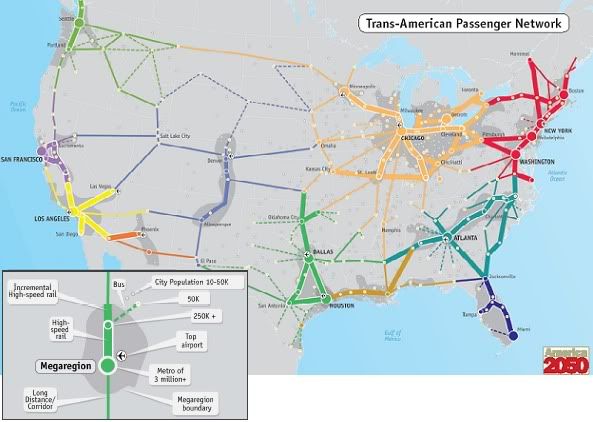
The uncertainties around climate change are forcing countries like the US to invest heavily in transportation infrastructure. This map, courtesy of America 2050, displays the planned Trans American Passenger Network which is a comprehensive inter-city rail network across the United States. There has been a $8 billion down payment made in the American Recovery and Reinvestment Act and $5 billion in Barack Obama's proposed budget towards this.

No matter how long Barack Obama spends on other major federal issues i.e. immigration reform, he has expressed vehement interest in bringing about an extensive passenger rail system which will optimize national transportation flows and efficiencies in America.

Why the pressure to do this? Other than the obvious climate change reason, the US is projected to grow by 140 million people by 2050. This will require massive investments in roads, highways and more importantly, rail networks. Having a Trans-American-Network of national inter-city passenger travel would significantly reduce the need for national flights and alleviate pressure on inter-state highway systems. Both national flights and inter-state highways contribute heavily to the country's greenhouse gas emissions.

So, this plan will provide more travel options for Americans. It is going to require a lot of federal and state investment. This plan recommends that federal investments in inter-city rail be directed towards corridors with the greatest demand for inter-city travel.

It will be interesting to see how this plays out in the US over the next little while. Especially considering the plethora of issues Obama plans on dealing with. For more information, see here.

Friday, March 19, 2010

Travel behaviour...


Before I get into the post, I wanted to wish Chris a happy birthday.

The pie chart to the left is a percentage breakdown of greenhouse gas emissions per sector.

I am doing a lot of reading these days about the relationship between travel behaviour and transportation choices. For example, why do people decide to drive their own vehicles (with only themselves in the vehicle) when they are surrounded by public transit choices, bike paths and carpooling options? There are some obvious reasons for this, but travel behaviour can be a lot more complex than this. Understanding travel behaviour has been a focal point of transportation research. More important, it has been crucial for understanding how we can minimize transportation's impact on climate change.

I was reading a study that looked at the factors influencing the future travel behaviour intentions of young people between 11 and 18 and how climate change considerations affect these. The sample was a group of youth in the U.K. Photography was shown by the researchers to the youth to compare photos between things like traffic congestion, motorists who looked happy while driving and pictures of the natural environment. These photos were used as a trigger for discussion about the environmental impacts of transport.

Results show how these young participants are enthusiastic to drive if provided the opportunity because of the speed, cost-savings, convenience, flexibility and freedom. The youth mentioned how walking and cycling is good for health, but it is an inconvenience. Using a car saves their "personal energy", they think that exercising should be separate from traveling. The sample group identified the importance of the environment and climate change, but said that it would still not deter them from their willingness to drive. Indeed, this was identified as the social dilemma where their own efforts to tackle climate change may be rendered worthless by the inaction of others.

What does this mean for policy? Policymakers need to promote cycling as a signal of success and promoting it as "cool" instead of just the obvious environmental and health benefits. Researchers suggest that society must empower young people in relation to their knowledge of climate change and how to tackle this issue as well as their ability to communicate this knowledge effectively to others.

The authors state that there would be merit in gathering more youth together and providing them with different transport choices, seeing what their choices are and their reasoning. Or, introducing “covered” cycle paths and walkways to protect people from the weather. Researchers suggest that these recommendations might help with changing youth’s perceptions regarding driving and climate change. Also, if there were regulations to enforce travel behaviour change towards more environmentally friendly options, then it could help remove the social dilemma identified by the youth.

As mentioned, climate change has become an overarching issue in the transportation research agenda. By developing a better understanding of travel behaviour, particularly for youth, policymakers will be able to implement measurements that promote a more environmentally friendly transportation system while concomitantly addressing the critical issue of climate change.

Key message: We need to understand how our youth perceive (if they even do) the issue of climate change as it relates to things like driving their family car. When I got my license at 16, I was completely excited to drive whenever and where ever I could. I never thought about the environment. Mind you, climate change has become more of a hot topic since, but we still need to communicate and educate our youth about the significant relationship between driving and its impacts on the planet.

Tuesday, March 9, 2010

No need to salt our roads: Spring is approaching and salt poisons our water…

A geological study from the University of Toronto has found that road salt poses numerous threats to groundwater and water quality. Their research findings come from a study based on Pickering, ON. Pickering is a GTA community relatively close to the 401 highway and a community that has witnessed a lot of suburban growth. Both the 401 and suburban roads use copious amounts of road salt for highway and road safety and to minimize the likelihood of accidents. Alas, in the Pickering context, a lot of this salt has ended up in a nearby watershed called Frenchman’s Bay, a lagoon on the shores of Lake Ontario.

The geologists found that over 3,600 tonnes of road salt end up in Frenchman’s Bay every winter due to direct runoff in creeks and streams. It is no coincidence that the fish population in this lagoon has been declining due to increased levels of salinity. Putting the salinity levels in some context, it is estimated that the lagoon has levels of salt that closely resemble ocean water. Higher levels of salinity simply contaminate the waters and drive the younger fish population away. Younger fish, unlike older fish, do not have the capacity to cope with saline intrusions because they are not used to it.

The impacts of road salt on Pickering's ground and surface water imply a higher than average amount of road salt usage. In Canada, about five million tonnes, or approximately 150 kilograms per Canadian, is used on roads each year to make them safe for travel in winter. A lot of this road salt is applied to roads in Ontario and Quebec.

Where does government intervention fit into all of this? Well, Environment Canada has recognized the “adverse” impacts of salt on wildlife, plants, water, soil etc. In the past, they considered adding road salt to the nation’s list of toxic substances, but... that never happened. Six years ago, the government instituted a “voluntary code of practices” to "encourage municipalities and others to use the de-icer more sparingly", while maintaining highway safety.

It is the province though that is using road salt for the 401 highway, not the municipalities. Plus, communities like Pickering are growing rapidly placing more pressure on local government to salt their roads because it is the most economically sensible way of ensuring road safety.

Voluntary code of practices should not be applied in this particular case. The geological study provides convincing evidence that road salt has negative ramifications for the large Pickering watershed. While other options are currently being reviewed, I think that municipalities must establish regulations that govern the use of road salt to account for their environmental impacts. Quotas must be established until we come up with more sophisticated engineering solutions.

Key message: The use of road salt helps make our roads safer at the expense of contaminating water quality, declining fish populations and wildlife. In an era where we are trying to sensibly integrate public policy with science, we need to find more practical alternatives that benefit society and nature.

Sunday, March 7, 2010

Congestion charging: more than just a few benefits...

Congestion charging is a really fascinating tool used by government; its purpose is usually two-fold: one, to reduce traffic congestion and pollution by charging motorists in certain zones of the city i.e. you drive in the zone, you pay the surcharge. Two, a lot of the revenue made from the charge goes into optimizing public transit systems i.e. subways, Bus Rapid Transit, trams etc.

According to the UK’s Office of National Statistics, people spend about 90 minutes each day traveling (commuting) on average – more time than they spend on childcare, sports, outdoor activities, shopping, social life and eating. If this time could be cut, we could hugely improve our social lives, families and leisure opportunities. Commuting has social and economic costs i.e. huge parking fees in the downtown area and time spent away from family. How do you get more of the middle to upper class to transition from their cars to public transit? Taking public transit can actually reduce commuting times because you avoid egregious highway traffic.

We need to make public transit more sexy in order to get people to use it. Making it sexy requires a lot of capital and financing. Congestion charging can provide the necessary capital to expand transit systems. You can make them accessible to every demographic of the city. Certain neighbourhoods in Manchester, England are totally isolated due to low quality/expensive public transit. This heightens poverty, conflict, racism, alienation and crime.

Public transit is expensive in Manchester because the system is struggling with operating expenses. A congestion charge could certainly provide some flow of capital to the system allowing it to improve in quality and be accessible to the city’s poorest.

Many people are fearful of public transit because it might be dangerous, crowded, noisy, smelly and uncomfortable. These are reasonable concerns that can be alleviated with funding, intelligent design and some creativity. A congestion charge is a smart economic approach for raising revenue because people will still behave (somewhat irrationally) by continuing to drive in congestion charge zones and pay the cost for doing so. Cities can benefit tremendously from such irrationality and secure even more funding for their public transit system. With more money and a few architects and planners on board, cities can really make their public transit services much more appealing.

A congestion charge zone cannot work in every city of the world, but we know it has been successful in London. If it could provide funding for expansion to include the marginalized, provide funding to make the system cleaner, more spacious and comfortable and provide professionals with a chance to minimize their commuting times, then it certainly has some notable benefits.

Key message: Congestion charging has multiple benefits. It may receive poor political acceptability at first, but the possible advantages are plentiful as evidenced in London, Stockholm and Singapore.