Among many of the articles I have read of late, along with hearing from prominent Canadian scientists and environmentalists, the state of Canada's commitment to the environment is eroding very quickly. An article from the Guardian provides some cogent facts:
-Canada's Stephen Harper government is spending more than 60 billion dollars on new military jets and warships while slashing more than 200 million dollars in funding for research and monitoring of the environment
-Some 776 Environment Canada employees have been told their jobs may be terminated. That's 11 percent of the current staff in a government department that has been a favourite target for budget and staff cuts for the past decade, to the point where it was barely functional
-For 34 years, the non-partisan Canadian Environmental Network (RCEN) successfully walked the line between the needs of government and the needs of its more than 650 civil society members. But on Oct. 13, after waiting more than six months for its expected 536,000 dollars in annual funding, the group was informed by letter it would not be coming. Ever.
-If there is a need to reduce the federal budget deficit, why is Canada continuing to give the oil and gas industry 1.4 billion dollars (1.3 billion U.S.) in subsidies every year?
My intention here is not to solely seek out facts that make the federal government look bad; but instead, raise some issues that I feel are quite salient. Making cuts to environmental and climatic research in 2011 sounds absurd to me. Moreover, the continuation of subsidizing an industry -- highly destructive to ecosystems and water supplies to say the least -- will lead Canada to become the world's most heavy GHG emitter. Sounds more backwards than economically productive to me.
Showing posts with label Environmentalism. Show all posts
Showing posts with label Environmentalism. Show all posts
Tuesday, November 22, 2011


Friday, November 4, 2011
David Suzuki on moving forward
Last night, I had the pleasure of hearing David Suzuki speak at a public lecture at UBC. I heard Dr. Suzuki speak four years ago at Trent when his messages then were slightly more pessimistic (and that was pre-global financial crisis).
This time around, the messages, I think, were far more positive and inspiring. I came out of the Chan Centre at UBC feeling optimistic and telling myself that as a planner, a lot of work needs to be done on the ecological, social and political front to advance sustainability in our society.
But it's not just planners that will have a role in this, it's everyone in society who has a vested interest in preserving the ecological systems that support our economies, and those who care about the welfare of future generations. It is the responsibility of everyone in society as this is a collective task. As Marshall Mcluhan put it "There are no passengers on Spaceship Earth. We are all crew".
Here are a few messages from Dr. Suzuki's lecture that I want to share:
1) This time around, he was highly critical of Prime Minister Stephen Harper. Among many of his critiques, he focused on Harper's anti-environmental science mentality as evidenced by the downsizing of Environment Canada through laying off scientists. David thinks this is absurd given the hitherto, well established science on climate change and its impacts to Canada. We need all of the scientists we can at this point to relay the information needed to bring about policies that help Canada adapt to climate change while concomitantly mitigating our emissions.
2) Being tough on carbon emissions means shrinking economic growth? Suzuki was particularly vocal about this one. He criticized Harper for making claims that taking action on climate change will reduce Canada's economic competitiveness. Scandinavian countries, particularly Sweden, have been very effective at cutting down emissions and growing their economy.
Suzuki made note of Sweden's introduction of a carbon tax in the 1990s which helped reduce the country's Co2 emissions by 9% below 1990 levels (thus meeting the Kyoto targets) while growing their economy by over 30%. Thus, there are examples out there of success, political will is the problem.
He argued that developed countries like Canada are so fixated and obsessed with "GDP" that we miss other important aspects of life such as belonging to a community to build relationships, going for walks to enjoy nature, getting to know our neighbours, volunteering, taking time away from work to appreciate other parts of life such as spending time with family. All of these activities are part of our human nature yet GDP does not capture them and thus they become trivial from a economic growth perspective.
3) We need to think about future generations! David was very clear on this one and I found this part of his lecture to be the most inspiring. As a 75 year old with grandchildren, he remarked that it is his grandchildren that keep him going everyday. Thinking about our future children, our future planet and the world they inherit is something that First Nations discuss through the 7 generations model. David told stories about his dad being the most important figure in his life in terms of wisdom, understanding the importance of family and thinking about the next generation.
He talked about living at his same house in Kitsilano for over 30 years and making space for his grandchildren. We need to step back and think about what we really need and want as a society. Do we really need that extra car, Iphone, large television set etc. David challenges us to think carefully about our consumption in light of succeeding generations.
4)
My only criticism of his talk was his rant about cities putting us out of touch with nature. He does have a point about how we used to be farming societies that generally lived within our means and did not consume like the urbanites we are today. However, cities are the future and whether we acknowledge this or not, they are the engines of creativity, talent, opportunity and innovation. As Jane Jacobs put it "the point of cities are multiplicity of choice".
So, I agree with David that nature is often restricted in cities and that's why we need to make more conscious efforts to preserve and promote nature within them (as done masterfully by Vancouver's Stanley Park). Losing connection to nature is what fuels consumption with completel disregard for ecological systems.
I was very happy when I left his lecture - inspired and feeling challenged on how I am going to confront these issues in my lifetime.
Here are some other links about David's life, his ideas and his leadership on such an important topic of our time.
The story of the future has yet to be told
Environmentalism's mistakes and where to go from here
On green energy
This time around, the messages, I think, were far more positive and inspiring. I came out of the Chan Centre at UBC feeling optimistic and telling myself that as a planner, a lot of work needs to be done on the ecological, social and political front to advance sustainability in our society.
But it's not just planners that will have a role in this, it's everyone in society who has a vested interest in preserving the ecological systems that support our economies, and those who care about the welfare of future generations. It is the responsibility of everyone in society as this is a collective task. As Marshall Mcluhan put it "There are no passengers on Spaceship Earth. We are all crew".
Here are a few messages from Dr. Suzuki's lecture that I want to share:
1) This time around, he was highly critical of Prime Minister Stephen Harper. Among many of his critiques, he focused on Harper's anti-environmental science mentality as evidenced by the downsizing of Environment Canada through laying off scientists. David thinks this is absurd given the hitherto, well established science on climate change and its impacts to Canada. We need all of the scientists we can at this point to relay the information needed to bring about policies that help Canada adapt to climate change while concomitantly mitigating our emissions.
2) Being tough on carbon emissions means shrinking economic growth? Suzuki was particularly vocal about this one. He criticized Harper for making claims that taking action on climate change will reduce Canada's economic competitiveness. Scandinavian countries, particularly Sweden, have been very effective at cutting down emissions and growing their economy.
Suzuki made note of Sweden's introduction of a carbon tax in the 1990s which helped reduce the country's Co2 emissions by 9% below 1990 levels (thus meeting the Kyoto targets) while growing their economy by over 30%. Thus, there are examples out there of success, political will is the problem.
He argued that developed countries like Canada are so fixated and obsessed with "GDP" that we miss other important aspects of life such as belonging to a community to build relationships, going for walks to enjoy nature, getting to know our neighbours, volunteering, taking time away from work to appreciate other parts of life such as spending time with family. All of these activities are part of our human nature yet GDP does not capture them and thus they become trivial from a economic growth perspective.
3) We need to think about future generations! David was very clear on this one and I found this part of his lecture to be the most inspiring. As a 75 year old with grandchildren, he remarked that it is his grandchildren that keep him going everyday. Thinking about our future children, our future planet and the world they inherit is something that First Nations discuss through the 7 generations model. David told stories about his dad being the most important figure in his life in terms of wisdom, understanding the importance of family and thinking about the next generation.
He talked about living at his same house in Kitsilano for over 30 years and making space for his grandchildren. We need to step back and think about what we really need and want as a society. Do we really need that extra car, Iphone, large television set etc. David challenges us to think carefully about our consumption in light of succeeding generations.
4)
My only criticism of his talk was his rant about cities putting us out of touch with nature. He does have a point about how we used to be farming societies that generally lived within our means and did not consume like the urbanites we are today. However, cities are the future and whether we acknowledge this or not, they are the engines of creativity, talent, opportunity and innovation. As Jane Jacobs put it "the point of cities are multiplicity of choice".
So, I agree with David that nature is often restricted in cities and that's why we need to make more conscious efforts to preserve and promote nature within them (as done masterfully by Vancouver's Stanley Park). Losing connection to nature is what fuels consumption with completel disregard for ecological systems.
I was very happy when I left his lecture - inspired and feeling challenged on how I am going to confront these issues in my lifetime.
Here are some other links about David's life, his ideas and his leadership on such an important topic of our time.
The story of the future has yet to be told
Environmentalism's mistakes and where to go from here
On green energy
Friday, August 26, 2011
A Case of Baptists and bootleggers?
From the Environmental Economics blog:
"A major environmental group has teamed up with a conservative think tank and others to urge the congressional supercommittee to slash oil, coal, ethanol and nuclear subsidies — a move the groups say would save $380 billion over the next five years.
Friends of the Earth, the Heartland Institute, Public Citizen and Taxpayers for Common Sense released a report Wednesday, dubbed “Green Scissors 2011,” that casts the cuts as benefiting both the environment and the economy.
“While all four groups have different missions, histories, goals and ideas about the role of government, we all agree that we can begin to overcome our nation’s budgetary and environmental woes by tackling spending that is not only wasteful but environmentally harmful,” the groups said in the report."
"A major environmental group has teamed up with a conservative think tank and others to urge the congressional supercommittee to slash oil, coal, ethanol and nuclear subsidies — a move the groups say would save $380 billion over the next five years.
Friends of the Earth, the Heartland Institute, Public Citizen and Taxpayers for Common Sense released a report Wednesday, dubbed “Green Scissors 2011,” that casts the cuts as benefiting both the environment and the economy.
“While all four groups have different missions, histories, goals and ideas about the role of government, we all agree that we can begin to overcome our nation’s budgetary and environmental woes by tackling spending that is not only wasteful but environmentally harmful,” the groups said in the report."
Monday, April 25, 2011
The unintended consequences of environmentalism
This post is about the unintended consequences of environmentalism, something well articulated by Edward Glaeser, author of a recent book called Triumph of the City: How Our Greatest Invention Makes Us Richer, Smarter, Greener, Healthier and Happier.
To begin, Ed Glaeser is one of my favourite urban scholars. He teaches economics at Harvard and has written about cities for a long time. His new book is a great read intended for anyone who loves cities and is curious about how they can/will change in the future as they become even more populated. For anyone wishing to grasp a historical and contemporary overview of how cities have shaped this world, his book is worth a read. The book features a number of cities from the booming IT sector in Bangalore to the ostensible greenery that Manhattan residents practice on a daily basis. The thesis of the book is that cities, if governed well by sensible public policies and institutions, are the world's greatest centres for allowing human beings to interact, innovate, create and live healthy and environmentally friendly lifestyles.
The greenness of cities is one part of Glaeser's book where he writes about how much more green and sustainable cities are than suburbs because urbanites use less electricity. For those statistical geeks out there, the book is full of numbers and impressive facts that illustrate how much more "green" cities are and can be over the much beloved suburban lifestyle that has been pervasive across the U.S. since 1945.
Some facts: the average single family detached home consumes 88 percent more electricity than the average apartment in a five or more unit building. The average suburban household consumes 27 percent more electricity than the average urban household. Electricity consumption is not only higher in suburban environments, but also in humid climates that require copious amounts of air conditioning. When gasoline consumption enters the discussion, things get even more dismal.
So, what about the unintended consequences of environmentalism? The idea here is that certain places in the United States like Houston, have local governments that are much more friendly to developers and pro-growth than other places in Coastal California or the Northeast. California has a more hospitable climate that does not require as much cooling in the summer or heat in the winter. Home heating and air conditioning are energy intensive and can be expensive household items overtime. By contrast, Houston or Atlanta, much more humid by comparison, require more energy for habitability.
Local environmentalists, many times fueled by NIMBYism, are eager to block housing development in the climate friendly areas. Most often, the arguments are for the protection of wildlife and ecosystems that are sensitive to development. These are valid reasons, however, they are often made based on incomplete environmental impact assessments.
"By using ecological arguments to oppose growth, California environmentalists are ensuring that America's carbon footprint will rise, by pushing new housing to less temperate climates".
Given California's more natural climate that minimizes the need for air conditioning and home heating, it is, from a carbon emissions point of view, a much more environmentally friendly place to develop housing than the aforementioned cities. Sadly, growth in places like Santa Clara County (California) has been slow; between 1990 and 2008, the county grew by 17.8 percent, significantly less than the national average. Prices have also remained high in these more climate friendly areas due to limited growth (constrained housing supply, land use restrictions and NIMBYism.
This problem is a fascinating one that should intrigue urban planners. While Glaeser is quick to criticize some aspects of the planning profession, he recognizes that this particular problem is one that warrants more attention and the involvement of planners given our current discussions about cities, suburbs and climate change.
My quick assessment of the conundrum raised by Glaeser is that planners should actually utilize a framework that illustrates the effect of housing on climate change. It's not just a matter of locating housing in more temperate environments, such as coastal California, but also thinking about increasing residential density in places that will have the least impact on carbon emission output. Whether this is Manhattan or San Francisco, both of which are very expensive places, we must consider the full costs of housing including the environmental impact.
To begin, Ed Glaeser is one of my favourite urban scholars. He teaches economics at Harvard and has written about cities for a long time. His new book is a great read intended for anyone who loves cities and is curious about how they can/will change in the future as they become even more populated. For anyone wishing to grasp a historical and contemporary overview of how cities have shaped this world, his book is worth a read. The book features a number of cities from the booming IT sector in Bangalore to the ostensible greenery that Manhattan residents practice on a daily basis. The thesis of the book is that cities, if governed well by sensible public policies and institutions, are the world's greatest centres for allowing human beings to interact, innovate, create and live healthy and environmentally friendly lifestyles.
The greenness of cities is one part of Glaeser's book where he writes about how much more green and sustainable cities are than suburbs because urbanites use less electricity. For those statistical geeks out there, the book is full of numbers and impressive facts that illustrate how much more "green" cities are and can be over the much beloved suburban lifestyle that has been pervasive across the U.S. since 1945.
Some facts: the average single family detached home consumes 88 percent more electricity than the average apartment in a five or more unit building. The average suburban household consumes 27 percent more electricity than the average urban household. Electricity consumption is not only higher in suburban environments, but also in humid climates that require copious amounts of air conditioning. When gasoline consumption enters the discussion, things get even more dismal.
So, what about the unintended consequences of environmentalism? The idea here is that certain places in the United States like Houston, have local governments that are much more friendly to developers and pro-growth than other places in Coastal California or the Northeast. California has a more hospitable climate that does not require as much cooling in the summer or heat in the winter. Home heating and air conditioning are energy intensive and can be expensive household items overtime. By contrast, Houston or Atlanta, much more humid by comparison, require more energy for habitability.
Local environmentalists, many times fueled by NIMBYism, are eager to block housing development in the climate friendly areas. Most often, the arguments are for the protection of wildlife and ecosystems that are sensitive to development. These are valid reasons, however, they are often made based on incomplete environmental impact assessments.
"By using ecological arguments to oppose growth, California environmentalists are ensuring that America's carbon footprint will rise, by pushing new housing to less temperate climates".
Given California's more natural climate that minimizes the need for air conditioning and home heating, it is, from a carbon emissions point of view, a much more environmentally friendly place to develop housing than the aforementioned cities. Sadly, growth in places like Santa Clara County (California) has been slow; between 1990 and 2008, the county grew by 17.8 percent, significantly less than the national average. Prices have also remained high in these more climate friendly areas due to limited growth (constrained housing supply, land use restrictions and NIMBYism.
This problem is a fascinating one that should intrigue urban planners. While Glaeser is quick to criticize some aspects of the planning profession, he recognizes that this particular problem is one that warrants more attention and the involvement of planners given our current discussions about cities, suburbs and climate change.
My quick assessment of the conundrum raised by Glaeser is that planners should actually utilize a framework that illustrates the effect of housing on climate change. It's not just a matter of locating housing in more temperate environments, such as coastal California, but also thinking about increasing residential density in places that will have the least impact on carbon emission output. Whether this is Manhattan or San Francisco, both of which are very expensive places, we must consider the full costs of housing including the environmental impact.
Monday, February 14, 2011
Guest Entry: Paper Bag it or the Back of the Line for You
By: Maria Rainier
Image credit: Photos Public Domain
 We all do it – go to the grocery store and forget to bring our reusable grocery bags. Oops, I’ll just have to remember next time. But in some states and countries and maybe soon everywhere, using plastic bags won’t be an option. San Francisco started the trend in 2007, banning plastic bags in grocery stores – according to a story covered by NPR in 2008, other cities, states and countries are jumping on the bandwagon to ban the use of plastic bags.
There are many conveniences to using plastics bags: they are lightweight, cheap, easy to use, always available and always convenient. Banning these conveniences seems like a major inconvenience to most people, but the impact of plastic bags on the environment is what’s most inconvenient.
The harmful effects of plastic bags on the environment:
1.Plastic bags litter the landscape and if burned, produce toxic fumes
2.Plastic bags are non-biodegradable and stick around for about 1,000 years, long after landfills
3. Plastic bags kill animals through ingestion and strangulation
4. Petroleum is used to produce plastic bags – we need petroleum unfortunately
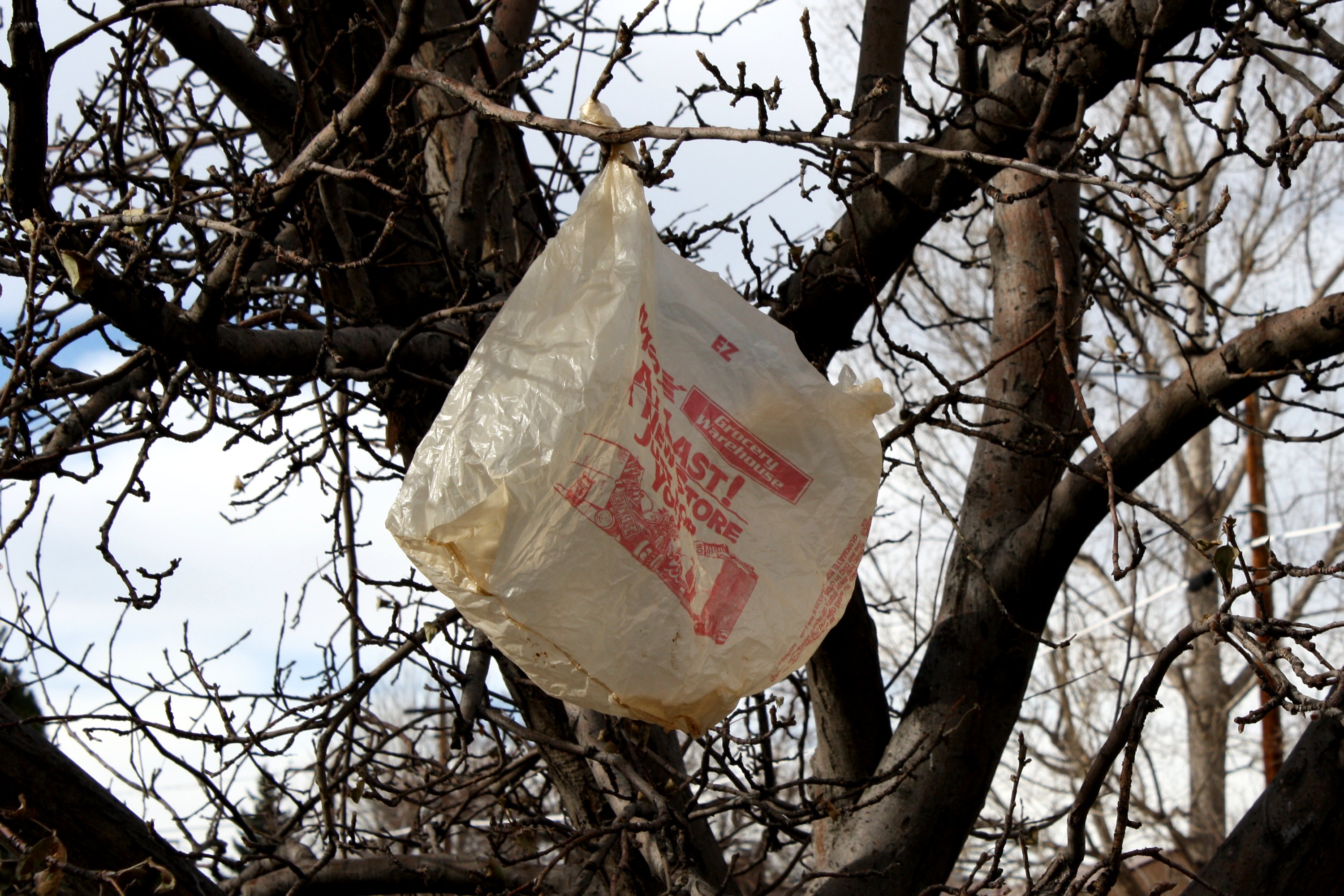
How many times have you driven by a park, parking lot, garden or anywhere else and seen a plastic bag just sitting there, glued to another unobtrusive object? Unobtrusive may have been a bad descriptor for a plastic bag; in all reality, there’s nothing unobtrusive about it.
How many times have you been accosted or surprised by a plastic bag flying in your face or seen one floating into space. In fact, a major part of the film American Beauty, where the boy says to Jane it is “the most beautiful thing I’ve ever filmed,” is about a plastic bag. Really? If that’s beautiful then Ricky, you need to get out more.
Many cities and countries have already started banning the use of plastic bags in supermarkets and stores:
Click here for a detailed list of these countries’ Plastic Bag Laws.
Plastic bags may be convenient for our daily lives but they are detrimental to the environment and when we start taking these environmental risks into consideration, only then will we be able to do something about it. The citizens who helped start the movement back in 2007 in San Francisco, probably started by voluntarily banning themselves from the use of plastic bags because starting a movement starts with yourself.
I have recently chosen to ban myself from using plastic bags as well – it’s simple really. I put reusable bags in my car for when I go grocery shopping and in the event that I forget them, I make myself buy news one to bring home my new purchases in. Having to buy a reusable bag that I already have at home is my way of punishing myself – I would rather go broke, due to my own forgetfulness, than punish the environment.
Maria Rainier is a freelance writer and blog junkie. She is currently a resident blogger at First in Education, where she's been looking into gender wage gap statistics to see if it can be explained through women choosing lower paying degrees and men choosing higher paying degrees. In her spare time, she enjoys square-foot gardening, swimming, and avoiding her laptop.
Image credit: Photos Public Domain
 We all do it – go to the grocery store and forget to bring our reusable grocery bags. Oops, I’ll just have to remember next time. But in some states and countries and maybe soon everywhere, using plastic bags won’t be an option. San Francisco started the trend in 2007, banning plastic bags in grocery stores – according to a story covered by NPR in 2008, other cities, states and countries are jumping on the bandwagon to ban the use of plastic bags.
There are many conveniences to using plastics bags: they are lightweight, cheap, easy to use, always available and always convenient. Banning these conveniences seems like a major inconvenience to most people, but the impact of plastic bags on the environment is what’s most inconvenient.
The harmful effects of plastic bags on the environment:
1.Plastic bags litter the landscape and if burned, produce toxic fumes
2.Plastic bags are non-biodegradable and stick around for about 1,000 years, long after landfills
3. Plastic bags kill animals through ingestion and strangulation
4. Petroleum is used to produce plastic bags – we need petroleum unfortunately
How many times have you driven by a park, parking lot, garden or anywhere else and seen a plastic bag just sitting there, glued to another unobtrusive object? Unobtrusive may have been a bad descriptor for a plastic bag; in all reality, there’s nothing unobtrusive about it.
How many times have you been accosted or surprised by a plastic bag flying in your face or seen one floating into space. In fact, a major part of the film American Beauty, where the boy says to Jane it is “the most beautiful thing I’ve ever filmed,” is about a plastic bag. Really? If that’s beautiful then Ricky, you need to get out more.
Many cities and countries have already started banning the use of plastic bags in supermarkets and stores:
- San Jose recently passed a ban on the usage of plastic bags and many surrounding cities are following the ordinance.
- Last November, parts of L.A. banned single-use and disposable plastic bags to 1.1 million people
- In August 2009, Mexico City banned the use of plastic bags from check-out lines at supermarkets
- In January, Muntinlupa City in the Philippines banned plastic bags & polystyrene containers
- Michigan is starting a movement and petition to ban plastic bag usage in their state
- Last October, an ordinance went into affect banning plastic bags from the Outer Banks of Dare, Currituck and Hyde counties.
Click here for a detailed list of these countries’ Plastic Bag Laws.
Plastic bags may be convenient for our daily lives but they are detrimental to the environment and when we start taking these environmental risks into consideration, only then will we be able to do something about it. The citizens who helped start the movement back in 2007 in San Francisco, probably started by voluntarily banning themselves from the use of plastic bags because starting a movement starts with yourself.
I have recently chosen to ban myself from using plastic bags as well – it’s simple really. I put reusable bags in my car for when I go grocery shopping and in the event that I forget them, I make myself buy news one to bring home my new purchases in. Having to buy a reusable bag that I already have at home is my way of punishing myself – I would rather go broke, due to my own forgetfulness, than punish the environment.
Maria Rainier is a freelance writer and blog junkie. She is currently a resident blogger at First in Education, where she's been looking into gender wage gap statistics to see if it can be explained through women choosing lower paying degrees and men choosing higher paying degrees. In her spare time, she enjoys square-foot gardening, swimming, and avoiding her laptop.
Sunday, October 10, 2010
The environmental impact of right-wing populism...
Incumbents beware. Governments around the world are shaking in their boots as elections, and the prospect of finding new work, loom ever closer. As is common with any recession, incumbent governments take much of the heat. No matter what else is going on in the world, if the economy is performing poorly and unemployment rears its ugly head, people focus on it and only it. And the government is at fault if it isn't fixed soon.

But this recession has been among the worst in recent history. In some places, its impact has been the worst since the Great Depression. The unfortunate reality of a recession is that with less money being made, the government makes less income through taxes. And with less tax income comes a smaller provision of services. Budget gets tight, programs get cut and ties get severed. Any rational thinker knows that if you want to maintain public services -- which are even more important in less prosperous times -- you need to raise taxes. But from a political standpoint, there are few more lethal land mines.
Threats of necessary tax raises have given rise to populism. In the United States, no recent populist movement has been stronger and more influential than the right-wing Tea Party Movement. Among many other things, the Tea Party folks are staunchly opposed to taxes, government regulation and almost all forms of government involvement in the daily lives of people. The November midterms could throw some Tea Party-backed Republicans -- having beaten out other established Republicans in the primaries because they weren't right wing enough -- into Congress.
This could spell disaster for environmental policy in the world's most powerful superpower. The Tea Party Movement -- and I generalize here -- still questions the impact and existence of climate change. Putting cap-and-trade or carbon tax policies into place are a no no, as is banning or reducing the level of offshore drilling, despite the BP disaster earlier this summer. Subsidies for renewable energy or public transit that might cost taxpayers money? Forget it.

Sadly, in order for most environmental programs and projects to be successful, they need to be funded out of the public purse. Privately-funded 'green' projects can be successful, but some tend to be tied to 'greenwashing' or green marketing while delivering very few actual results. Free market proponents argue that if the environment is as important as we claim, the market will reflect it by providing value to it. Well, that isn't quite how it works. And you can be sure it won't happen if Tea Party folks get into Washington.
Even closer to home in Canada, the Toronto mayoral race has given way to populism so strong, many are left dumbfounded. Rob Ford, a controversial City Councillor -- whose colourful history includes rants fuelled by homophobia and racism, drug charges and even getting ejected from a Toronto Maple Leafs game -- has taken everyone by surprise by leading the polls in the October race for leadership of Canada's flagship city. His 'regular guy' approach has attracted those who fear Toronto is becoming the playground of the elite. But if he comes to power, the city's environmentally progressive reputation -- along with much of its progressive reputation -- could fall by the wayside.
Rob Ford believes bike lanes are stupid. Roads are for cars and cars only. Other 'green' programs could see a similar fate.

Dalton McGuinty, the Premier of Ontario, is facing some heat, too. While trying to manage an unprecedentedly large fiscal deficit and wrestling with Ontario's move to a 'have-not' province, his Liberal government has introduced a variety of progressive yet controversial programs, including full day Kindergarten and more relevant to this blog, the omnibus Green Energy Act. The GEA has put Ontario at the forefront of renewable energy policy, but not without a cost. Ratepayers will see higher electric bills and rural communities are protesting the unwelcome introduction of major wind and solar projects in their regions. This rural uprising is contributing to a resurgence of the province's Progressive Conservative Party, which has vowed to do its best to repeal many aspects of the GEA.
Populism is not always a danger for the environment. Indeed, environmental problems -- like other progressive social movements -- have the potential to contribute to a populist cause. But this time around it's not Martin Luther King Jr. or Rachel Carson leading a cause, it's Glenn Beck. This populism doesn't want the next JFK in the White House; it wants Sarah Palin.

But this recession has been among the worst in recent history. In some places, its impact has been the worst since the Great Depression. The unfortunate reality of a recession is that with less money being made, the government makes less income through taxes. And with less tax income comes a smaller provision of services. Budget gets tight, programs get cut and ties get severed. Any rational thinker knows that if you want to maintain public services -- which are even more important in less prosperous times -- you need to raise taxes. But from a political standpoint, there are few more lethal land mines.
Threats of necessary tax raises have given rise to populism. In the United States, no recent populist movement has been stronger and more influential than the right-wing Tea Party Movement. Among many other things, the Tea Party folks are staunchly opposed to taxes, government regulation and almost all forms of government involvement in the daily lives of people. The November midterms could throw some Tea Party-backed Republicans -- having beaten out other established Republicans in the primaries because they weren't right wing enough -- into Congress.
This could spell disaster for environmental policy in the world's most powerful superpower. The Tea Party Movement -- and I generalize here -- still questions the impact and existence of climate change. Putting cap-and-trade or carbon tax policies into place are a no no, as is banning or reducing the level of offshore drilling, despite the BP disaster earlier this summer. Subsidies for renewable energy or public transit that might cost taxpayers money? Forget it.
Sadly, in order for most environmental programs and projects to be successful, they need to be funded out of the public purse. Privately-funded 'green' projects can be successful, but some tend to be tied to 'greenwashing' or green marketing while delivering very few actual results. Free market proponents argue that if the environment is as important as we claim, the market will reflect it by providing value to it. Well, that isn't quite how it works. And you can be sure it won't happen if Tea Party folks get into Washington.
Even closer to home in Canada, the Toronto mayoral race has given way to populism so strong, many are left dumbfounded. Rob Ford, a controversial City Councillor -- whose colourful history includes rants fuelled by homophobia and racism, drug charges and even getting ejected from a Toronto Maple Leafs game -- has taken everyone by surprise by leading the polls in the October race for leadership of Canada's flagship city. His 'regular guy' approach has attracted those who fear Toronto is becoming the playground of the elite. But if he comes to power, the city's environmentally progressive reputation -- along with much of its progressive reputation -- could fall by the wayside.
Rob Ford believes bike lanes are stupid. Roads are for cars and cars only. Other 'green' programs could see a similar fate.

Dalton McGuinty, the Premier of Ontario, is facing some heat, too. While trying to manage an unprecedentedly large fiscal deficit and wrestling with Ontario's move to a 'have-not' province, his Liberal government has introduced a variety of progressive yet controversial programs, including full day Kindergarten and more relevant to this blog, the omnibus Green Energy Act. The GEA has put Ontario at the forefront of renewable energy policy, but not without a cost. Ratepayers will see higher electric bills and rural communities are protesting the unwelcome introduction of major wind and solar projects in their regions. This rural uprising is contributing to a resurgence of the province's Progressive Conservative Party, which has vowed to do its best to repeal many aspects of the GEA.
Populism is not always a danger for the environment. Indeed, environmental problems -- like other progressive social movements -- have the potential to contribute to a populist cause. But this time around it's not Martin Luther King Jr. or Rachel Carson leading a cause, it's Glenn Beck. This populism doesn't want the next JFK in the White House; it wants Sarah Palin.
Tuesday, August 3, 2010
Ultimate Frisbee: Peterborough's Hidden Environmental Gem...

But when chatting with a fellow environmentalist last night over a few beers, he was equally astonished when I told them that Peterborough's ultimate frisbee league is the most environmentally-focused social network I've come across in all of Peterborough. Having been involved for a few years I had never really tried to organize my thoughts and figure out why. So here it goes.
Ultimate frisbee, by its very nature, encourages social cooperation. The game is not refereed and is instead officiated through a complex honour system. The level of obnoxious competitiveness synonymous with many other sports is non-existent as the game lives by something called the Spirit of the Game, summed up by the Ultimate Players Association:
Ultimate has traditionally relied upon a spirit of sportsmanship which places the responsibility for fair play on the player. Highly competitive play is encouraged, but never at the expense of the bond of mutual respect between players, adherence to the agreed upon rules of the game, or the basic joy of play. Protection of these vital elements serves to eliminate adverse conduct from the Ultimate field. Such actions as taunting of opposing players, dangerous aggression, intentional fouling, or other 'win-at-all-costs' behavior are contrary to the spirit of the game and must be avoided by all players.
These 'rules' reflect something of a social contract in which the greater good is prioritized over any individuals. Such an approach is similar to that of the socially progressive and social justice movements, which have traditionally had a strong tie to environmentalism.
Driving is discouraged through a variety of league policies that encourage carpooling, walking or taking bikes, most notably the Carbon Flip, where the beginning disc flip -- similar to a coin toss in other sports -- is not 50/50, but determined by the number of non drivers on each team. Those that enter the league without a hint of environmentalist cares are almost forced to adopt a certain approach to the world during an ultimate frisbee game. This may have as much to do with the type of people playing ultimate in Peterborough as the game itself.
The makeup of Peterborough's players is extremely diverse. It is neither limited to a bunch of hippies nor is it an exclusive club for the rich and famous. I was astonished when I joined my first team to find out it was full of doctors, professors and engineers. Yet any social class system built entirely on household income is non-existent in the Peterborough Ultimate League. The people are generally adults under 40 -- with some exceptions --, an age bracket that seems to be more environmentally conscious that its elders. Many people I've played with are teachers, professors at Trent and Fleming -- two very eco-conscious schools, -- civil servants at the Ministry of Natural Resources, NGO folks and local business owners with green companies.
So you want to find the real movers and shakers in the 'green' world of Peterborough? Just look for a frisbee.
Photo: Tourne Disc
Monday, June 21, 2010
Plastic Bags in HK
 “Love Hong Kong, Use Less Plastic Bags”.
I was strolling around the Hung Hom market this past weekend shopping for groceries and cheap kitchen utensils. Walking around the market really confirmed the Hong Kong I envisioned, that of a super capitalist and hard-working society.
I was fascinated by the various merchants and their marketing techniques to entice both foreigners and locals alike into buying their products. This sense of capitalism is quite interesting and mixed with a bit of greenery.
While Hong Kong is a free market society, they are quite self-sufficiently green. I took this photograph to illustrate the City’s sense of environmental stewardship. Based on some observation, plastic bags are rarely used in the grocery stores; everyone brings their own backpack or reusable bags.
While Toronto and other international cities have recently started to charge for plastic bags (see here), Hong Kong seems to have convinced many of its citizens and tourists to strongly consider avoiding plastic bags. The store I shopped at had a nominal charge on plastic bags but overall, they used signs and their customers to foster a culture of conservation.
Reducing plastic bags significantly alleviates pressure on waste management systems. A culture of greenery and sustainable consumption is something that Hong Kong should pride itself on.
Key message: Hong Kong is committed to reducing the number of plastic bags used in the City. Good on you, Hong Kong.
Monday, June 14, 2010
Greenest City Action Team: Vancouver
 I am reading through a report titled "Greenest City". It was put together in 2009 by the Greenest City Action Team (GCAT). The team comprises a number of environmental experts including councillors, Vancouver's Mayor Gregor Robertson, David Suzuki, David Boyd (one of Canada's leading environmental lawyers) just to name a few. This group of independent experts represents an immense knowledge base. They have a close understanding of the most pressing environmental interests that Vancouver faces.
 The GCAT was given an audacious mandate: to figure out what Vancouver needs to do to become the greenest city in the world by 2020. The report is about 30-pages in length.
The report outlines several recommendations including the "greenest city action fund". In short, this recommendation suggests that the City seek funding partners (the provincial and federal governments, private donors, and businesses) to establish a Greenest City Action Fund to support investments in green infrastructure, energy efficiency, green jobs, environmental education and green business.
Specifically, with the establishment of this fund, the City could create a world-class environmental education centre, the acquisition of land for public green spaces, development of small-scale sources of renewable energy (geothermal, biomass, solar etc) and even an energy efficiency retrofit program for residential buildings.
Cities like Stockholm have shown great leadership on similar initiatives. Indeed, in 2003, Stockholm established the "Miljomiljarden" or Environmental Billion initiative, dedicating one billion Swedish kronor to improving environmental conditions. The money was spent on various projects including: environmental information, activities that promote the preservation of biodiversity, efficient energy consumption and waste management and the decontamination of polluted lands, lakes and water courses. Stockholm was recently named the Greenest City in Europe.
Vancouver has high hopes but is undoubtedly on the right track. The Greenest City Action Fund is a progressive and holistic approach to greening a city. However, it is not money that will exclusively solve all of Vancouver's environmental challenges. The fund will require a number of inputs beyond just monetary provision. Indeed, greening a city requires active participation and collaboration among the private sector, government agencies, citizens, agriculture and local schools. All of these stakeholders are critical in the sustainability process and all need to articulate how such a fund would benefit the city as a whole.
Key Message: We should commend the hitherto green leadership shown by the Mayor, Gregor Robertson and the Greenest City Action Team. With their ambitions, vision and drive, the team will in some way lead Vancouver in a direction that will make the city more livable and sustainable.
Wednesday, June 9, 2010
An "Economy vs. Environment" Debate

I was reading an article from the New York Times titled "Muddy Road Molds Debate on the Future of Guyana". The article reminded me of that classic debate between the economy and the environment. While this particular example is far more complicated, it illustrates how a country (Guyana) has the opportunity to pave a 300-mile road that connects the capital (Georgetown) to Letham, a boomtown on the border with Brazil.
Investors from Brazil are ecstatic about this because it would allow them to search for a deepwater port near Georgetown, giving northern Brazil a "modern artery to export its goods to the Caribbean and North America".
For Guyana, the project presents an opportunity and a threat. Could the road help provide Guyana with an identity, especially an economic identity? This small country of 753,000 is the poorest in South America, with per capita income lower than Bolivia. The road would help Guyana reap significant benefits from trade and take the country more aggressively forward into the global economy.
On the other hand, Guyana could take the more ecologically sustainable path to its economic development. Indeed, the President, Bharrat Jagdeo (who visited Trent University in October) has demonstrated great leadership on forest protection policies and other environmental initiatives.
Environmentalists are deeply concerned about the potential road. Paving it could damage the forest, disrupt and displace river otters, arapaima fish and jaguars. It is projected that two million acres of rain forest could be affected if the road is paved.
Road proponents have acknowledged that the project could bring about upheaval. But they also see how it could ease Guyana's poverty. But, who's going to pay for it? The Prime Minister of Guyana, Sam Hinds, supports the project, as long as Guyana could find $350 million to finance it. There is no indication as to how much the Brazilian government will pay for the project. Their return on investment would be quite adequate considering their expanded trade routes. While the road would be stretched across the country of Guyana, it would be completely inequitable for this poor nation to finance the project at 100%.
Citizens have come out and expressed their deep concerns. Justin de Freitas, 35, who worked as a porter along the road said "that road is going to end our way of life".
There are others as well (including Indigenous) who could be affected by such a project.
To build or not to build? A looming question with seemingly clear costs and benefits. Does the country risk sacrificing its native species, local ecosystems and forested areas for a paved road that will ostensibly bring economic progress? Does it jeopardize its image as a global leader in forest protection policies? These are just some of the tough battles that Guyana now faces with concomitant pressure from the rising economic power that is Brazil.
Key message: These projects are incredibly complex. Squandering an economic opportunity for environmental protection is always a tough one to swallow. A country like Guyana has ambitions to utilize more renewable energy and continue to protect its pristine forests. However, tough decisions lie ahead about economic opportunities that can potentially bring about more benefits to the country's citizenry and alleviate national poverty.
Sunday, June 6, 2010
Re: Trent's Green Grad...
My recent post on Trent's efforts to have a "green" graduation and my actual experience several days later highlights the difference between good intentions and real outcomes. Last week, Trent's three days of convocation ceremonies employed three different strategies to reduce the environmental impact of the graduation event. Unfortunately, all three strategies came away looking fairly chincy.
Its second annual "Bottled Water-Free" convocation was relatively successful and was highlighted by the stainless steel water bottles provided to each graduate. The water bottles, however, were of poor quality. The lids would not stay on properly and once just came right off when I picked up the bottle. Moreover, there were a few instances where the bottoms of the bottles blew off when they were dropped on the ground. I appreciate the effort Trent, but I'm not very confident that many of those bottles will be reused frequently in the future.
The second lackluster effort fell on the shoulders of the student group, Sustainable Trent, of which, in the interest of full disclosure, I am an outgoing member. For several years, a handful of dedicated volunteers have worked to put together the Green Pledge, a voluntary pledge taken by graduates to keep the environment in mind when making major decisions in the future. Unfortunately, the main coordinator of the Green Pledge was unable to do it this year and wasn't picked up until the last minute. As I stood in line minutes away from procession, an ST volunteer handed me a pin and asked if I wanted to take the pledge. I knew what it was, so I took the pin. Another graduate behind me did not know what it was, but took it after a one line description. Unsurprisingly, very few graduates had a green pin on. It was a sad sight after such popularity in the past.
The third effort came in the form of free public transit passes to graduates and their guests. I'll admit that I didn't look too much into this and don't know how popular it was, but when looking into the logistics, it looked a little tedious. In order to ride for free, graduates and guests had to print out tickets from the website. Because many of the guests and graduates were coming in from out of town and staying in hotels, printing a piece of paper wouldn't be all that feasible and (forgive my assessment of human beings) most people wouldn't have thought about that ahead of time. Why not just make the Trent Express free that day for everyone? I would not be surprised, however, if the bus drivers just let everyone on anyways without the pass.
I hate to gripe about Trent's 'green' efforts, but they were hyped so much and yet so half-heartedly followed through on. And some people will likely tell me to not be so critical and just be happy Trent tried. But too bad. If you want to legitimize your 'green' reputation, do it with some effort.
But alas, this should not take away from the main occasion. A graduation is a special thing to celebrate, the ceremony was enjoyable and I offer congratulations to all the other graduates. It's a shame it couldn't have a been a little 'greener'.
Monday, February 8, 2010
The environmental movement is killing the mood, but there is still hope...
 The world is facing an epidemic. Every year, people are having less and less sex in cars. The time honoured tradition was once rampant with the bench seat featured in the massive American vehicles of the 1960s, but has been stifled by a combination of bucket seats, heavier traffic and smaller cars -- largely driven by the environmental movement. But all is not lost.
In this hilarious article in the Globe & Mail, Andrew Clark describes how vehicular sex can be salvaged, even in these troubling times. Just in time for Valentine's Day, too.
For those of you looking for a really good laugh (rare in the G&M) and maybe some 'driving' tips, I highly recommend reading "Your Valentine's Day guide to vehicular sex".
Tuesday, January 26, 2010
An environmental military...

In my class this morning we watched clips from an episode of Whale Wars, a series that follows the radical anti-whaling actions of the environmental group, Sea Shepherd. The group uses a decades old sea-faring vessel, aptly named the Steve Irwin, to hunt down whaling fleets and stop them from hunting whales. A variety of tactics are used, including fire hoses, ramming and even non-toxic, environmentally friendly homemade stinkbombs that make it impossible to work on the deck of the ship.
Sea Shepherd is one of a select few environmental groups that go to such radical and violent lengths to take action and get their message across. Indeed, its founder, Paul Watson (the original founder of Greenpeace and senior member until they kicked him out for his violent strategies) has long said that the traditional forms of protest often lead to no action whatsoever.
The tactics employed by Sea Shepherd are indeed dangerous, but they are also fairly militaristic. Some members of the crew of the Steve Irwin have formal naval experience. In a way, Sea Shepherd represents a very small navy (it has some other ships as well) and it has even titled its fleet, Neptune's Navy.
It has got me thinking. What if Sea Shepherd could grow bigger? What if donations swelled to such a degree that they could purchase even more ships and even more advanced equipment? Soon enough, Sea Shepherd could have itself a solid fleet capable of holding considerable influence. Theoretically, it could have a navy larger than most other countries in the world (mind you, the sophistication and militaristic specialization of the vessels might be lacking).
And what if some other environmental groups with similar radical action plans got involved and their budgets expanded hugely? They could amass the equivalent of a small air force with planes and helicopters. Sea Shepherd already has at least one helicopter. Again, theoretically, some kind of informal environmental military could be established.
Of course, what the intentions of such a force would be would certainly influence the rest of the world's response to it. For instance, Sea Shepherd's actions on whaling and fishing vessels have resulted in arrest warrants been put out in particular countries, though not in its home base of the United States. It has yet to attract enough attention to be considered overly dangerous and require a global response. Of course, if this hypothetical military force started doing more than hassling whalers, more people might start to take notice.
And whether or not such a force could actually find a market in which it could do its work is also an important question to ask. Much of the success of Sea Shepherd has come because it is working towards a specific cause and also working primarily in the global policy grey zone: international waters. This hypothetical force would probably want to expand its mandate, but expanding too far could get it into trouble, especially if much of its work didn't happen outside national boundaries.
It is an interesting proposition, but is marred by countless factors: How would you finance it? Where's the line between 'direct action environmental group' and 'dangerous vigilantes'? What happens if it actually goes to battle with another major force, like a private security force or even a national government?
Now, I would imagine it highly unlikely that the world's globalized security forces would let something like that form. After all, Sea Shepherd is not a sovereign state and national governments would not have to go through the same international process to shut it down -- not that sovereignty always stops them, but that's beside the point. Moreover, who knows whether groups like Sea Shepherd would even want to participate in something that grew beyond its current mandate, size and scope. And I very much doubt that any force of this nature would want to kill anyone.
In light of such an unlikely formation, I can see two semi-legitimate uses for this hypothetical environmental paramilitary force. First, it could serve as a private security force. The United States government, for example, has been using a private security force in Iraq for several years, although it is subject to a great deal of controversy. Theoretically, the environmental force could do contract work for organizations or causes that it sees fit to help. Say some e-waste activists can't get a certain government to stop shipping its e-waste to China even if it is blocked under international law, so instead it decides to stop the ship using direct action by blockading the ship with the paramilitary fleet. But considering that Paul Watson prefers volunteers for Sea Shepherd work -- volunteers have a greater interest and aren't doing it simply for the paycheque, he argues -- he probably wouldn't want to contract his work out for money.
The second application I could see for such a force would be as the de-facto enforcers of international laws. Sea Shepherd already acts in that regard with specific international laws. One of the biggest problems with international laws, after they have been signed and ratified, is global enforcement. Other than groups like the United Nations Security Forces, there are few or no global security forces to uphold international laws. This hypothetical force could do that for environmentally-related international laws, at least to some degree. Of course, the formal complexities of such an idea are well beyond the scope of this post.
I'll finish by noting that by no means am I advocating for such an environmental paramilitary force, but merely exploring the idea. I certainly prefer peaceful and non-violent solutions to problems, but we all know that that doesn't always work.
Tuesday, December 15, 2009
The Future of Cities in the U.S.
A number of months ago, I blogged about an article written by Edward Glaeser, a Professor of Economics at Harvard. Many of the arguments from his article are found in the youtube clip above. I don't agree with all of his points, but he makes many convincing arguments.
His research focus is on the economics of housing. On the environmental side of things, he has published papers on how climate should influence how cities grow. California for example, has the most temperate climate in the country and as a result, homes use less heat in the winter and less electricity in the summer. Yet, many environmentalists oppose any sort of development in these places because they want to preserve the natural environment.
To quote Glaeser, "a new building in California, as opposed to Texas, reduces America’s carbon emissions. Yet, instead of fighting to make it easier to build in California, environmentalists have played a significant role in stemming the growth of America’s greenest cities." Places like Houston are sprawling rapidly. Many of the homes constructed in Houston's suburban communities require air conditioning to run 24/7 because of the unbearable humidity. California, which is growing at 8%, has strict regulations regarding housing development. This is unfortunate because higher densities are needed in places like California (better climate) and not in places like Houston which use artificial cooling to keep everyone happy!
In the video clip, Glaeser contrasts California with places like Houston, Dallas and Atlanta; these three areas are both among the nation’s five most carbon-intensive living areas and among the three fastest-growing metropolitan areas.
To learn more about this topic, see the video.
Tuesday, September 1, 2009
Stupid Green Ideas: hybrid parking spots...

Apparently this is not the first of its kind. Larger box stores like IKEA and Whole Foods have dipped into these waters, too.
So is it a silly idea?
Well, enforcement is a bugger. Finding non-permit vehicles parked in handicapped spots is certainly not a rarity and such an offence probably strikes witnesses much more severely than parking illegally in a hybrid spot.
Secondly, the environmental benefits of hybrids over traditional vehicles is certainly not absolute. What if the hybrid driver drives tens times as much as the driver of an SUV? Which of these drivers should really be rewarded? And furthermore, hybrids are not always the most fuel-economic vehicles. Lexus has several hybrids, one of which has 438 HP V8 engine. Its fuel economy is worse than that of its parent company's Toyota Tacoma pickup truck. Even Cadillac's Escalade (pictured above) has a hybrid version. There is no way these vehicles should be given priority over non-hybrid, but more fuel-efficient vehicles. And what about an electric car? Would it qualify?
Thirdly, lots of people think poorly of hybrids because the drivers are sometimes perceived to be rich, snobby, self-righteous, do-gooding elites. They always aren't, but the perceptions will stick and this certainly won't help. Most people don't have a problem giving priority to the handicapped or expecting mothers, but they might think the hybrid spot a tad elitist.
Lastly, this seems like nothing more than a marketing ploy for those who employ such a strategy. It allows the stores to brand themselves as 'green' and attract more customers, without actually implementing an effective policy. It just looks good.
So yes, it is silly.
But then again, even if it is silly, at least it is something. The majority of hybrids out there are much more fuel-efficient than the rest of vehicles on the road. It probably won't hurt anyone, since angry drivers will soon drop their threats of switching supermarkets and just find another spot. And lots of corporations are employing 'green' strategies, so a harmless one like this can't hurt, right?
That is of course, if you live by the mantra 'an empty policy is better than no policy'.
I don't own a hybrid, but I do spot one in the parking lot across the way. I think I might steal the 'hybrid' logo on its rear end and attach it to my car so I can take advantage of this great deal.
Out of my way, soon-to-be mothers and handicapped, I'm saving the world!
Friday, August 28, 2009
Are Canadians becoming more conservationist-minded?
This is a question that someone recently posed to me. My answer, not backed by any sufficient statistics or anything is.... yes we are. I am hopeful at least.
Let’s start with some natural resource history. Canada has been regarded as a resource-based economy since Confederation in 1867. Natural resources or staples such as lumber, minerals, fresh water and fisheries have all played an instrumental role in shaping and developing this nation’s economy. Natural resource development has contributed to the creation of jobs in British Columbia through their forestry sector, mineral development in Central Canada and now oil in Alberta and Saskatchewan. The national economy is characterized by a low population/resource ratio which has given Canada a comparative advantage in resources and primary resources.
In other words, Canada’s abundance of natural resources and low population density has both historically and contemporarily been a battle between nature and civilization; anthropocentric ideals exploiting resources for economic growth. The vast size of this nation and its resource endowment, when measured on a per capita basis, has historically encouraged a sense of limitless potential and availability.
Most of the macro regions of Canada developed as they did because of their dependence on the extraction and utilization of staples commodities. Atlantic Canada, prior to its economic collapse, was reliant on cod as its main staple. Central Canada had an abundance of fur. The Prairies specialized in the wheat crop and finally, British Columbia possessed and continues to have copious amounts of timber. However, recently, forest fires and the mountain pine beetle have reminded British Columbians that they need to concentrate more attention on their main natural resource. Generally, I think we have learned that the relentless consumption of natural resources is economically devastating.
To the more contemporary: Canada has reaped significant economic benefits through the free market and through free trade with the United States. However, this consumption oriented ideology is slowly dissipating as the concept of ‘limits to growth’ has come to the forefront. Canadians have been increasingly aware of the need to conserve such resources to maintain the economy and quality of life.
Climate change along with mass resource depletion will directly impact Canada’s economy and impact the socio-economic well-being of millions of citizens. For instance, British Columbia is in transition from exploitation of old growth stands to harvest sustainability as a result of an overwhelmingly consumptionist mindset that has pervaded the lumber industry for many years.
With increased environmental awareness, Canadians are becoming more pro-active in fields like waste management, recycling and reduction of waste, pollution abatement initiatives, higher participation in city rebate programs and advocating greater protection of the Great Lakes Ecosystem Basin which is currently facing problems with toxic contamination, eutrophication and pollution runoff.
In sum, the scale of exploitation of Canada’s natural resources is slowly fostering this notion of sustainable development. In decades past, resource depletion was more characteristic of the economy rather than the conservation of resources, but with this new emerging salience of the environment, I think that conservation is becoming more characteristic of the Canadian populous.
Let’s start with some natural resource history. Canada has been regarded as a resource-based economy since Confederation in 1867. Natural resources or staples such as lumber, minerals, fresh water and fisheries have all played an instrumental role in shaping and developing this nation’s economy. Natural resource development has contributed to the creation of jobs in British Columbia through their forestry sector, mineral development in Central Canada and now oil in Alberta and Saskatchewan. The national economy is characterized by a low population/resource ratio which has given Canada a comparative advantage in resources and primary resources.
In other words, Canada’s abundance of natural resources and low population density has both historically and contemporarily been a battle between nature and civilization; anthropocentric ideals exploiting resources for economic growth. The vast size of this nation and its resource endowment, when measured on a per capita basis, has historically encouraged a sense of limitless potential and availability.
Most of the macro regions of Canada developed as they did because of their dependence on the extraction and utilization of staples commodities. Atlantic Canada, prior to its economic collapse, was reliant on cod as its main staple. Central Canada had an abundance of fur. The Prairies specialized in the wheat crop and finally, British Columbia possessed and continues to have copious amounts of timber. However, recently, forest fires and the mountain pine beetle have reminded British Columbians that they need to concentrate more attention on their main natural resource. Generally, I think we have learned that the relentless consumption of natural resources is economically devastating.
To the more contemporary: Canada has reaped significant economic benefits through the free market and through free trade with the United States. However, this consumption oriented ideology is slowly dissipating as the concept of ‘limits to growth’ has come to the forefront. Canadians have been increasingly aware of the need to conserve such resources to maintain the economy and quality of life.
Climate change along with mass resource depletion will directly impact Canada’s economy and impact the socio-economic well-being of millions of citizens. For instance, British Columbia is in transition from exploitation of old growth stands to harvest sustainability as a result of an overwhelmingly consumptionist mindset that has pervaded the lumber industry for many years.
With increased environmental awareness, Canadians are becoming more pro-active in fields like waste management, recycling and reduction of waste, pollution abatement initiatives, higher participation in city rebate programs and advocating greater protection of the Great Lakes Ecosystem Basin which is currently facing problems with toxic contamination, eutrophication and pollution runoff.
In sum, the scale of exploitation of Canada’s natural resources is slowly fostering this notion of sustainable development. In decades past, resource depletion was more characteristic of the economy rather than the conservation of resources, but with this new emerging salience of the environment, I think that conservation is becoming more characteristic of the Canadian populous.
Sunday, July 26, 2009
Are you an environmentalist?...
I posed this question on our blog several months ago after watching the film Addicted to Plastic at the Peterborough Film Festival. The film's creator asked this of the many people he interviewed during his film, including farmers, sailors, scientists and entrepreneurs.
The results were mixed. Some were very happy to consider themselves environmentalists, including some farmers, citing their intrinsic tie to the environment, while others were vehemently opposed to the idea, such as an entrepreneur who reuses material to build large objects and some scientists who felt that shouldn't pick sides as it would ruin their research credibility.
So what exactly does it mean to be an environmentalist?
According to some dictionaries, an environmentalist is one who "advocates for or works towards protecting the natural environment from destruction or pollution". That's fairly vague, but such vagueness is entirely appropriate when looking at such a broad term.
The word is relative to each person. Some environmentalists will do anything and everything in their power to "protect the natural environment". Others may only make environmentally-focused decisions every once in awhile. Some may not even know they're doing something 'environmentally friendly'.
But it is this first group that seems to have grabbed the popular definition of what an environmentalist is. These are the granola-munching, Greenpeace flag-waving, ultra-vegan, reuse everything, 'don't bother that mosquito because it's a beautiful creature' types. Quite simply, they are the hardcores. And I should point out that there is nothing wrong with this. In fact, I'm quite impressed by the lifestyle that many of these people live. I certainly could never do it.
But the problem is that when the average person considers what it is to be an environmentalist, this is what first comes to mind. The entrepreneur wants nothing to do with a label that would associate him with the hardcores. And some others might simply feel they don't 'qualify' to be an environmentalist because they are not up to the standard set by the hardcores. Sally down the road might be very 'green', but since she still drives her Volvo to work and frequently watches movies on her Plasma TV, she thinks there is no way she could be an environmentalist.
The idea that environmentalists are limited to the hardcores is something that needs to change. It is certainly on its way. As the shopping list of environmental dangers is getting more and more attention, a growing number of people are starting to act 'greener'. And while government incentives are certainly helping out, there seems to be more to it than economics. People actually care.
Four years ago I didn't really care. I recycled because my parents told me to, left the TV on for hours after I left the room, had no idea what global warming was (and didn't care) and enjoyed spewing greenhouse gases into the atmosphere while doing donuts in a car.
But before you think I'm about to preach to you like an environmental convert, I haven't changed that much. I still love to drive, watch lots of TV, eat non-local, processed food and fly across Canada several times a year.
But I know the environment is important. I'm trying to do my part. I'm living a relatively 'greener' life. But I'm not perfect. But I consider myself an environmentalist.
You don't have to be a hardcore to care about the environment or to contribute in some way to helping it out.
Lastly, I would like to touch on the importance of using such a term. One might very easily toss aside this entire argument because self-labelling may not do anything when it comes to actual behaviour. This is true (cough, One million acts of green, cough), to a point. But feeling positive about your lifestyle is important. For years, the environmental strategy was to make people feel guilty about their behaviour. But it hasn't really worked and it may have exacerbated the problem.
But if people are more inclined to feel good about some of their actions rather than guilty about what they don't do, this whole environmental thing might be a lot more successful.
So ask yourself, even though you might hate the hardcores or don't strive to their standard, do you care about the environment in some way or another? Are you an environmentalist?
The results were mixed. Some were very happy to consider themselves environmentalists, including some farmers, citing their intrinsic tie to the environment, while others were vehemently opposed to the idea, such as an entrepreneur who reuses material to build large objects and some scientists who felt that shouldn't pick sides as it would ruin their research credibility.
So what exactly does it mean to be an environmentalist?
According to some dictionaries, an environmentalist is one who "advocates for or works towards protecting the natural environment from destruction or pollution". That's fairly vague, but such vagueness is entirely appropriate when looking at such a broad term.
The word is relative to each person. Some environmentalists will do anything and everything in their power to "protect the natural environment". Others may only make environmentally-focused decisions every once in awhile. Some may not even know they're doing something 'environmentally friendly'.
But it is this first group that seems to have grabbed the popular definition of what an environmentalist is. These are the granola-munching, Greenpeace flag-waving, ultra-vegan, reuse everything, 'don't bother that mosquito because it's a beautiful creature' types. Quite simply, they are the hardcores. And I should point out that there is nothing wrong with this. In fact, I'm quite impressed by the lifestyle that many of these people live. I certainly could never do it.
But the problem is that when the average person considers what it is to be an environmentalist, this is what first comes to mind. The entrepreneur wants nothing to do with a label that would associate him with the hardcores. And some others might simply feel they don't 'qualify' to be an environmentalist because they are not up to the standard set by the hardcores. Sally down the road might be very 'green', but since she still drives her Volvo to work and frequently watches movies on her Plasma TV, she thinks there is no way she could be an environmentalist.
The idea that environmentalists are limited to the hardcores is something that needs to change. It is certainly on its way. As the shopping list of environmental dangers is getting more and more attention, a growing number of people are starting to act 'greener'. And while government incentives are certainly helping out, there seems to be more to it than economics. People actually care.
Four years ago I didn't really care. I recycled because my parents told me to, left the TV on for hours after I left the room, had no idea what global warming was (and didn't care) and enjoyed spewing greenhouse gases into the atmosphere while doing donuts in a car.
But before you think I'm about to preach to you like an environmental convert, I haven't changed that much. I still love to drive, watch lots of TV, eat non-local, processed food and fly across Canada several times a year.
But I know the environment is important. I'm trying to do my part. I'm living a relatively 'greener' life. But I'm not perfect. But I consider myself an environmentalist.
You don't have to be a hardcore to care about the environment or to contribute in some way to helping it out.
Lastly, I would like to touch on the importance of using such a term. One might very easily toss aside this entire argument because self-labelling may not do anything when it comes to actual behaviour. This is true (cough, One million acts of green, cough), to a point. But feeling positive about your lifestyle is important. For years, the environmental strategy was to make people feel guilty about their behaviour. But it hasn't really worked and it may have exacerbated the problem.
But if people are more inclined to feel good about some of their actions rather than guilty about what they don't do, this whole environmental thing might be a lot more successful.
So ask yourself, even though you might hate the hardcores or don't strive to their standard, do you care about the environment in some way or another? Are you an environmentalist?
Thursday, June 18, 2009
Bill McKibben, mobilizing America on climate change action…
American environmentalist and author Bill McKibben, has and continues to vehemently spread awareness and education over global climate change. We don’t hear much about McKibben in Canada because of David Suzuki’s ubiquity, but McKibben has raised some really important questions around climate change and America’s energy challenge.
Among many of his noble efforts in the climate change movement, he has created a website called 350.org which is campaign dedicated to raising awareness over this salient issue. 350 refers to 350 parts per million. Climate change experts have identified this number as the safe upper limit for carbon dioxide emissions in our atmosphere. We are presently at 385 parts per million and as McKibben continues to exclaim “climate change is not a problem for the future; it’s a crisis for this moment". Anyone can join 350.org and become a member of this movement. More to come on local initiatives and groups you can join to further your knowledge on climate change and how you can educate and mobilize others in your community to think more seriously about it.
Wednesday, June 10, 2009
Trent University's summer endeavours...
Universities are interesting things. The idea of one probably brings thoughts of learning, knowledge and especially at a liberal-arts school like Trent, progressive policies. While we could bat around the actual definition of progressive for days, I use the term to describe policies that are more holistic, perhaps edgy and certainly less than holistic.
Environmentalists should be familiar with the idea of progressiveness. After all, environmentalism in its modern form is a component of progressiveness.
University's are often at the forefront of developing or at least implementing new technologies and ideas. I'm currently working at Trent University over the summer and I'm witnessing a whole swath of these new technologies and ideas being put into place.
Thanks in large part to a generous donation Montreal Canadien's GM Bob Gainey, Trent is currently constructing one of Canada's greenest buildings. Known as the Camp Kawartha Environment Centre, the straw-bale building will be powered by the sun, have innovative rainwater collection systems and have composting toilets.
Last week, this year's Trent graduates gathered with guests, faculty and staff for convocation. The convocation turned out to be a very "green" affair. Apart from grads sporting green gowns, free transit passes were given out to discourage driving to the ceremonies and encourage the use of public transportation and graduates were encouraged to take the "green pledge", an oath to take the environment into consideration during one's future endeavours. The most notable aspect of the ceremonies was the decision to not provide bottled water, which was a significant change from the norm at Trent and throughout North America. The move was expected to save thousands of bottles from being consumed. Appropriately, bottled water's worst nightmare and Canada's own Maude Barlow was awarded an honorary degree as well.
A significant addition is also being added to the Athletic Centre, which is supposed to be standardized at one of LEED's (Leadership in Energy and Environmental Design) highest bars.
But we must also acknowledge the institutional nature of Trent. It may be a wonderful breeding ground for progressive ideas, but every breeding ground needs an infrastructure. As such, the 'green' endeavours of our small university this summer may very well be overshadowed by the 'not-so-green' activities.
While the Camp Kawartha Environment Centre might be one of Canada's greenest, the DNA Building being built just north of it is anything but. Despite a multi-million dollar price tag, the facility is being built very quickly and the materials are fairly cheap in quality. There is no effort to make the buildings architecturally interesting or to even make them fit with the rest of the school. And because Trent is almost completely surrounded by Nature Areas, a good deal of greenspace has been removed for building and parking lots.
To the north of the campus, a highly controversial hydro dam is being built. While it will deliver greenhouse-gas free power to Peterborough, its construction has resulted in the clearance of acres of Trent's famous Nature Areas.
Roads are parking lots are being put all over campus. One such road, currently designated 'temporary', has gone over a wonderful piece of grassland by the athletic facility that once housed two beach volleyball courts. Unfortunately, I've learned over the years that nothing like that at Trent is really temporary. And even if it were, I highly doubt they'd put the volleyball courts back.
Even some of Trent's most modest 'green' efforts are being squashed. Literally. A month or so ago, landscapers started digging up tons of grassy area around the sides of the buildings to replant grass seeds. Just as that slowly started to get going, we find this morning that a construction crew brought all their trucks into the replanted area. Bye bye grass.
Trent is a wonderful place. It's full of greenery and is trying its best to maintain its 'green' reputation. Unfortunately, sometimes other forces are a little too strong. The worry is that these other forces will eventually remove so much of the 'green' that Trent will lose the majority of its natural environment. That environment, both physical and amongst the people, is what makes Trent unique and so great.
Environmentalists should be familiar with the idea of progressiveness. After all, environmentalism in its modern form is a component of progressiveness.
University's are often at the forefront of developing or at least implementing new technologies and ideas. I'm currently working at Trent University over the summer and I'm witnessing a whole swath of these new technologies and ideas being put into place.
Thanks in large part to a generous donation Montreal Canadien's GM Bob Gainey, Trent is currently constructing one of Canada's greenest buildings. Known as the Camp Kawartha Environment Centre, the straw-bale building will be powered by the sun, have innovative rainwater collection systems and have composting toilets.
Last week, this year's Trent graduates gathered with guests, faculty and staff for convocation. The convocation turned out to be a very "green" affair. Apart from grads sporting green gowns, free transit passes were given out to discourage driving to the ceremonies and encourage the use of public transportation and graduates were encouraged to take the "green pledge", an oath to take the environment into consideration during one's future endeavours. The most notable aspect of the ceremonies was the decision to not provide bottled water, which was a significant change from the norm at Trent and throughout North America. The move was expected to save thousands of bottles from being consumed. Appropriately, bottled water's worst nightmare and Canada's own Maude Barlow was awarded an honorary degree as well.
A significant addition is also being added to the Athletic Centre, which is supposed to be standardized at one of LEED's (Leadership in Energy and Environmental Design) highest bars.
But we must also acknowledge the institutional nature of Trent. It may be a wonderful breeding ground for progressive ideas, but every breeding ground needs an infrastructure. As such, the 'green' endeavours of our small university this summer may very well be overshadowed by the 'not-so-green' activities.
While the Camp Kawartha Environment Centre might be one of Canada's greenest, the DNA Building being built just north of it is anything but. Despite a multi-million dollar price tag, the facility is being built very quickly and the materials are fairly cheap in quality. There is no effort to make the buildings architecturally interesting or to even make them fit with the rest of the school. And because Trent is almost completely surrounded by Nature Areas, a good deal of greenspace has been removed for building and parking lots.
To the north of the campus, a highly controversial hydro dam is being built. While it will deliver greenhouse-gas free power to Peterborough, its construction has resulted in the clearance of acres of Trent's famous Nature Areas.
Roads are parking lots are being put all over campus. One such road, currently designated 'temporary', has gone over a wonderful piece of grassland by the athletic facility that once housed two beach volleyball courts. Unfortunately, I've learned over the years that nothing like that at Trent is really temporary. And even if it were, I highly doubt they'd put the volleyball courts back.
Even some of Trent's most modest 'green' efforts are being squashed. Literally. A month or so ago, landscapers started digging up tons of grassy area around the sides of the buildings to replant grass seeds. Just as that slowly started to get going, we find this morning that a construction crew brought all their trucks into the replanted area. Bye bye grass.
Trent is a wonderful place. It's full of greenery and is trying its best to maintain its 'green' reputation. Unfortunately, sometimes other forces are a little too strong. The worry is that these other forces will eventually remove so much of the 'green' that Trent will lose the majority of its natural environment. That environment, both physical and amongst the people, is what makes Trent unique and so great.
Tuesday, June 2, 2009
Gee is a critic of Toronto’s new 5 cent plastic bag charge…
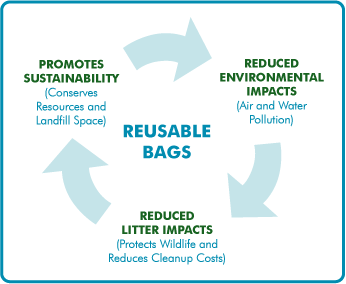
Marcus Gee, an international affairs columnist for the Globe and Mail, recently wrote an article criticizing Toronto’s new bylaw requiring all grocery stores to charge 5 cents for plastic bags. He writes “There is more sanctimony than sense behind this rule, which took effect Monday and which will require even the hard-pressed corner store guy to post signs explaining the five-cent charge.”
Other critics like Gee, also mention how plastic bags are recyclable and reusable anyway and serve multiple purposes. Marcus argues that they are especially useful for lining garbage bins. He thinks that we will have to buy plastic bags anyway whether from a grocery store or from another vendor to serve these various functions. One part of his article that is particularly irksome, erroneous and ill-informed is his discussion over landfills and waste diversion. “Modern landfills are marvels of environmental management that have next to no impact on the land around them. Impermeable, high-tech membranes prevent liquids from escaping into the groundwater. Methane is funnelled off and burned to produce electricity. “
Firstly, all modern landfills constitute “hazardous industrial waste landfill” and can be technical and scientific and therefore be exclusionary and esoteric to the general public. There are still a lot of uncertainties surrounding their impacts on groundwater, water quality and the environment generally. Further, they take up vast amounts of space, have no element of sustainability and produce a lot of social and environmental injustices. Additionally, many environmental law cases in Ontario deal with the controversies over landfills. The odour from the landfill site can permeate local farms and residential areas. Landfill odour can constitute a nuisance and unreasonable interference. It endangers life and health. Citizens have a lot of causes of actions (torts) that they can use for this very reason to sue and condemn the use of landfills.
Now, in terms of charging for plastic bags (something Gee thinks is preposterous), there are many benefits. In short, considering the number of shoppers in the metropolitan area, a five cent charge can induce citizens to change their behaviour. In addition, a user charge can persuade citizens to make the investment in buying reusable bags which are sturdier, compact and can carry a higher volume of groceries.
All the revenues collected from this five cent shopping bag charge will accumulate in the store’s budget, and it is expected that the money will be used for environmental projects. Again, “environmental projects and or funds” is quite nebulous. However, there can certainly be more regulation here whereby the municipal government monitors how these stores use their revenue. The biggest criticism of the 5 cent charge should not be its futility, but maybe how the 5 cents will be used. Economically, it makes sense. Chris and I both did some quick math on this in a previous post which you could see here.
Toronto wants to achieve a 70 percent diversion of waste from landfills by 2012. This is feasible. And achieving this will require a serious cut down on those ubiquitous disposable coffee cups, higher rates of composting, recycling and user charges like the 5 cent plastic bag fee. Regulatory measures are also significant for waste diversion and if the implementation of a bylaw reduces total waste generated, then a 5 cent charge certainly has merit. Marcus Gee may not approve of these various initiatives but they are all indispensable for achieving a higher waste diversion rate.
Key message: The real goal of such a bylaw is to promote sustainability through the use of reusable bags. Charging a small fee for plastic bags gets people thinking about the environment and provides an inclination and incentive to either consume less or make a switch to reusable bags.
Subscribe to:
Posts (Atom)