Remember that scene from Honey I Shrunk the Kids where the shrunken kids end up in the yard, completely engrossed in towering blades of grass and weeds? Well, such a reality -- minus the shrinking -- could be on us at any moment. According to officials in eastern Ontario's Renfrew County, a giant and dangerous weed is now present in Ontario.
Known as Giant Hogweed, it can stand as tall as six metres and its sap can cause blindness and skin damage similar that of a fire or chemical burn. Apparently it has also been spotted in southern Ontario. You can read a lot more about it here. Interestingly, it is already present in Newfoundland, New Brunswick, Quebec, Alberta and British Columbia. Of course, when it finally hits Ontario -- ever closer to the Centre of the Universe -- it becomes big news.
The spread of big dangerous plants reminds me of the film The Happening, which I just watched a few days ago. SPOILER ALERT. In the movie, people start killing themselves -- in ever so creative ways -- when an airborne toxin gets into their system. What's causing the toxin? Pissed off plants, of course. We better keep Mark Wahlberg and M. Night Shyamalan on speed dial, just in case this Hogweed starts going after us. They'll know what to do.
On a movie-related note, I recently watched Daybreakers, where vampires have taken over the world in 2019 and are running low on human blood. You'd think eventually someone, somewhere, even vampires, would learn from the collapse of the cod fishery in Atlantic Canada.
Well, those people that might be translating such learnings into the protection of natural lands are now being branded as fascists. Bill Bennett, the Liberal Minister of Mining in British Columbia, lampooned proponents of the Keystone Valley receiving National Park status as eco-fascists. Bennett already has a history of lashing out, so Mr. Campbell, I suggest you get rid of this guy before he further derails your already wimpering 'green' provincial mantra. And Mr. Bennett, if you're going to compare environmentalists to the likes of Mussolini and Hitler, I suggest you at least spell the term fascist correctly.
And finally, I am impressed but feel oddly unsettled with the news of a solar powered airplane completing a 26 hour test flight. I'm all for renewable energy and air travel is a major source of carbon emissions, but knowing that solar energy is the only source fueling the plane would not inspire great confidence. I know, I know, give it time so it can prove itself and soon the world will be a better place, but at least I know that top-notch airplane fuel is fairly trustworthy. Then again, just over one hundred years ago, they thought the Wright Brothers were crazy. Maybe it just takes time to normalize to the situation.
Tuesday, July 13, 2010


Water in China: Part II
Water quality in China is in need of desperate revitalization. For such a large developing (arguably now developed) country that has made immense economic progress over the past 20 years, it is no surprise that water quality has been a victim of such economic development. As discussed in part 1, the priorities of economic growth in China have superseded the priorities of environmental protection and ecological balance. Like part 1, all of the information in this post is derived from Peter Gleick's "China and Water" publication.
As reported by Peter Gleick, there is not a lot of information or data available on China’s water quality. However, China’s State Environmental Protection Agency (SEPA), the World Health Organization (WHO) and the Organization for Economic Cooperation and Development (OECD) have published some data on China’s water quality and have made it available to the public. The data and resources reveal that many of China’s rivers are grossly polluted by human and industrial wastes. An uncounted number of aquatic species have been driven to extinction. An estimated 20,000 chemical factories, half of which are along the Yangtze River (China’s longest river) are dumping uncontrolled or marginally controlled pollutants into China’s rivers.
In 2006, nearly half of China’s major cities did not meet state drinking water quality standards. China’s 10th 5-year plan (2001-2006) mandated the construction of thousands of new wastewater treatment plants, yet a 2006 survey by SEPA revealed that half of the new plants actually built were operating improperly or not at all. In 2005, China’s experienced 1,400 environmental pollution accidents of which half involved water pollution. Water quality has been deteriorating in main rivers including the Songhua, Hai He, and Huai He rivers.
On a positive note, drinking tap water in Beijing has been declared “safe” under the country’s new national drinking water standards for 106 contaminants in spite of some local complaints about its taste. Unfortunately, the OECD has reported that hundreds of millions of Chinese are drinking water contaminated with inorganic pollutants such as arsenic and excessive fluoride including toxins from untreated factory wastewater. Some concerned farmers, living in contaminated regions grow grain with poor water quality, sell that grain and purchase grain from other parts of China they believe have safe water.
Make no mistake about it, untreated wastewater is so problematic affecting every facet of life including social, economic and personal development. Approximately 4.4 billion tons of untreated or partially treated wastewater are dumped into the Huai He River annually.
Now over to the positive and promising. So, we know that wastewater treatment is indeed a critical indicator of public health, environmental and economic progress. Even countries like the U.S. have had issues treating certain contaminants to improve water quality. Wastewater progress must be concomitant with the country’s other development indicators as it plays an indispensable role in ameliorating social and personal well-being.
Fortunately, the government has recognized this challenge and has pledged to commit more capital and labour towards the construction of more wastewater and water treatment plants. The country is also looking at private companies from abroad to assist with wastewater financing and construction.
“More traditional water-supply and treatment infrastructure is also being built rapidly, including water and wastewater treatment plants. Officials announced plans to build ten sewage disposal plants in northwest China’s Shaanxi province, along the Weihe River, the largest tributary of the Yellow River. Another 30 plants are to be built by 2010”.
In one agreement, French Water Company Veolia has set up a joint French-Chinese venture to build a series of water projects, including urban and industrial wastewater treatment plants, desalination facilities, water-treatment equipment, and water-management services in the northern city of Teda. This is just one example, other joint ventures will become more commonplace as the Chinese turn to foreign technical expertise to assist with such essential water projects to improve water quality. What is now needed is a clear institutional and legal framework committed to reducing industrial waste and using a more sustainable approach to water management.
While massive water companies like Veolia and Suez have earned notorious reputations –namely because of water privatization—they will nonetheless have an important role to play in countries like China for increasing public health standards and taking China into a more prosperous water future.
The final part of the series will feature discussion around the economics of water in China along with the importance of public participation in water projects.
As reported by Peter Gleick, there is not a lot of information or data available on China’s water quality. However, China’s State Environmental Protection Agency (SEPA), the World Health Organization (WHO) and the Organization for Economic Cooperation and Development (OECD) have published some data on China’s water quality and have made it available to the public. The data and resources reveal that many of China’s rivers are grossly polluted by human and industrial wastes. An uncounted number of aquatic species have been driven to extinction. An estimated 20,000 chemical factories, half of which are along the Yangtze River (China’s longest river) are dumping uncontrolled or marginally controlled pollutants into China’s rivers.
In 2006, nearly half of China’s major cities did not meet state drinking water quality standards. China’s 10th 5-year plan (2001-2006) mandated the construction of thousands of new wastewater treatment plants, yet a 2006 survey by SEPA revealed that half of the new plants actually built were operating improperly or not at all. In 2005, China’s experienced 1,400 environmental pollution accidents of which half involved water pollution. Water quality has been deteriorating in main rivers including the Songhua, Hai He, and Huai He rivers.
On a positive note, drinking tap water in Beijing has been declared “safe” under the country’s new national drinking water standards for 106 contaminants in spite of some local complaints about its taste. Unfortunately, the OECD has reported that hundreds of millions of Chinese are drinking water contaminated with inorganic pollutants such as arsenic and excessive fluoride including toxins from untreated factory wastewater. Some concerned farmers, living in contaminated regions grow grain with poor water quality, sell that grain and purchase grain from other parts of China they believe have safe water.
Make no mistake about it, untreated wastewater is so problematic affecting every facet of life including social, economic and personal development. Approximately 4.4 billion tons of untreated or partially treated wastewater are dumped into the Huai He River annually.
Now over to the positive and promising. So, we know that wastewater treatment is indeed a critical indicator of public health, environmental and economic progress. Even countries like the U.S. have had issues treating certain contaminants to improve water quality. Wastewater progress must be concomitant with the country’s other development indicators as it plays an indispensable role in ameliorating social and personal well-being.
Fortunately, the government has recognized this challenge and has pledged to commit more capital and labour towards the construction of more wastewater and water treatment plants. The country is also looking at private companies from abroad to assist with wastewater financing and construction.
“More traditional water-supply and treatment infrastructure is also being built rapidly, including water and wastewater treatment plants. Officials announced plans to build ten sewage disposal plants in northwest China’s Shaanxi province, along the Weihe River, the largest tributary of the Yellow River. Another 30 plants are to be built by 2010”.
In one agreement, French Water Company Veolia has set up a joint French-Chinese venture to build a series of water projects, including urban and industrial wastewater treatment plants, desalination facilities, water-treatment equipment, and water-management services in the northern city of Teda. This is just one example, other joint ventures will become more commonplace as the Chinese turn to foreign technical expertise to assist with such essential water projects to improve water quality. What is now needed is a clear institutional and legal framework committed to reducing industrial waste and using a more sustainable approach to water management.
While massive water companies like Veolia and Suez have earned notorious reputations –namely because of water privatization—they will nonetheless have an important role to play in countries like China for increasing public health standards and taking China into a more prosperous water future.
The final part of the series will feature discussion around the economics of water in China along with the importance of public participation in water projects.
Friday, July 9, 2010
Charging for plastic bags: Hong Kong
It has been one year since Hong Kong introduced a levy scheme charging 50 HK cents (6.6 cents Canadian) per plastic bag. That's right, if you forget to bring your reusable bags to the supermarket, you get charged 50 HK cents for every plastic bag you need. Hong Kong’s levy scheme has been successful as evidenced from the statistics below.
Recent news in Hong Kong confirm the success of the 50 cent charge. The only surprising statistic, which can be both negative or positive (depending on how you look at it) was that the government was expecting to pool in about $200 million from the levy over the course of the year, however, it only brought in $20 million. Obviously, this this can be attributed to the large scale reduction in plastic bag use and the massive increase in reusable bag use.
This news provides a great deal of relief to city officials who have been criticized for their lackluster efforts on waste management. As land is scarce in Hong Kong, there is little space for waste sites and landfills. This continues to challenge city officials as to what approach might be most effective and efficient with dealing with waste. Fortunately, plastic bag use has dropped significantly.
Toronto and Washington D.C. both have plastic bag levy schemes. Washington DC, unlike Toronto and Hong Kong, is clearer as to how they spend the revenue raised from the scheme. For example, Washington D.C. raised $150,000 from their 5 cent levy in January 2010. This money went towards cleaning up the Anacostia River. Thus, environmental remediation efforts in D.C. have been aided by the levy and citizens are much clearer about how the revenue is spent.
Hopefully the government of Hong Kong will be a little clearer as to how they will spend the revenue.
Here is a summary of some of some statistics:
-$19.8 million was the total amount of money collected from the levy between July 2009 and March 2010. This revenue goes directly to the government
-Usage of plastic bags is now far less than before the levy was introduced, with a reduction of 90%
-The number of registered outlets now collecting the plastic bags levy has reached 3,000
Recent news in Hong Kong confirm the success of the 50 cent charge. The only surprising statistic, which can be both negative or positive (depending on how you look at it) was that the government was expecting to pool in about $200 million from the levy over the course of the year, however, it only brought in $20 million. Obviously, this this can be attributed to the large scale reduction in plastic bag use and the massive increase in reusable bag use.
This news provides a great deal of relief to city officials who have been criticized for their lackluster efforts on waste management. As land is scarce in Hong Kong, there is little space for waste sites and landfills. This continues to challenge city officials as to what approach might be most effective and efficient with dealing with waste. Fortunately, plastic bag use has dropped significantly.
Toronto and Washington D.C. both have plastic bag levy schemes. Washington DC, unlike Toronto and Hong Kong, is clearer as to how they spend the revenue raised from the scheme. For example, Washington D.C. raised $150,000 from their 5 cent levy in January 2010. This money went towards cleaning up the Anacostia River. Thus, environmental remediation efforts in D.C. have been aided by the levy and citizens are much clearer about how the revenue is spent.
Hopefully the government of Hong Kong will be a little clearer as to how they will spend the revenue.
Here is a summary of some of some statistics:
-$19.8 million was the total amount of money collected from the levy between July 2009 and March 2010. This revenue goes directly to the government
-Usage of plastic bags is now far less than before the levy was introduced, with a reduction of 90%
-The number of registered outlets now collecting the plastic bags levy has reached 3,000
Wednesday, July 7, 2010
Chris' Bike Trip: 2 Months to go...
I am now only two months away from my somewhat scheduled departure time for my bike tour around the United States. Since my last post on the trip, many different things have taken place.
Much of the progress has come in the form of equipment. A shopping spree on MEC's website eventually led to a smattering of new bags, sleeping/camping equipment and some new bike tools. When I'm finally ready to go I'll post a detailed list/photos of all the equipment I'll be bringing along. By far the most important investment in the past few weeks has been the purchase of a new, custom-built touring bike. I was exceptionally lucky to receive some gifts for convocation that allow me to purchase the new bike.
The bike is a Surly Long Haul Trucker, widely regarded as one of the top touring bikes on the market. After talking to a few friends about theirs, I elected to purchase it from a shop in Cambridge, Ontario called Cycle Cambridge. After providing my measurements, the folks at Cycle Cambridge will take the LHT frame and build it to my sizing with custom parts specific to my needs on the trip. For example, many of the parts will be high quality mountain bike parts, making durability and repairability a priority. I'm not going to pretend to know what makes all the different parts brands better than others, but I'll post a list of everything once I pick up the bike -- which is currently being built.
The route has endured a few changes. Rather than going from Winnipeg to Utah and up to Vancouver, I've elected to just go straight to Vancouver. There are two reasons for this: 1) prevailing winds will make travelling westward longer than is typical and 2) I'd like to beat the weather. I figure once I'm passed the Rockies, I'll be much safer weather wise. I will likely take the less-travelled Crowsnest Highway through southern BC as opposed to Highway #1, largely because I've already driven #1 and would like to see some other spots. If anyone is familiar with BC and some good sites, please let me know. I've already been told to check out the San Juan Islands just off Vancouver Island, although they're technically part of Washington.
The other possible route change might be more major and is one I have been mulling about in my head. I am nervous that come early-mid March, the weather along the Eastern Seaboard of the USA might be less than stellar. What may very well occur is that the trip might have to end around there, in one of the Carolinas. It can still get pretty chilly in the spring on the Atlantic. Of course, it is a long way off, but something I've been thinking about.
In other news, it looks as though Winnipeg will have to wait at least one more year until they get an NHL team, which means I'll get to make a stopover in Phoenix to watch a cheap Jets game. I'll be one of nine fans there. Seeing sports games will be a priority for me during this trip, especially ones in the southern US when the weather is nice. My dad often talks about travelling around the US when he was younger and seeing tons of MLB and NFL games, although tickets were far more affordable back then. Maybe I'll get to see Bosh, Wade (& Lebron?) in Miami when I swing by?
One aspect of the trip I am halfheartedly looking forward to is going to the Gulf Coast. It will still be an awesome spectacle, but for all the wrong reasons. What was once pristine natural land will now be oiled from the BP spill. This in itself will be a sight to see, but a truly sad one. One can only hope the area has had some chance to recover.
The notion that the trip is happening has been growing on my family, some of which have been less than enthusiastic. However, the benefits of the trip are starting to headline their thoughts of it, as opposed to all of the unlikely, yet possible, risks. There is even talk of my meeting up with my parents somewhere down south for their now-annual winter vacation. That would certainly be a treat.
As the date gets closer I will have to plan more carefully and look at specific routes. In chatting with a friend today, he suggested I start making a plethora of Google Map routes complete with documents on accomodations, attractions, roads, food and other things. I'll certainly start looking into that.
On a blogospheric note, I am trying to get the Winnipeg Free Press to host my blog posts on the trip, so it would be located both here and on that site. The most recent thing I've heard is that they are considering it, but could provide no money for it. I will have to rely on the earnings from this blog to get me through the trip. If only Tim would up my allowance...
Once I get closer to the departure date, I will try to provide as financially transparent a blog as possible. People tend to think money matters are taboo, but for others thinking about doing a trip like this, I think it would be extremely helpful to know how much it really costs. Plus, it will help me keep track of my own expenses.
Some people have asked me about training for the trip. I ride my bike almost everywhere I go and am already in very good shape. Later this month I will be making a few weekend bike tours around parts of Ontario and some in Manitoba when I arrive. I already know I can go at least 150 km in a day without killing myself from rides I've previously done, on a loaded mountain bike no less. But my approach will be to 'train as I go', perhaps going farther each day as I get used to the distances and the lifestyle. I'm sure there are far more rigid training regimens for a trip of this nature, but I hate training, so we'll see how it goes.
Much of the progress has come in the form of equipment. A shopping spree on MEC's website eventually led to a smattering of new bags, sleeping/camping equipment and some new bike tools. When I'm finally ready to go I'll post a detailed list/photos of all the equipment I'll be bringing along. By far the most important investment in the past few weeks has been the purchase of a new, custom-built touring bike. I was exceptionally lucky to receive some gifts for convocation that allow me to purchase the new bike.
The bike is a Surly Long Haul Trucker, widely regarded as one of the top touring bikes on the market. After talking to a few friends about theirs, I elected to purchase it from a shop in Cambridge, Ontario called Cycle Cambridge. After providing my measurements, the folks at Cycle Cambridge will take the LHT frame and build it to my sizing with custom parts specific to my needs on the trip. For example, many of the parts will be high quality mountain bike parts, making durability and repairability a priority. I'm not going to pretend to know what makes all the different parts brands better than others, but I'll post a list of everything once I pick up the bike -- which is currently being built.
The route has endured a few changes. Rather than going from Winnipeg to Utah and up to Vancouver, I've elected to just go straight to Vancouver. There are two reasons for this: 1) prevailing winds will make travelling westward longer than is typical and 2) I'd like to beat the weather. I figure once I'm passed the Rockies, I'll be much safer weather wise. I will likely take the less-travelled Crowsnest Highway through southern BC as opposed to Highway #1, largely because I've already driven #1 and would like to see some other spots. If anyone is familiar with BC and some good sites, please let me know. I've already been told to check out the San Juan Islands just off Vancouver Island, although they're technically part of Washington.
The other possible route change might be more major and is one I have been mulling about in my head. I am nervous that come early-mid March, the weather along the Eastern Seaboard of the USA might be less than stellar. What may very well occur is that the trip might have to end around there, in one of the Carolinas. It can still get pretty chilly in the spring on the Atlantic. Of course, it is a long way off, but something I've been thinking about.
In other news, it looks as though Winnipeg will have to wait at least one more year until they get an NHL team, which means I'll get to make a stopover in Phoenix to watch a cheap Jets game. I'll be one of nine fans there. Seeing sports games will be a priority for me during this trip, especially ones in the southern US when the weather is nice. My dad often talks about travelling around the US when he was younger and seeing tons of MLB and NFL games, although tickets were far more affordable back then. Maybe I'll get to see Bosh, Wade (& Lebron?) in Miami when I swing by?
One aspect of the trip I am halfheartedly looking forward to is going to the Gulf Coast. It will still be an awesome spectacle, but for all the wrong reasons. What was once pristine natural land will now be oiled from the BP spill. This in itself will be a sight to see, but a truly sad one. One can only hope the area has had some chance to recover.
The notion that the trip is happening has been growing on my family, some of which have been less than enthusiastic. However, the benefits of the trip are starting to headline their thoughts of it, as opposed to all of the unlikely, yet possible, risks. There is even talk of my meeting up with my parents somewhere down south for their now-annual winter vacation. That would certainly be a treat.
As the date gets closer I will have to plan more carefully and look at specific routes. In chatting with a friend today, he suggested I start making a plethora of Google Map routes complete with documents on accomodations, attractions, roads, food and other things. I'll certainly start looking into that.
On a blogospheric note, I am trying to get the Winnipeg Free Press to host my blog posts on the trip, so it would be located both here and on that site. The most recent thing I've heard is that they are considering it, but could provide no money for it. I will have to rely on the earnings from this blog to get me through the trip. If only Tim would up my allowance...
Once I get closer to the departure date, I will try to provide as financially transparent a blog as possible. People tend to think money matters are taboo, but for others thinking about doing a trip like this, I think it would be extremely helpful to know how much it really costs. Plus, it will help me keep track of my own expenses.
Some people have asked me about training for the trip. I ride my bike almost everywhere I go and am already in very good shape. Later this month I will be making a few weekend bike tours around parts of Ontario and some in Manitoba when I arrive. I already know I can go at least 150 km in a day without killing myself from rides I've previously done, on a loaded mountain bike no less. But my approach will be to 'train as I go', perhaps going farther each day as I get used to the distances and the lifestyle. I'm sure there are far more rigid training regimens for a trip of this nature, but I hate training, so we'll see how it goes.
Tuesday, July 6, 2010
Local carbon offsets...
Let’s get one thing straight. I don’t like carbon offsets. I think that they overshadow the real problems we have to deal with by allowing us to buy our way out of it. Feel guilty about driving your Escalade? Just pay someone to plant some trees. Phew, that guilt was getting a little heavy.
But what I will concede is that they are better than nothing. If Johnny is going to drive his Escalade no matter what, it’s preferable that he does something to offset the drive as opposed to nothing at all. That being said, involuntary programs like a carbon tax or cap-and-trade system might hit Johnny closer to the source so he wouldn’t drive his Escalade as much.
Now, some carbon offset programs are better than others. I won’t go into detail about all the drawbacks and general silliness of the industry this time, but you can find my views on it here. Quite simply, I think that national and international carbon offset programs are fraught with dangers, most notably the arbitrary – and profit-raising – price-setting by offset companies and the occasional ineffectiveness of the actual offset project, disappointingly common with tree planting.
I am currently involved in a project exploring the feasibility of different carbon offset programs that would operate locally in Peterborough and the Kawarthas. Despite all I hold against offsets in general, local offset programs do have a certain appeal.
Instead of putting your money towards a project that could be on the other side of the world, you could instead put your money towards a project you could see every day, be run by people you know, or that even yourself are involved with. Your money could go towards a community-owned renewable energy project, the protection of natural land you think is important or even educational projects.
Such programs do face many barriers. There is only so much money that can come from a local market, especially in areas that are not densely populated. And the added costs of financing projects without high economies of scale – and in some cases, without profit in mind – might prevent financial viability. The impending arrival of international carbon trading markets might also prevent some programs from getting off the ground, as communities wait for regulations and standards to be set so their projects would comply. Local projects would share the arbitrary nature of price-to-carbon valuation, but people may be less concerned about precise pricing with local projects they have a direct connection with, especially those of the non-profit type.
Carbon offsets bother me, but they’re better than nothing. And certainly better than nothing when done on the local level with local interests and benefits to the community in mind.
Water in China: Part 1
 Three major rivers in China.
As someone deeply passionate about water resources, and being close to Mainland China, I thought I would write a three part series about China’s water situation and provide some analysis. Most of the information in this series is derived from a chapter of a publication called “The World’s Water 2008-2009”. The chapter, titled “China and Water” is written by Peter Gleick. Part 1 of this series will feature the salient connection between China’s economy and its dependence on water resources. These posts will be lengthy so feel free to just read sections.
Simply put, demand for fresh water is growing in China. Renewable water availability is 2,138 cubic meters per person per year. That’s more than India’s 1,719 cubic meters but smaller than the US (10,231 cubic meters). A lot the water is located in the Southern region of the country. More recently, there has been more pressure to pipe water over long distances to the north with economic development happening there. China’s voracious demand for water comes at a time when the country is growing so rapidly (both in population and economy) with some provinces already over 100 million people (Henan Province, for example).
China’s response to such growth has been through the construction of more water infrastructure such as hydro-electric dam projects on China’s many rivers. The country has over 14 major rivers including the famous Yangtze river running over 6000 kilometers in length. These projects are economically beneficial in that they produce electricity for various industries and they provide water for various users including the public, industry and agriculture. Manufacturing and other industries consume lots of water but help keep productivity and China’s trade surplus in check.
With such immense economic growth, and with water being indispensable for that growth, social friction starts to arise as citizens become displaced and soon homeless from such massive water projects. Hydro-electric dams like the Three Gorges Dam (the biggest hydro-electric dam in the world) has displaced millions of people along the Yangtze River where public consultation was non-existent and simply an impediment to building such a critical project.
According to Gleick’s research, many local governments are forced to protect local industries and jobs at the expense of displacement and crippling water protection. Economic development is driven by the utilization of water resources. Case in point, water use per unit of GDP or economic productivity is higher in China compared to many other countries. In 2003, 465 cubic meters of water were used to produce 10,000 yuan worth of GDP, four times the world average and nearly 20 times that of Japan and Europe at that time.
The Chinese are currently building the South to-North Water Transfer Project, to “funnel 45 billion cubic meters a year to the northern part of the country from the Yangtze River basin. That project was approved in 2002 to address water shortages in the north. Even if fully built, it will not be completed until in the middle of this century. Amid construction, there is growing concern about both environmental and social problems.”
This is just a contemporary example of a hydro-electric dam stirring up controversy. China recently announced that total investments in the water sector during its five year plan (2006-2011) could be as large as one trillion yuan (156 billion Canadian $). This investment will focus on water distribution systems and the construction of thousands of wastewater treatment plants. Fortunately, wastewater treatment plants will help improve quality of life and help with environmental protection efforts (I'll blog about this in Part 2).
So, is China suffering from that conventional economy versus environment debate? Water resources are being exploited for energy purposes, industrial uses and keeping local economies going. However, such large scale projects have produced a lot of social issues and polluted rivers.
We often overlook the salient connection between water and economic growth. In China, this connection is indeed a critical one and vastly important for the country’s future. China is expanding water supply through dams and forthcoming coastal desalination. These are innovative engineering solutions but the equations do not always account for “people”. And in China, people or persons equal 1.3 billion. Thus, expanding water supply must be done in an equitable way that benefits all water users including the public, industry, agriculture and commerce. Dams and increasing water supply must be balanced with public participation and consultation, water education and conservation.
In the next part, I will discuss water quality in China and the current policies in place to protect that water. I will also touch on quantity and what China is doing in terms of pricing and rationing i.e. some of the economics.
Simply put, demand for fresh water is growing in China. Renewable water availability is 2,138 cubic meters per person per year. That’s more than India’s 1,719 cubic meters but smaller than the US (10,231 cubic meters). A lot the water is located in the Southern region of the country. More recently, there has been more pressure to pipe water over long distances to the north with economic development happening there. China’s voracious demand for water comes at a time when the country is growing so rapidly (both in population and economy) with some provinces already over 100 million people (Henan Province, for example).
China’s response to such growth has been through the construction of more water infrastructure such as hydro-electric dam projects on China’s many rivers. The country has over 14 major rivers including the famous Yangtze river running over 6000 kilometers in length. These projects are economically beneficial in that they produce electricity for various industries and they provide water for various users including the public, industry and agriculture. Manufacturing and other industries consume lots of water but help keep productivity and China’s trade surplus in check.
With such immense economic growth, and with water being indispensable for that growth, social friction starts to arise as citizens become displaced and soon homeless from such massive water projects. Hydro-electric dams like the Three Gorges Dam (the biggest hydro-electric dam in the world) has displaced millions of people along the Yangtze River where public consultation was non-existent and simply an impediment to building such a critical project.
According to Gleick’s research, many local governments are forced to protect local industries and jobs at the expense of displacement and crippling water protection. Economic development is driven by the utilization of water resources. Case in point, water use per unit of GDP or economic productivity is higher in China compared to many other countries. In 2003, 465 cubic meters of water were used to produce 10,000 yuan worth of GDP, four times the world average and nearly 20 times that of Japan and Europe at that time.
The Chinese are currently building the South to-North Water Transfer Project, to “funnel 45 billion cubic meters a year to the northern part of the country from the Yangtze River basin. That project was approved in 2002 to address water shortages in the north. Even if fully built, it will not be completed until in the middle of this century. Amid construction, there is growing concern about both environmental and social problems.”
This is just a contemporary example of a hydro-electric dam stirring up controversy. China recently announced that total investments in the water sector during its five year plan (2006-2011) could be as large as one trillion yuan (156 billion Canadian $). This investment will focus on water distribution systems and the construction of thousands of wastewater treatment plants. Fortunately, wastewater treatment plants will help improve quality of life and help with environmental protection efforts (I'll blog about this in Part 2).
So, is China suffering from that conventional economy versus environment debate? Water resources are being exploited for energy purposes, industrial uses and keeping local economies going. However, such large scale projects have produced a lot of social issues and polluted rivers.
We often overlook the salient connection between water and economic growth. In China, this connection is indeed a critical one and vastly important for the country’s future. China is expanding water supply through dams and forthcoming coastal desalination. These are innovative engineering solutions but the equations do not always account for “people”. And in China, people or persons equal 1.3 billion. Thus, expanding water supply must be done in an equitable way that benefits all water users including the public, industry, agriculture and commerce. Dams and increasing water supply must be balanced with public participation and consultation, water education and conservation.
In the next part, I will discuss water quality in China and the current policies in place to protect that water. I will also touch on quantity and what China is doing in terms of pricing and rationing i.e. some of the economics.
Thursday, July 1, 2010
Transportation planning in Austria?
 I got this image from David Levinson's Transportationist blog. Perhaps a good example of bad urban planning in Klagenfurt, Austria.
Tuesday, June 29, 2010
Buy bottled water and you get a free water bottle...

I took a picture of this Volvic ad because I thought it was hilarious. It's posted right outside a grocery store near my place. If you purchase bottled water (four to be precise) you are eligible to receive a “Free” water bottle. That seems a bit odd in that water bottles (which are a perfect way to carry around your water) are also used because they are reusable and better for the environment than bottled water. But, the store will only give you the water bottle if you buy four un-recyclable, over-priced, energy intensive and wasteful bottles of bottled water.
Let’s do some quick math: if twenty customers, on average, everyday over one week were attracted by this bizarre incentive and went ahead with the deal, we would have the following:
20 persons/day x 4 bottled water = 80 bottles of water/day in aggregate or 4 per person/day.
80 bottles/day x 7 days = 560 bottles per week.
The price of one 500 ML bottled water at the store is 15 HK dollars ($2.02 CAN). So you need to spend $60 HK dollars in order to receive the free water bottle that probably costs the same price but, alas, is harder to find.
Not to totally criticize the Volvic deal, but it’s pretty horrendous for the environment. We have blogged about bottled water and its unfortunate realities numerous times. Sadly, drinking water from the tap in Hong Kong is simply not the same as it is in Canada because the water is not treated as adequately. I have been advised not to drink tap water so I have been consuming bottled water here at my place. Indeed, I am somewhat of a hypocrite, but truthfully, I have no other option.
It makes me think how fortunate we are in Canada to have clean, affordable and environmentally-friendly drinking water right at the turn of the tap.
Saturday, June 26, 2010
Hong Kong: Geography, Climate and Population

Image of Hong Kong from Victoria Peak (552 meters in height).
Seeing as I'll be in Hong Kong for the next two months, many of my posts will be about this City and its progress and challenges surrounding the environment. Don’t worry though, every so often I’ll post something that isn’t entirely focussed on the “environment” so you don’t get too bored.
This post is a general overview of Hong Kong’s geography, climate and population. Yes, this information is widely available on Wikipedia but I figured I could break it down so you know a little bit more about this very vibrant and dynamic place. As someone who studied the Environment and Human Geography for the past four years, the least I could do is provide some information about place, location, demographics and density.
To begin, Hong Kong is a Special Administrative Region (SAR) of China. This means that it is a part of Mainland China but has its own economic and political system "one country, two systems".
Hong Kong has the fourth highest population density in the world in terms of special regions/countries (Macau, Monaco and Singapore are first, second and third respectively). The population of Hong Kong is just over 7,000,000 people with a total land area of 1,104 square kilometers; this puts its population density at 6,480 persons per km2 (Toronto's is 3,972 persons per km2).
Hong Kong’s 1,104 square kilometers is spread out over three regions that constitute the City, these regions include New Territories, Kowloon and Hong Kong Island. New Territories is the most northern region located just below Mainland China. It is the biggest by land size but has the smallest population density at 3,820 persons per km2. Hong Kong Island (where I work) is the smallest by land size and has a density of 16,220 persons per km2. The airport is located on Lantau Island which is another island of Hong Kong.
Finally, I live on Kowloon Peninsula which has the highest density at 43,970 persons per km2 (it’s intense but I love it). If you look at the map, there is an area in Kowloon called “Mong Kok”. The population density is intense, I reckon it has the highest density in Hong Kong and is one of the most dense places in the world.

Hong Kong has a humid sub-tropical climate (very humid and wet in the summer, very dry in the winter). Right now, the average temperature has been around 30 degrees Celsius with intense humidity and lots of rain. Victoria Harbour is the body of water between Kowloon and Hong Kong Islands. The City is also surrounded by a number of mountains and peaks which you can view here. Hong Kong is just south of the Tropic of Cancer. The South China Sea is immediately south of Hong Kong Island which is excellent for its exports and international trade.
The former airport, Kai Tak, was located on Kowloon side right in the urban area. As the city’s population started to grow (immensely) residential space became more limited and thus justified the re-location of the airport on Lantau Island, just West of Kowloon and immediately south of New Territories. The International Airport on Lantau Island has much more land and is quite far from any residential developments. The previous airport (Kai Tak) is prime real estate and City Planners are currently zoning the plot of land into various uses which I’ll blog about in the coming weeks.
All three regions of Hong Kong are very different in terms of density, development and infrastructure. The New Territories has a lower population density and has lots of agricultural land. The district is under more pressure to develop residential units so as to accommodate Hong Kong’s growing population. The City however, is not growing as fast as it once was. Population growth slowed 0.3 percent from 2008 to 2009.
I hope this has furthered your knowledge of Hong Kong just a little bit. More to come.
Friday, June 25, 2010
The wacky world of wind energy opposition...

Are they too imposing? Too loud? Do they kill too many birds and bats? Maybe you're worried that the low-frequency vibrations will cause headaches, faint or even cancers? Or maybe you're pissed off that the Ontario government is happy to give wind developers extra revenue directly from your wallet?
I bet it's because a list of bird mortalities from Ontario's Wolfe Island reads strikingly similar to a list of the dead at Auschwitz.
Sadly, this is an actual -- and outrageously distasteful -- comparison I have come across this summer from the representative of a major anti-wind community group. The development of wind energy in Ontario has generated a lot of opposition to wind. Unfortunately, passionate opposition brings out the worst in people. Or, as the case may be, brings out the worst people.
Ridiculous claims are not uncommon in the growing world of wind opposition. I have personally come across a story from a woman who claimed that her friend, who lives next to an industrial wind turbine, had to shovel up hundreds of dead birds every few mornings from her yard. Sure. Others I have spoken to have come across people who compare the impact of new wind turbines with the rape and murder of community members. Some of the members of these groups even suspect that the OPP and RCMP have tapped their phones and track their emails. Something tells me that they're a little too busy with real life. Oh, and the G20.
Unfortunately, these quacks are giving wind opposition a bad name. If a project is proposed, the looney tunes will headline the opposition, stirring up all sorts of anger, but ultimately eroding credibility and limiting the role of healthy, rational conversation and debate. The right wing Tea Party Movement in the United States is comparable.
You see, not all wind development is good. There is a good way and a bad way. Right now, lots of developers are doing it the bad way. Half-hearted public meetings; total ignorance of the local community; scoffs at concerned local governments and a purely economic focus. They, however, can not be entirely blamed for this. The provincial government, through the Green Energy Act, has made it perfectly legal to hold marginal public meetings and ignore municipal governments. In fact, it's almost encouraged, in the name of streamlined approvals and preventing any more climate change.
The major pro-wind groups, like the Canadian Wind Energy Association (CanWEA), immediately associate every bit of opposition with the wild claims held by the quacks I talked about earlier. Moreover, both CanWEA and the government have created an atmosphere of extremes: either you support wind power with us or you're against it along with the Holocaust comparison folks.
This isn't fair. Just because wind energy represents all sorts of good like 'green energy', energy independence and renewability, does not mean we can simply throw opposing arguments to the ground. There needs to be a reasonable conversation and the burden for such a transition falls on both sides. The government needs to stop being so antagonistic or it's going to find itself deeper in what is already a deep hole of political turmoil, and the crazy anti-wind people need to shut up and stay out of it. Do you really think anyone is going to listen to you if you compare wind turbine development with the Holocaust?
A professor at Trent once told me -- in a rather accusational way, I might add -- that I am pro-wind. I corrected her and told her that I am actually only pro-wind if it is done right. That means effective public consultation and even participation, designing the projects appropriately and making sure the risks and benefits of the project are distributed equally with both developers and the surrounding community. I'm not a gung-ho, wind at all costs kind of guy and I don't believe she is a crazy anti-wind whacko.
There is a right way to do it and a wrong way. Let's try to figure out the right way.
Image Credit: Soul Online
Wednesday, June 23, 2010
How walkable is your city?...
"Everything is walking distance if you have the time."
True as Steven Wright's quote may be on theoretical terms, most people would place their bets on a more conservative definition of walking distance.
I only moved a couple hundred metres away from my old house in Peterborough, but I have come to realize that such a distance can have a significant impact on my lifestyle. I first noticed this impact when my parents came to visit for convocation a few weeks ago. When they would visit in the past -- my old house was located just north of Peterborough's downtown -- we would walk downtown in the evenings to one of the city's many downtown haunts, frequently enjoying one or many pints with our meals. We could then walk leisurely back to the house and relax before the night's driver could legally get back behind the wheel so my parent's could go back to their hotel.
But this time it was different. What was once a comfortable ten minute walk downtown has since turned into something that takes almost twenty minutes. Even for someone in their 20s this is a fair jaunt, and far more tiresome for a couple hovering around their 60s. Instead of walking we drove downtown, making for a less pleasant and fulfilling Peterborough experience.
Even on my own it is a bit different. While I bike mostly everywhere I go, a quick walk to the grocery store to pick up some food is now a thing of the past. To meet someone for food or a drink downtown I take my bike whereas I might have walked in the past.
My new residence was considerably less walkable than my previous one. And this was confirmed by a piece of software called Walk Score. You simply type in your address and it finds what is nearby to your house, giving you a score out of 100. It is very simple and useful.
Programs like Walk Score have several other benefits. If you are looking to buy or rent property, you can measure the walkability of the location. Same thing for visitors and tourists looking to walk around rather than drive.
There is a strong focus these days on alternative transportation: cycling, public transportation, carpooling, etc. Walking seems to get left in the dust much of the time. After living in an area with an extremely high walk score, I know just how pleasant, convenient and healthy such an area can be.
True as Steven Wright's quote may be on theoretical terms, most people would place their bets on a more conservative definition of walking distance.
I only moved a couple hundred metres away from my old house in Peterborough, but I have come to realize that such a distance can have a significant impact on my lifestyle. I first noticed this impact when my parents came to visit for convocation a few weeks ago. When they would visit in the past -- my old house was located just north of Peterborough's downtown -- we would walk downtown in the evenings to one of the city's many downtown haunts, frequently enjoying one or many pints with our meals. We could then walk leisurely back to the house and relax before the night's driver could legally get back behind the wheel so my parent's could go back to their hotel.
But this time it was different. What was once a comfortable ten minute walk downtown has since turned into something that takes almost twenty minutes. Even for someone in their 20s this is a fair jaunt, and far more tiresome for a couple hovering around their 60s. Instead of walking we drove downtown, making for a less pleasant and fulfilling Peterborough experience.
Even on my own it is a bit different. While I bike mostly everywhere I go, a quick walk to the grocery store to pick up some food is now a thing of the past. To meet someone for food or a drink downtown I take my bike whereas I might have walked in the past.
My new residence was considerably less walkable than my previous one. And this was confirmed by a piece of software called Walk Score. You simply type in your address and it finds what is nearby to your house, giving you a score out of 100. It is very simple and useful.
Programs like Walk Score have several other benefits. If you are looking to buy or rent property, you can measure the walkability of the location. Same thing for visitors and tourists looking to walk around rather than drive.
There is a strong focus these days on alternative transportation: cycling, public transportation, carpooling, etc. Walking seems to get left in the dust much of the time. After living in an area with an extremely high walk score, I know just how pleasant, convenient and healthy such an area can be.
Monday, June 21, 2010
Plastic Bags in HK
 “Love Hong Kong, Use Less Plastic Bags”.
I was strolling around the Hung Hom market this past weekend shopping for groceries and cheap kitchen utensils. Walking around the market really confirmed the Hong Kong I envisioned, that of a super capitalist and hard-working society.
I was fascinated by the various merchants and their marketing techniques to entice both foreigners and locals alike into buying their products. This sense of capitalism is quite interesting and mixed with a bit of greenery.
While Hong Kong is a free market society, they are quite self-sufficiently green. I took this photograph to illustrate the City’s sense of environmental stewardship. Based on some observation, plastic bags are rarely used in the grocery stores; everyone brings their own backpack or reusable bags.
While Toronto and other international cities have recently started to charge for plastic bags (see here), Hong Kong seems to have convinced many of its citizens and tourists to strongly consider avoiding plastic bags. The store I shopped at had a nominal charge on plastic bags but overall, they used signs and their customers to foster a culture of conservation.
Reducing plastic bags significantly alleviates pressure on waste management systems. A culture of greenery and sustainable consumption is something that Hong Kong should pride itself on.
Key message: Hong Kong is committed to reducing the number of plastic bags used in the City. Good on you, Hong Kong.
Saturday, June 19, 2010
The MTR in Hong Kong...
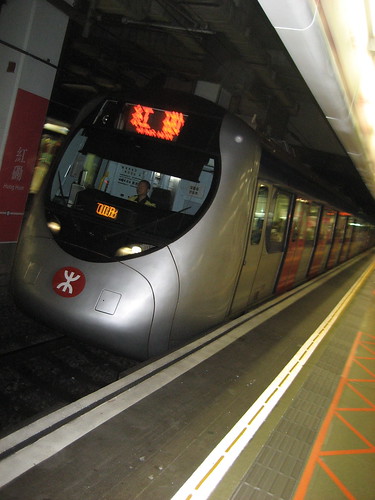
I recently arrived in Hong Kong to begin a two-month internship with a property development company called Cheung Kong Holdings. I start work on June 21st.
As someone deeply passionate about urban planning, my first observations in Hong Kong were: one, its high density environment and two, its extremely adequate public transit system, known as the Mass Transit Railway (MTR). The MTR is an integral part of Hong Kong's transportation system. I took the MTR from the Airport, located in the far west, to Hung Hom Station located in Kowloon (the station closest to where I am staying).
I had to switch trains a couple of times with my luggage (a pain to carry around) but was completely distracted by the MTR's efficiency, good ridership (approx 4 million trips made on the MTR on an average weekday) and intelligent technology. The trains have TVs that provide updates of transit delays, the weather and local news to name a few. Overall, a much more exciting and interesting way to travel than a cab.
Enviro Boys has blogged extensively about public transit in the past. A lot of my posts on public transit have been based on what I have read from academic journals, news articles and other publications. I have first-hand experience with Toronto's TTC, but this system is in need of desperate revitalization.
The MTR is going to be my main method of transit over the next two months. It could take me anywhere I need to go around Hong Kong. I will use it to go from Kowloon (where I live) to Hong Kong Island (where I work). Most impressively, the MTR is incredibly efficient and affordable! Efficient and affordable public transit systems are a rarity in Canada. Of course, Hong Kong's high density and compactness justify the need for an excllent transit system. Nonetheless, there are so many lessons to learn from the MTR, lessons I will bring with me to Vancouver and my grad program.
There will be more posts about the MTR as the weeks progress. Hopefully, these posts will come from observation and first-hand experience, a different approach to my coverage of public transit on this blog.
Photo Image: Picture of MTR West Line Train courtesy of flickr.com
Wednesday, June 16, 2010
The Enviro Boys Graduate

Chris and I graduated at Trent on June 3rd, 2010. It was a wonderful day spending time with fellow graduates and collectively cherishing the accomplishment of receiving our undergrad degrees. Both Chris and I had very fulfilling undergrad experiences from the courses we took, to the faculty research we assisted with and to our culminating honours theses. Trent is a school we will dearly miss.
In December 2008, when Chris asked me if I was interested in co-blogging with him, I was honoured, not knowing how much we would benefit from the blogging experience. In January 2009, we started this blog and have grown tremendously from it. It was an Environmental Policy class at Trent that was our source of inspiration for starting this blog. Among many of the benefits we attained from a Trent education, we developed a blog at this university and we are grateful that it provided the inspiration to do so. We will continue the blog as we both begin new journeys; ones that will be full of adventure, learning and challenge.
At our Convocation ceremony, Nancy Strictland was the recipient of the honorary Doctor of Laws degree. She received her Honours B.Sc from Trent in Physical Geography. Nancy has dedicated her life to international development and global citizenship. She has done great work in creating educational links between Bhutan and Canada. Indeed, from 1992 to 2008 Nancy worked for the University of New Brunswick coordinating a series of Canadian International Development Agency (CIDA) funded education projects and heading the Canadian Cooperation Office in Bhutan.
She also worked with the World University Service of Canada (WUSC) as a geography teacher in rural Zimbabwe. You can view her acceptance speech below:
Monday, June 14, 2010
Greenest City Action Team: Vancouver
 I am reading through a report titled "Greenest City". It was put together in 2009 by the Greenest City Action Team (GCAT). The team comprises a number of environmental experts including councillors, Vancouver's Mayor Gregor Robertson, David Suzuki, David Boyd (one of Canada's leading environmental lawyers) just to name a few. This group of independent experts represents an immense knowledge base. They have a close understanding of the most pressing environmental interests that Vancouver faces.
 The GCAT was given an audacious mandate: to figure out what Vancouver needs to do to become the greenest city in the world by 2020. The report is about 30-pages in length.
The report outlines several recommendations including the "greenest city action fund". In short, this recommendation suggests that the City seek funding partners (the provincial and federal governments, private donors, and businesses) to establish a Greenest City Action Fund to support investments in green infrastructure, energy efficiency, green jobs, environmental education and green business.
Specifically, with the establishment of this fund, the City could create a world-class environmental education centre, the acquisition of land for public green spaces, development of small-scale sources of renewable energy (geothermal, biomass, solar etc) and even an energy efficiency retrofit program for residential buildings.
Cities like Stockholm have shown great leadership on similar initiatives. Indeed, in 2003, Stockholm established the "Miljomiljarden" or Environmental Billion initiative, dedicating one billion Swedish kronor to improving environmental conditions. The money was spent on various projects including: environmental information, activities that promote the preservation of biodiversity, efficient energy consumption and waste management and the decontamination of polluted lands, lakes and water courses. Stockholm was recently named the Greenest City in Europe.
Vancouver has high hopes but is undoubtedly on the right track. The Greenest City Action Fund is a progressive and holistic approach to greening a city. However, it is not money that will exclusively solve all of Vancouver's environmental challenges. The fund will require a number of inputs beyond just monetary provision. Indeed, greening a city requires active participation and collaboration among the private sector, government agencies, citizens, agriculture and local schools. All of these stakeholders are critical in the sustainability process and all need to articulate how such a fund would benefit the city as a whole.
Key Message: We should commend the hitherto green leadership shown by the Mayor, Gregor Robertson and the Greenest City Action Team. With their ambitions, vision and drive, the team will in some way lead Vancouver in a direction that will make the city more livable and sustainable.
Wednesday, June 9, 2010
A take on Harper's fake lake...
What would you do with $2 million dollars?
Some would buy a fake lake. But not a real fake lake. That's cruel.
As part of its extravagant spending spree on the G8/G20 summits later this month, the Conservative government is now on the defensive for a $2 million indoor lake being built in downtown Toronto, complete with a dock, Adirondack Chairs and walls of canoes. According to the government, it is a necessary expense to showcase and market what Canada has to offer.
I'm not the first, and certainly won't be the last, to say that this is absolutely idiotic. The billion dollar security bill is outrageous and the rest of the spending is ridiculous. The fake lake epitomizes everything that is wrong with the G8/G20 summits.
Apart from the fact that the government is throwing vast sums of money at the summits while operating at a record deficit and while lots of Canadian people & programs could use that cash, we need to remember exactly what all this spending is for. It's for a three day conference that will, let's be realistic, come to nothing more than a consensus to meet again and discuss further. At best. And lots of issues aren't even on the table, like the embarrassing abortion and environmental policies the head-in-the-sand government stomps around with.
The "marketing what Canada has to offer" argument is fair until you look beyond the words in quotation marks. Lots of countries that host these international conferences like to market different aspects of the country to increase tourism or just boast. So what are we marketing? The bloody Muskokas.
Listen, I love the Muskokas. It is a beautiful area with some of the greatest lakes and cottage country in the world. But let's get realistic for a second. Anyone living in southern Ontario knows that much of the Muskokas is now an exclusive playground for the elite. What was once a relatively remote and affordable escape for Ontarians has been turned into a cottage country club, where century-old cottages are being torn down daily to make way for McMansions. You might be on the water, but don't kid yourself, those behemoths aren't cottages. And good luck affording one unless you work in the highest offices of Bay Street. This is not representative of Canada
And the canoes? Yes, we love canoeing in Canada. But the Conservative government doesn't. Last year, the government sneakily passed an amendment to the Navigable Waters Protection Act that basically changed the definition of what navigable waters are, making it much easier to develop on popular canoeing and kayaking routes. Canoeing and kayaking groups were far from impressed. And more recently, they're using a loophole in the Fisheries Act to legally classify some Canadian lakes as toxic mining waste sites. Please, come enjoy our waste-filled lakes!
The last thing I'll touch on is how Harper is increasingly eroding Canada's international reputation. He touts our stable financial system, which he is not entirely responsible for. Apart from that, we look like fools on the international stage. Our environmental record is dismal and we seem to be competing with China in the race to best stymie climate change negotiations. Everywhere you look these days, Canada seems to be the sore thumb sticking out in the world. And not in a good way, whether it be on a global bank tax, international abortion funding or on the fishing of endangered tuna. For the G8 and G20 leaders, attending Canada's summits must be like going to your classmate's party only because your mom told you you had to.
I remember many years ago feeling very proud to be Canadian when my father told me how many Americans attach a Canadian flag patch to their gear when travelling abroad because being Canadian was enviable. My bank likely won't collapse and I get a GST cheque in the mail every three months, but I fear that I won't be able to give my children the same message.
Some would buy a fake lake. But not a real fake lake. That's cruel.
As part of its extravagant spending spree on the G8/G20 summits later this month, the Conservative government is now on the defensive for a $2 million indoor lake being built in downtown Toronto, complete with a dock, Adirondack Chairs and walls of canoes. According to the government, it is a necessary expense to showcase and market what Canada has to offer.
I'm not the first, and certainly won't be the last, to say that this is absolutely idiotic. The billion dollar security bill is outrageous and the rest of the spending is ridiculous. The fake lake epitomizes everything that is wrong with the G8/G20 summits.
Apart from the fact that the government is throwing vast sums of money at the summits while operating at a record deficit and while lots of Canadian people & programs could use that cash, we need to remember exactly what all this spending is for. It's for a three day conference that will, let's be realistic, come to nothing more than a consensus to meet again and discuss further. At best. And lots of issues aren't even on the table, like the embarrassing abortion and environmental policies the head-in-the-sand government stomps around with.
The "marketing what Canada has to offer" argument is fair until you look beyond the words in quotation marks. Lots of countries that host these international conferences like to market different aspects of the country to increase tourism or just boast. So what are we marketing? The bloody Muskokas.
Listen, I love the Muskokas. It is a beautiful area with some of the greatest lakes and cottage country in the world. But let's get realistic for a second. Anyone living in southern Ontario knows that much of the Muskokas is now an exclusive playground for the elite. What was once a relatively remote and affordable escape for Ontarians has been turned into a cottage country club, where century-old cottages are being torn down daily to make way for McMansions. You might be on the water, but don't kid yourself, those behemoths aren't cottages. And good luck affording one unless you work in the highest offices of Bay Street. This is not representative of Canada
And the canoes? Yes, we love canoeing in Canada. But the Conservative government doesn't. Last year, the government sneakily passed an amendment to the Navigable Waters Protection Act that basically changed the definition of what navigable waters are, making it much easier to develop on popular canoeing and kayaking routes. Canoeing and kayaking groups were far from impressed. And more recently, they're using a loophole in the Fisheries Act to legally classify some Canadian lakes as toxic mining waste sites. Please, come enjoy our waste-filled lakes!
The last thing I'll touch on is how Harper is increasingly eroding Canada's international reputation. He touts our stable financial system, which he is not entirely responsible for. Apart from that, we look like fools on the international stage. Our environmental record is dismal and we seem to be competing with China in the race to best stymie climate change negotiations. Everywhere you look these days, Canada seems to be the sore thumb sticking out in the world. And not in a good way, whether it be on a global bank tax, international abortion funding or on the fishing of endangered tuna. For the G8 and G20 leaders, attending Canada's summits must be like going to your classmate's party only because your mom told you you had to.
I remember many years ago feeling very proud to be Canadian when my father told me how many Americans attach a Canadian flag patch to their gear when travelling abroad because being Canadian was enviable. My bank likely won't collapse and I get a GST cheque in the mail every three months, but I fear that I won't be able to give my children the same message.
An "Economy vs. Environment" Debate

I was reading an article from the New York Times titled "Muddy Road Molds Debate on the Future of Guyana". The article reminded me of that classic debate between the economy and the environment. While this particular example is far more complicated, it illustrates how a country (Guyana) has the opportunity to pave a 300-mile road that connects the capital (Georgetown) to Letham, a boomtown on the border with Brazil.
Investors from Brazil are ecstatic about this because it would allow them to search for a deepwater port near Georgetown, giving northern Brazil a "modern artery to export its goods to the Caribbean and North America".
For Guyana, the project presents an opportunity and a threat. Could the road help provide Guyana with an identity, especially an economic identity? This small country of 753,000 is the poorest in South America, with per capita income lower than Bolivia. The road would help Guyana reap significant benefits from trade and take the country more aggressively forward into the global economy.
On the other hand, Guyana could take the more ecologically sustainable path to its economic development. Indeed, the President, Bharrat Jagdeo (who visited Trent University in October) has demonstrated great leadership on forest protection policies and other environmental initiatives.
Environmentalists are deeply concerned about the potential road. Paving it could damage the forest, disrupt and displace river otters, arapaima fish and jaguars. It is projected that two million acres of rain forest could be affected if the road is paved.
Road proponents have acknowledged that the project could bring about upheaval. But they also see how it could ease Guyana's poverty. But, who's going to pay for it? The Prime Minister of Guyana, Sam Hinds, supports the project, as long as Guyana could find $350 million to finance it. There is no indication as to how much the Brazilian government will pay for the project. Their return on investment would be quite adequate considering their expanded trade routes. While the road would be stretched across the country of Guyana, it would be completely inequitable for this poor nation to finance the project at 100%.
Citizens have come out and expressed their deep concerns. Justin de Freitas, 35, who worked as a porter along the road said "that road is going to end our way of life".
There are others as well (including Indigenous) who could be affected by such a project.
To build or not to build? A looming question with seemingly clear costs and benefits. Does the country risk sacrificing its native species, local ecosystems and forested areas for a paved road that will ostensibly bring economic progress? Does it jeopardize its image as a global leader in forest protection policies? These are just some of the tough battles that Guyana now faces with concomitant pressure from the rising economic power that is Brazil.
Key message: These projects are incredibly complex. Squandering an economic opportunity for environmental protection is always a tough one to swallow. A country like Guyana has ambitions to utilize more renewable energy and continue to protect its pristine forests. However, tough decisions lie ahead about economic opportunities that can potentially bring about more benefits to the country's citizenry and alleviate national poverty.
Tuesday, June 8, 2010
A Special Report on Water from The Economist
The audio program above provides a thorough review of the world's water situation. John Grimond from The Economist, discusses the "hot topics" of global water resources.
We hear about hydro-electric power (a clean and green form of electricity but controversial as shown in China's Three Gorges Dam.) We also hear about the future of desalination, a technology that allows us to convert salt water to fresh water through a process called reverse osmosis. It is utilized in a few places in the world currently, (Israel, the UAE and Australia to name a few). The economics of desalination is getting better, however, the energy requirements are still really high. This has created the impetus to use renewable energy to power desalination, a process that could eventually happen on a large scale basis.
Singapore (population:4.5 million) is cited as a steward of water conservation and efficiency. Singaporeans use 155 litres of water a day, that's half of what the average Canadian uses. Andhra Pradesh (a state on the south eastern coast of India) is another example where we are seeing more experiments with effective groundwater management which has reduced demand for water. In Andhra Pradesh, all sectors including agriculture, use less water and far more efficiently.
Finally, cooperation is another significant component in our discussion of water resources. The Nile Basin Initiative is cited as the example regarding good cooperation on water. It is a "partnership among the Nile riparian states that seeks to develop the river in a cooperative manner, share substantial socioeconomic benefits, and promote regional peace and security".
Key Message: While water is becoming more scarce globally, the use of technology is becoming more sophisticated. Also, some of our global leaders (in Singapore, Andhra Pradesh and Guelph) are demonstrating the importance of water conservation and fair allocation. How we price and trade water in an era of scarcity will be one of the more interesting topics in the years to come.
Sunday, June 6, 2010
Re: Trent's Green Grad...
My recent post on Trent's efforts to have a "green" graduation and my actual experience several days later highlights the difference between good intentions and real outcomes. Last week, Trent's three days of convocation ceremonies employed three different strategies to reduce the environmental impact of the graduation event. Unfortunately, all three strategies came away looking fairly chincy.
Its second annual "Bottled Water-Free" convocation was relatively successful and was highlighted by the stainless steel water bottles provided to each graduate. The water bottles, however, were of poor quality. The lids would not stay on properly and once just came right off when I picked up the bottle. Moreover, there were a few instances where the bottoms of the bottles blew off when they were dropped on the ground. I appreciate the effort Trent, but I'm not very confident that many of those bottles will be reused frequently in the future.
The second lackluster effort fell on the shoulders of the student group, Sustainable Trent, of which, in the interest of full disclosure, I am an outgoing member. For several years, a handful of dedicated volunteers have worked to put together the Green Pledge, a voluntary pledge taken by graduates to keep the environment in mind when making major decisions in the future. Unfortunately, the main coordinator of the Green Pledge was unable to do it this year and wasn't picked up until the last minute. As I stood in line minutes away from procession, an ST volunteer handed me a pin and asked if I wanted to take the pledge. I knew what it was, so I took the pin. Another graduate behind me did not know what it was, but took it after a one line description. Unsurprisingly, very few graduates had a green pin on. It was a sad sight after such popularity in the past.
The third effort came in the form of free public transit passes to graduates and their guests. I'll admit that I didn't look too much into this and don't know how popular it was, but when looking into the logistics, it looked a little tedious. In order to ride for free, graduates and guests had to print out tickets from the website. Because many of the guests and graduates were coming in from out of town and staying in hotels, printing a piece of paper wouldn't be all that feasible and (forgive my assessment of human beings) most people wouldn't have thought about that ahead of time. Why not just make the Trent Express free that day for everyone? I would not be surprised, however, if the bus drivers just let everyone on anyways without the pass.
I hate to gripe about Trent's 'green' efforts, but they were hyped so much and yet so half-heartedly followed through on. And some people will likely tell me to not be so critical and just be happy Trent tried. But too bad. If you want to legitimize your 'green' reputation, do it with some effort.
But alas, this should not take away from the main occasion. A graduation is a special thing to celebrate, the ceremony was enjoyable and I offer congratulations to all the other graduates. It's a shame it couldn't have a been a little 'greener'.
Thursday, June 3, 2010
Our Guest Post for Aguanomics

David Zetland was kind to write a guest post for Enviro Boys. David's key message was: with good water management in place, the conditions for equity, efficiency and sustainability are all achievable.
On that note, Chris and I wrote a guest post (an exchange) for David's blog at Aguanomics. We wrote about Guelph, Ontario, as Canada's water steward leader.
Feel free to check out our post at Aguanomics.
Tuesday, June 1, 2010
Guest Entry: A few thoughts for the Canucks...
By: David Zetland of Aguanomics
Tim and Chris asked me to turn my California perspective on Canada's water situation. I won't talk about pollution from refining tar sands, aquifer depletion in the plains, unsustainable "traditional" fisheries and farms in Nova Scotia, Quebec's hydropower, or the water-people mismatch in Nunavut. Instead, I will talk about those great big lakes full of fresh water.
I was chatting with one of your neighbors about the potential for marking water from the Great Lakes. I told him that "you folks" should define diversions, clarify water rights, and create a market for trading rights.
"But David," he said. "There's so much water that the price is sure to be $0. Demand is so small compared to supply."
"Ahhh, but that's the point."
Apparently people are getting all excited and upset about Great Lakes water when it's really too abundant to worry about. A $0 price for water signifies one of two things. Either people are making senseless arguements about its precious nature when supply far exceeds demand, or people are making sensible arguments that need to be integrated into our definitions of supply and demand. In either case, we need more objective facts (prices) and fewer subjective emotions.
You tell me if I'm right or missed something.
But let's just assume for the moment that the price really would be $0. Does that mean that a market and prices are a bad idea?
No. First of all, it's useful to set up a framework when there is still plenty of water around. If the price rises above $0, then people will know that water is getting more scarce. Second, the value of water is always higher than its price. There's no need to fear that a $0 price connotes a $0 value.
Third, it's important to get market signals -- prices -- out there early. Water shortages are manmade, and they often show up because bureaucrats in charge of allocation do not aggregate all of the supply and demand signals that a market would. Bureaucrats would still keep their jobs (whew!), but they would make sure that the market -- rights, trades, delivery -- was functioning.
But some of you might be wondering if we don't already have a price for water, the price that appears on your monthly water bills. Well, no you don't. Those bills reflect the cost of delivering pressurized clean water 24/7. They reflect the cost of pipes, energy and salaries that go into that service. They do NOT reflect the price (or value) of water. That price is $0, not just because there's no market, but because most of your water comes from utilities that have a right to divert as much as they want from lakes, rivers or aquifers into the water distribution system.
By the way, your cost of service may be flat rate -- an all-you-can-eat fixed charge -- or uniform rate -- the more you use, the more you pay, but either system is based on recovering the cost of the system, not "paying for water." Note that uniform rates tend to reduce consumption (the same way that paying per liter of petrol does); they also make heavy water users pay for a larger share -- their "fair" share -- of the system costs.
It may not make sense to switch to meters -- if their installation cost is much greater than the water savings -- but they are the best first step towards promoting water conservation. (I wonder if farmers in the Plains buy metered water?)
Bottom Line: Good water management is equitable, efficient and sustainable. Don't start too late, or you'll follow California into a deep dark hole of "how the hell are we going to get out of this?"
Dr. David Zetland has a PhD in Agricultural and Resource Economics from the University of California, Davis. Currently, he is S.v. Ciriacy-Wantrup Postdoctoral Fellow in Natural Resource Economics and Political Economy, University of California, Berkeley.
Tim and Chris asked me to turn my California perspective on Canada's water situation. I won't talk about pollution from refining tar sands, aquifer depletion in the plains, unsustainable "traditional" fisheries and farms in Nova Scotia, Quebec's hydropower, or the water-people mismatch in Nunavut. Instead, I will talk about those great big lakes full of fresh water.
I was chatting with one of your neighbors about the potential for marking water from the Great Lakes. I told him that "you folks" should define diversions, clarify water rights, and create a market for trading rights.
"But David," he said. "There's so much water that the price is sure to be $0. Demand is so small compared to supply."
"Ahhh, but that's the point."
Apparently people are getting all excited and upset about Great Lakes water when it's really too abundant to worry about. A $0 price for water signifies one of two things. Either people are making senseless arguements about its precious nature when supply far exceeds demand, or people are making sensible arguments that need to be integrated into our definitions of supply and demand. In either case, we need more objective facts (prices) and fewer subjective emotions.
You tell me if I'm right or missed something.
But let's just assume for the moment that the price really would be $0. Does that mean that a market and prices are a bad idea?
No. First of all, it's useful to set up a framework when there is still plenty of water around. If the price rises above $0, then people will know that water is getting more scarce. Second, the value of water is always higher than its price. There's no need to fear that a $0 price connotes a $0 value.
Third, it's important to get market signals -- prices -- out there early. Water shortages are manmade, and they often show up because bureaucrats in charge of allocation do not aggregate all of the supply and demand signals that a market would. Bureaucrats would still keep their jobs (whew!), but they would make sure that the market -- rights, trades, delivery -- was functioning.
But some of you might be wondering if we don't already have a price for water, the price that appears on your monthly water bills. Well, no you don't. Those bills reflect the cost of delivering pressurized clean water 24/7. They reflect the cost of pipes, energy and salaries that go into that service. They do NOT reflect the price (or value) of water. That price is $0, not just because there's no market, but because most of your water comes from utilities that have a right to divert as much as they want from lakes, rivers or aquifers into the water distribution system.
By the way, your cost of service may be flat rate -- an all-you-can-eat fixed charge -- or uniform rate -- the more you use, the more you pay, but either system is based on recovering the cost of the system, not "paying for water." Note that uniform rates tend to reduce consumption (the same way that paying per liter of petrol does); they also make heavy water users pay for a larger share -- their "fair" share -- of the system costs.
It may not make sense to switch to meters -- if their installation cost is much greater than the water savings -- but they are the best first step towards promoting water conservation. (I wonder if farmers in the Plains buy metered water?)
Bottom Line: Good water management is equitable, efficient and sustainable. Don't start too late, or you'll follow California into a deep dark hole of "how the hell are we going to get out of this?"
Dr. David Zetland has a PhD in Agricultural and Resource Economics from the University of California, Davis. Currently, he is S.v. Ciriacy-Wantrup Postdoctoral Fellow in Natural Resource Economics and Political Economy, University of California, Berkeley.
Monday, May 31, 2010
Lunch with David Zetland
Chris and I had lunch today with David Zetland in downtown Toronto. David is S.v. Ciriacy-Wantrup Postdoctoral Fellow in Natural Resource Economics and Political Economy, UC Berkeley. Chris and I have been corresponding with David for a number of months about water policy and the economics of water.
David was also kind enough to do a short guest lecture in April for our Global Environmental Policy class. Our class called David's office at Berkeley via teleconferencing. He shared many great insights about how we value water, how we should price it, how we should distribute it and how we can work better and more effectively with water managers and bureaucrats.
David maintains a water economics blog titled "Aguanomics".
I would encourage you to read his short but very insightful article in Forbes Magazine titled "The Water Shortage Myth". It can be found here:
http://www.forbes.com/2008/07/14/california-supply-demand-oped-cx_dz_0715water.html.
Also, he did a really neat interview with Tom Keene from Bloomberg Radio back in January 2009. Keene poses questions to Zetland concerning water supply, thoughts on bottled water versus tap water, pricing mechanisms, and water distribution. If you haven't heard it already, check out the audio file here:
http://media.bloomberg.com/bb/avfile/Economics/On_Economy/vGBtvsfu8Ofg.mp3
It was a privilege to have lunch with David as we shared stories, talked about water policy, our future plans and more. We wish him all the best with his travels in Central America.
David was also kind enough to do a short guest lecture in April for our Global Environmental Policy class. Our class called David's office at Berkeley via teleconferencing. He shared many great insights about how we value water, how we should price it, how we should distribute it and how we can work better and more effectively with water managers and bureaucrats.
David maintains a water economics blog titled "Aguanomics".
I would encourage you to read his short but very insightful article in Forbes Magazine titled "The Water Shortage Myth". It can be found here:
http://www.forbes.com/2008/07/14/california-supply-demand-oped-cx_dz_0715water.html.
Also, he did a really neat interview with Tom Keene from Bloomberg Radio back in January 2009. Keene poses questions to Zetland concerning water supply, thoughts on bottled water versus tap water, pricing mechanisms, and water distribution. If you haven't heard it already, check out the audio file here:
http://media.bloomberg.com/bb/avfile/Economics/On_Economy/vGBtvsfu8Ofg.mp3
It was a privilege to have lunch with David as we shared stories, talked about water policy, our future plans and more. We wish him all the best with his travels in Central America.
Friday, May 28, 2010
Trent's Green Grad...

This time next week, Trent's seemingly empty and idyllic Peterborough campus will be overrun by a swath of robed graduates and their guests. Tim and I will be among them, taking the famed walk across Trent's photogenic Faryon Bridge to accept our degrees.
It is convocation season around Canada. Graduates can range from only a several hundred at the smaller schools, to at least ten thousand at some of the larger schools. Families, friends and other guests flock to celebrate with the new grads. These are far from small functions.
For its part, Trent is trying to make the convocation ceremonies as 'green' as possible. Extending over a period of three days, the five-ceremony process has used approximately 5,000 single use water bottles in previous years. For the second consecutive year, Trent will employ a Bottled-Water Free Convocation, a move Trent pioneered among Canadian campuses. Each graduate will be provided with a reusable stainless steel water bottle -- already filled with clean tap water -- for the ceremony and potable tap water will be provided for guests in recyclable or biodegradable cups. Of course, for those who feel an unexplainably strong inkling for bottled water, it can probably be bought in a vending machine for three times the price of gasoline.
As an aside, did anyone happen to watch CTV News a few nights ago where it reported on the findings of a new study that found bacteria levels to be "revoltingly" high in many bottled water products? Relatively unpublicized studies are cited all the time by opponents of bottled water to little avail, but when the national news starts reporting on it, a major blow will be dealt to the bottled water industry.
Returning to Trent, the school will also be providing graduates and their guests with free passes on public transit to encourage the use of public transportation over cars. Mind you, Peterborough's public transportation system is not particularly impressive, so this might not be as popular as one might hope, but it's worth a shot. After all, transporting a couple of thousand people by car over bus is pretty inefficient. Can you imagine U of T or York providing free transit for its convocations via TTC? It would a very 'green' move, but I certainly wouldn't want the bill landing on my desk.
Trent's third major 'green' initiative is its Green Pledge, a pledge graduating students can opt to take where "they pledge to explore and take into account the social and environmental consequences of any job they consider and will try to improve those aspects of the organization for which they work". For the informal commitment, graduates get to where a nice little green pin.
In addition to the initiatives at Trent, I certainly hope people get a chance to explore Peterborough. In the summer, it can be one of the most beautiful cities in Canada.
Thursday, May 27, 2010

Wednesday, May 26, 2010
A highly informative video on High Speed Rail
The video above is primarily focused on California but nevertheless, it provides an excellent overview of High Speed Rail (HSR). California is one of those American states that will receive funding ($2.3 billion) from the Obama Administration for High Speed Rail construction.
Liam Julian from the Hoover Institution out of Standford University, provides a summary of the problems with HSR in the U.S. available here.
Roy MacGregor from the Globe and Mail speaks about HSR in certain regions in Canada and some of its benefits.
Getting more serious on vehicle emissions...
The Canadian government is at last approaching the subject of vehicle emissions a little more seriously. In an article from the Globe and Mail, the Federal government has predicted that it will cost Canada’s auto makers, fuel suppliers and drivers almost $13-billion to meet greenhouse gas emission standards over the next six years.
We are also going to see renewable fuel regulations as of September 1, 2010 which are great, but they too will be costly. There is going to be a mandatory 5-per-cent ethanol content in gasoline which is going to cost roughly $3.2-billion.
Auto manufacturers will incur (well this is a first) $3.7-billion in added costs from the 2011-2016 standards out of a total price tag of $4.2-billion. At last, they will be carrying a bigger burden in terms of fuel standards and making their vehicles more efficient.
Vehicle emission standards are no doubt expensive. As we continue to manufacture vehicles, pass legislation and see a concomitant rise in gasoline prices, one would figure that driving (or to buy a car) can be costly. The Transportation sector is a huge emitter of carbon dioxide. 27 per cent of the country’s greenhouse gas emissions are produced by cars, trucks, trains, ships and aircraft.
These new standards will definitely alleviate the emissions output of motor vehicles and perhaps provide a logical reason to explore other innovative transportation options i.e. High Speed Rail.
Environment Canada is confident that the "benefits of better fuel economy will exceed costs by three to one, including $9.7-billion in fuel savings which, officials said, will more than make up for higher vehicle prices. It calculated motorists will recover their added upfront costs in a year and a half"
For some links on vehicle emissions see below:
http://en.wikipedia.org/wiki/Emission_standard
http://www.ic.gc.ca/eic/site/auto-auto.nsf/eng/am01205.html
http://ec.europa.eu/enterprise/sectors/automotive/environment/financial/index_en.htm
We are also going to see renewable fuel regulations as of September 1, 2010 which are great, but they too will be costly. There is going to be a mandatory 5-per-cent ethanol content in gasoline which is going to cost roughly $3.2-billion.
Auto manufacturers will incur (well this is a first) $3.7-billion in added costs from the 2011-2016 standards out of a total price tag of $4.2-billion. At last, they will be carrying a bigger burden in terms of fuel standards and making their vehicles more efficient.
Vehicle emission standards are no doubt expensive. As we continue to manufacture vehicles, pass legislation and see a concomitant rise in gasoline prices, one would figure that driving (or to buy a car) can be costly. The Transportation sector is a huge emitter of carbon dioxide. 27 per cent of the country’s greenhouse gas emissions are produced by cars, trucks, trains, ships and aircraft.
These new standards will definitely alleviate the emissions output of motor vehicles and perhaps provide a logical reason to explore other innovative transportation options i.e. High Speed Rail.
Environment Canada is confident that the "benefits of better fuel economy will exceed costs by three to one, including $9.7-billion in fuel savings which, officials said, will more than make up for higher vehicle prices. It calculated motorists will recover their added upfront costs in a year and a half"
For some links on vehicle emissions see below:
http://en.wikipedia.org/wiki/Emission_standard
http://www.ic.gc.ca/eic/site/auto-auto.nsf/eng/am01205.html
http://ec.europa.eu/enterprise/sectors/automotive/environment/financial/index_en.htm
Tuesday, May 25, 2010
Uber nerds unite: A trip to the Canada Wide Science Fair...
It was like grade 8 all over again. Rows upon rows of display boards; some put together with the artistic prowess of a kindergartener, while others had the scientific precision of a well-published academic. Each student sat well-dressed in front of their projects as onlookers slowly walked by, the more successful ones draped in medals and trying to fend off a scrum of questioners like Crosby after his gold-medal goal, while the less successful sat quietly text messaging or talking with some of their newly-made friends.
In such an atmosphere, the distinction is easily made. But in the real world, each of these kids is at the top of their game. This is after all, the national science fair. Thousands of people are involved, including top level research programs and bigwig multinationals. My science fair was like a pickup game of hockey, but this was the NHL. I was completely blown away by the level of work and intellect put into these projects.
I found it particularly astonishing that roughly half the projects I saw had to do with the environment, be it with a focus on renewable energy, reducing pollution or water issues. I talked to a girl in grade 8 who did a project on water conservation. She knew far more about the global water crisis than many people my age and was able to not only convey her information to me quite clearly, but was also able to have a conversation with me about it. Grade 8!
This focus on the environment was quite indicative of how important this kind of stuff is. Energy, particularly wind and solar energy, garnered a lot of attention. I saw numerous projects looking at how to make more efficient wind turbines, better solar panels and even ways to integrate the two. I talked to one girl who had spent many previous years researching different ways to improve the efficiency of solar panels and this year decided to research how applicable they really are. Her poster was called Solar Fraud, where she told me how financially inefficient they are, how the chemicals used to make them are really dangerous and how some solar contractors are swindlers. This is true. But when I asked her if she had compared any of this to other energy technologies, she hadn't. Because she was so young, I gave her the benefit of the doubt. But what was really impressive was how she responded when I asked her if we should just kick solar technology to the curb. Instead of the expected yes, she said we should instead be investing in more R&D so we don't need to use the dangerous chemicals. Lots of people would simply say solar is stupid.
Several projects focused on assessing how green certain products were, such as the kid who tested the biodegradability of certain soaps with that label in his fishtank. Sadly, none of the fish made it. So much for the biodegradable label.
I should disclose that these were only a handful of projects and the ones that appealed to me. I only had a short time there and wished I could have explored more of them in greater detail. The ones that received high levels of praise were largely incomprehensible to a mere mortal like myself. I also walked in there in a university frame of mind. When I saw projects I thought to myself, "I already know that" or "there's already folks looking at that somewhere else."
It was not until I left that it really sank in how impressive this was. Yes, I already know lots of this. But I'm 22, not 12. And yes, there's already people looking at this stuff. But they are well-educated engineers, not kids. I can only imagine what they will accomplish in the future.
The future is bright.
In such an atmosphere, the distinction is easily made. But in the real world, each of these kids is at the top of their game. This is after all, the national science fair. Thousands of people are involved, including top level research programs and bigwig multinationals. My science fair was like a pickup game of hockey, but this was the NHL. I was completely blown away by the level of work and intellect put into these projects.
I found it particularly astonishing that roughly half the projects I saw had to do with the environment, be it with a focus on renewable energy, reducing pollution or water issues. I talked to a girl in grade 8 who did a project on water conservation. She knew far more about the global water crisis than many people my age and was able to not only convey her information to me quite clearly, but was also able to have a conversation with me about it. Grade 8!
This focus on the environment was quite indicative of how important this kind of stuff is. Energy, particularly wind and solar energy, garnered a lot of attention. I saw numerous projects looking at how to make more efficient wind turbines, better solar panels and even ways to integrate the two. I talked to one girl who had spent many previous years researching different ways to improve the efficiency of solar panels and this year decided to research how applicable they really are. Her poster was called Solar Fraud, where she told me how financially inefficient they are, how the chemicals used to make them are really dangerous and how some solar contractors are swindlers. This is true. But when I asked her if she had compared any of this to other energy technologies, she hadn't. Because she was so young, I gave her the benefit of the doubt. But what was really impressive was how she responded when I asked her if we should just kick solar technology to the curb. Instead of the expected yes, she said we should instead be investing in more R&D so we don't need to use the dangerous chemicals. Lots of people would simply say solar is stupid.
Several projects focused on assessing how green certain products were, such as the kid who tested the biodegradability of certain soaps with that label in his fishtank. Sadly, none of the fish made it. So much for the biodegradable label.
I should disclose that these were only a handful of projects and the ones that appealed to me. I only had a short time there and wished I could have explored more of them in greater detail. The ones that received high levels of praise were largely incomprehensible to a mere mortal like myself. I also walked in there in a university frame of mind. When I saw projects I thought to myself, "I already know that" or "there's already folks looking at that somewhere else."
It was not until I left that it really sank in how impressive this was. Yes, I already know lots of this. But I'm 22, not 12. And yes, there's already people looking at this stuff. But they are well-educated engineers, not kids. I can only imagine what they will accomplish in the future.
The future is bright.
Friday, May 21, 2010
Guest Entry: Bike Lanes Serve all Torontonians

This guest entry was written by Yvonne Bambrick for the Toronto Board of Trade. With the author's permission, Yvonne was kind enough to share it with us.
By: Yvonne Bambrick
Bike lanes are a non-partisan issue because they serve all Torontonians. These inexpensive pieces of infrastructure are an important component of the changing realities of urban transportation — not, as many attempt to paint them, a pet project for a small number of commuters.
Cities across North America have been transitioning from merely viewing bicycles as a recreational tool, to understanding that cycling is a legitimate and necessary transportation option. Bicycle infrastructure (lanes, sharrows, bike boxes, etc.) and an active cycling culture benefits drivers, pedestrians, transit riders and cyclists alike. However, infrastructure alone will not suffice — it must be paired with public education.
There are many immediate and positive impacts with bike lanes. They create a dedicated space in which cyclists feel safer, and encourage more people to choose cycling as a mode of transportation — they are a boon to local business and the most affordable and sustainable way to grow our road capacity.
More people on bicycles means fewer people taking up precious road space in cars, and a pressure valve for an overburdened peak-hour transit system. Bike lanes add a greater level of predictability to our roads by showing more clearly where we can expect each transportation mode to be traveling.
With more cyclists on our roads, the phrase “safety in numbers” holds true — the greater the number of cyclists, the more visible they become to motor vehicles and pedestrians. One of the greatest impacts of bike lanes is as a tangible expression of the fact that bicycles have a place in our transportation network.
Economy and Taxes
Encouraging and creating space for Torontonians to choose cycling transportation is one of the cheapest, fastest and most effective ways to accommodate our growing population, and to increase the capacity of our roadways to efficiently move people from A to B.
Bike lanes are cheap! A quick look at Portland, a prime example of a North American city that has fully integrated cycling, confirms this. They calculated that their entire complement of cycling related infrastructure — some 300 miles of bike lanes — cost approximately $60million; the equivalent to the cost of 1 mile of new freeway!
We often hear the argument, ‘If cyclists want bike lanes, they should pay for them.’ Cyclists already do pay for them. Anyone who pays rent or property tax in Toronto is paying for our municipal roadways. If you compare the relative impact of cars and bicycles on the roadways themselves, on our collective airspace, and the healthcare costs of pollution and a sedentary life that driving promotes, it is quite apparent that cyclists are actually subsidizing automobile drivers.
Cycling is also good for business. A recent study by the Clean Air Partnership conducted in Bloor West Village counters the popular myth that removing on-street parking is “bad for business.”
Their conclusions include:
•People who arrive by transit, foot, and bicycle visit more often and report spending more money than those who drive
•People who preferred to see street use reallocated for widened sidewalks or a bike lane were significantly more likely to spend more than $100 per month than those who preferred no change
•The majority of people surveyed, merchants included (58%) preferred to see street use reallocated for widened sidewalks or a bike lane, even if on-street parking were reduced by 50%.
•In this neighbourhood, the majority of merchants predicted that reducing on street parking in favour of widened sidewalks or a bike lane would either not impact or increase their daily customer numbers, and therefore do not believe it will negatively affect commercial activity.
Flow & Congestion
The core function of our roadways is to efficiently move people to and from destinations across the city — not simply, as some still believe, to rapidly throughput automobiles. In fact, the broader aim of Toronto’s much delayed 2001 Bike Plan and proposed Bikeway Network that was designed by our city’s transportation experts, is to insure minimum disruptions to motor vehicle traffic, transit and parking, while creating a safer transportation environment for the growing number of tax-paying Torontonians who choose to ride bicycles for getting around the city.
The streets of Toronto, with or without bike lanes, are a shared environment and all road users have a role to play as we negotiate these busy spaces on a daily basis. Predictable, responsible behaviour, indicating ones intentions through verbal and non-verbal communication, and a bit of good old fashion respect are the keys to safely sharing the road and maintaining the flow of all forms of traffic.
Safety
Road safety is everyone’s responsibility, and we could all use a refresher on our responsibilities. Due to the classification of bicycles as vehicles under the Highway Traffic Act, some confusion still exists because of the hybrid nature of bicycles – they are self propelled and human scale, yet mechanical vehicles. While subject to the same rules of the road, bicycles rely on momentum, have no protective shell, and are vulnerable to minor road surface disruptions.
For example, a small pothole or utility cut that might not affect a car could endanger a cyclist. In the absence of clearly designated places for cyclists to ride, the line between pedestrian/vehicular spaces has been blurred. Poor roadway conditions, combined with an often hostile roadway environment, caused in part due to a lack of sufficient infrastructure that would allow all traffic to flow better, and occasional bullying by intolerant drivers has in some cases pushed cyclists onto the sidewalks where they don’t belong.
Ultimately the thing we must all remember is that in a car/bike collision it is always the cyclist that loses – a bit of skin, a week of work, or in the worst circumstance, a life. That loss could be suffered by your neighbour, your child’s schoolteacher, your lawyer, or your brother — we all know and love a cyclist. Bike lanes and public education about road sharing responsibilities and best practice serve all Torontonians regardless of mode. We’re all in this together.
With education in mind, the Toronto Cyclists Union and our partners, have submitted a full update proposal for the Ontario Driver’s Handbook with far more pedestrian & cycling-related road sharing content throughout; we have created the Toronto Cyclists Handbook (soon available in Toronto’s top 17 languages), and we proposed a shorter and more accessible ‘Urban Cycling 101’ course to be added to the City’s Can-Bike cycling skills curriculum.
Leadership
Leadership regarding active transportation is needed from all levels of government in Canada. While we have seen modest improvements at the municipal level in recent years, and the beginnings of active transportation policy implementation at the provincial level via Metrolinx, we have yet to hear anything at all from the federal level.
On this issue, the US is several steps ahead of us so-called ‘progressive’ Canadians with the US Department of Transportation’s Policy statement on bicycle and pedestrian accommodation. This personal blog post from US Secretary of Transportation Ray LaHood’s tabletop speech at the National Bike Summit in March 2010 reflects their new Policy Statement on Bicycle and Pedestrian Accommodation Regulations and Recommendations. Canada, clearly, has some catching up to do.
Strength in Numbers
Those who have thus far been courageous enough, given current conditions, to choose cycling transportation should be supported and encouraged, not made to fight for acceptance and respect against ignorant, politically motivated, fear-mongering rhetoric. More people choosing cycling transportation is of benefit to all.
Yvonne Bambrick is the Executive Director of the Toronto Cyclists Union
Wednesday, May 19, 2010
Housing Density and the Environment…
“What is the proper density for city dwellings?” This was a question posed by the late renowned urbanist Jane Jacobs. This question is critiqued by Harvard economics professor Edward Glaeser in an insightful post that I encourage you to read. In short, Jacobs (in her active citizenry era) was vocal about the need for density limitations. Density and diversity were two things that she advocated for in the urbanized environment time and time again. But if an area was too dense, Jacobs argued that this would repress diversity and not stimulate it. Thus, she called for density restrictions (usually in dwelling units) so buildings could not grow at extremely tall heights.
Glaeser writes “Jacobs was reacting to the Le Corbusier-inspired public housing passions of the 1950s, when tall structures reflected the passions of planners more than consumer demand. Jacobs was right to emphasize that shorter neighbourhoods also have tremendous virtues”
“But Manhattan’s crime levels have fallen dramatically in recent decades, proving that with sufficient policing, safe streets can be perfectly compatible with tall buildings.”
I’ll touch on the environmental relevance in a bit, but the interesting economics is that restricting new construction and keeping building heights low (because of density maximums) simply means that housing supply cannot satisfy demand. The result is high prices in the city’s core making it only affordable to the wealthy and pushing out the poor. In cities like New York or even Vancouver, the downtown areas or boroughs have really good demand for condos, townhouses and other units because of closeness to work, amenities, the waterfront, public transit etc. Thus by limiting housing supply options, this will immediately force housing development in areas outside of the city in the form of cheaper suburban housing.
I do not have to go at length about the unfortunate (and numerous) ramifications of suburban housing but I want you to think about how your city is growing and what the housing market looks like.
Glaeser says that we should be embracing, not eschewing, densities over 200 units per acre. That’s the safe density number for a place like Manhattan or NYC’s downtown area.
The City of Vancouver (which I’ll blog about at length in the coming months) has not necessarily used density restrictions for urban growth, but has mountains and the ocean to limit housing development in the city. However, the city is all about growing up and not out (an urban planner’s dream) to avoid sprawl. There are many condos and housing units located in the downtown, alas, they are expensive just like Manhattan. So the wealthier class and urban professionals can live and work in the same area. However, the poorer class (with jobs concentrated in the downtown) cannot live there because of housing affordability issues.
Key message: We really need to focus on how we can create affordable spaces in urbanized environments so we don’t see an economic decline that is directly related to the cost of housing. Also, we can make our cities more sustainable and livable this way thereby achieving higher density and creating the impetus for increased public transit use.
Glaeser writes “Jacobs was reacting to the Le Corbusier-inspired public housing passions of the 1950s, when tall structures reflected the passions of planners more than consumer demand. Jacobs was right to emphasize that shorter neighbourhoods also have tremendous virtues”
“But Manhattan’s crime levels have fallen dramatically in recent decades, proving that with sufficient policing, safe streets can be perfectly compatible with tall buildings.”
I’ll touch on the environmental relevance in a bit, but the interesting economics is that restricting new construction and keeping building heights low (because of density maximums) simply means that housing supply cannot satisfy demand. The result is high prices in the city’s core making it only affordable to the wealthy and pushing out the poor. In cities like New York or even Vancouver, the downtown areas or boroughs have really good demand for condos, townhouses and other units because of closeness to work, amenities, the waterfront, public transit etc. Thus by limiting housing supply options, this will immediately force housing development in areas outside of the city in the form of cheaper suburban housing.
I do not have to go at length about the unfortunate (and numerous) ramifications of suburban housing but I want you to think about how your city is growing and what the housing market looks like.
Glaeser says that we should be embracing, not eschewing, densities over 200 units per acre. That’s the safe density number for a place like Manhattan or NYC’s downtown area.
The City of Vancouver (which I’ll blog about at length in the coming months) has not necessarily used density restrictions for urban growth, but has mountains and the ocean to limit housing development in the city. However, the city is all about growing up and not out (an urban planner’s dream) to avoid sprawl. There are many condos and housing units located in the downtown, alas, they are expensive just like Manhattan. So the wealthier class and urban professionals can live and work in the same area. However, the poorer class (with jobs concentrated in the downtown) cannot live there because of housing affordability issues.
Key message: We really need to focus on how we can create affordable spaces in urbanized environments so we don’t see an economic decline that is directly related to the cost of housing. Also, we can make our cities more sustainable and livable this way thereby achieving higher density and creating the impetus for increased public transit use.
Subscribe to:
Posts (Atom)