Image credit: veracitystew.com
It has been a while since Enviro Boys has written about the topic of e-waste, or waste management more generally. Like all environmental problems, this one is complicated.
Elisabeth Rosenthal from the NY Times Green Blog reports:
"When Americans turn in their old car batteries for recycling, they probably think they are doing good for the planet. And done well, recycling batteries is certainly environmentally responsible, since lead mining and processing cause far greater emissions of carbon dioxide than extracting lead from old car batteries for re-use."
More:
"But my article from Mexico should remind us that recycling can be “green” or not, depending on how it is done. That is particularly true of electronic waste, including batteries, where one goal of the recycling process is to extract precious metals. In much of the world, recycling is a big business with ties to gangs and organized crime. That is often the case with lead battery recycling plants in Mexico, that country’s officials told me".
I wrote about this topic of couple of years ago. E-waste is electronic waste in the form of batteries, computers and other electronics that are exported from one country to another for informal recycling processes.
My quick assessment pointed to how the US has not signed the Basel Convention on the Control of Transboundary Movements of Hazardous Wastes and Their Disposal. Worse yet, the Resource Conservation and Recovery Act of the US gives the country authority and control over hazardous and toxic wastes.
E-waste is simply a part of the US's waste disposal strategy. These policies surreptitiously cover up their inherent problems, because they appear to be designed to promote E-waste but in actuality, such waste can end up countries such as Mexico (as reported by Elisabeth Rosenthal). E-waste is also a problem within southeast and east Asia causing pollution and serious ecological harm. See here for the article. While the US is guilty, I am sure Canada is just as bad but alas, the lack of transparency with its waste disposal, make it difficult to know where our car batteries end up, for example.
E-waste is a tricky problem. There have been many recommendations made to nation states on how to deal with this problem. Rosenthal concludes with:
"The government could simply ban used battery exports, as Slab Watchdog suggests. Or it could require that Mexican factories processing used batteries from the United States meet our environmental standards and undergo inspections. The Food and Drug Administration inspects foreign factories that make drugs imported into the United States. The Environmental Protection Agency could take on a similar role for battery recycling plants".
You can read the full story of recycling American car batteries in Mexico here.
An inclusionary dialogue on anything and everything green from the minds of two Canadian university students with the intention of exchanging ideas and opinions pertaining to the environment. We encourage you to contribute to the blog as a reader, commenter and even an author. We're all part of the environment and sharing ideas is a role we can all play.
Showing posts with label United States. Show all posts
Saturday, December 10, 2011
Wednesday, November 30, 2011
Water auctions and participatory water management
An excellent article by Abraham Abhishek on innovative ways to improve water management. Some highlights from the post:
"The Umatilla County Critical Groundwater Solutions Taskforce in Oregon, United States is a body that represents government officials, scientists and (perhaps most importantly) various communities and native tribes in the county. It was formed in response to a dual crisis - rapidly depleting groundwater, and impending conflict amongst various users in the county and neighbouring areas. The taskforce enabled water users and technocrats to work together, which resulted in comprehensive planning and effective implementation of groundwater management activities".
"the proposed water auction mechanism and the observed water management system—seem to make at least one common suggestion: that water security demands efficient water management, which should be based on decentralized decision making. All-in-auctions run counter to the more centralized processes of reallocating water rights, represented by quotas and subsidies. Umatilla-like participatory planning and outreach brings water governance a notch closer to the end users".
Full article here.
Sunday, November 6, 2011
Keystone XL Pipeline and its discontents
From the New York Times' Green blog:
"Thousands turned out on Sunday at the White House for a protest against the proposed Keystone XL pipeline, which would carry oil from the tar sands of Alberta some 1,700 miles to Texas. Opponents say that oil sands processing contributes to greenhouse gas emissions, and that the pipeline itself could threaten a precious aquifer".
More here from the Winnipeg Free Press.
Saturday, October 29, 2011
Cap and trade in California
A recent article by James Tansey from the Tyee reports that:
"The ARB (California Air Resources Board) voted unanimously on Friday to approve the final regulations that will create the second largest carbon market in the world, beginning in 2013. While the U.S. Federal government's interest in climate policy has declined, California, still the world's seventh largest economy, will implement a cap and trade scheme that represents the most significant issue in U.S. climate policy since the Kyoto Protocol".
This evidently puts pressure on British Columbia to be more committed to the Western Climate Initiative.
"While British Columbia's interest in climate policy was affirmed by the premier earlier in 2011, the government's commitment to the WCI is currently subject to an economic impacts review; often in government this kind of study is the earliest sign of a retreat from a policy position".
This bold move by California (a state that has had tremendous financial hardship through its budget crisis), marks a sense of commitment and leadership to climate policy. Whether other U.S. states follow in a time when the economy dominates every political discussion is unlikely. However, BC has and should consider its commitment to the WCI, not least for a province that ostensibly prides itself on green initiatives like the carbon tax (which I think needs to be reformed) but for a great opportunity to harness the enthusiasm from down south to move forward on climate policy.
Wednesday, October 5, 2011
Roads vs. transit in the U.S.
The Infrastructurist provides a thoughtful discussion of federal funding for roads versus funding for transit in the United States.
"Take Obama’s latest proposed jobs bill, which includes $27 billion for immediate spending on highways and bridges, and around $9 billion for rail. Clearly, that’s a huge tilt. What about changing that ratio of fund distribution, on the basis that nearly every large city is currently working to introduce transit? In other words, what if we gave $27 billion to transit, and $9 billion to roads?"
The conclusion of the post:
"Given all of this context, where should the federal dollars go (assuming that any ever get distributed)? The answer, according to transit experts, may lie in a compromise — adjusting our standards for design, say, so a bridge reconstruction must include accommodation for a future rail line. And making transit decisions with a discerning eye. “Transit lines should expand in response to land use – not just because of the desire to expand,” Eddy says. “And on the highway side, what needs to be wrestled to the ground is the idea that you must always get in a car to get where you want to go — and that your car is the best way to get there.”
The bottomline is that cities in the U.S. and all over North America are growing and demanding better transit service. Transit has grown tremedously in popularity across North America's biggest cities since the 1980s. In Vancouver, transit ridership has grown 50% over the past 10 years while the population has only grown by 15%. Reasons for this increase in demand are numerous but principally revolve around gains in efficiency, service and comfort level. Beyond federal funding though, transit systems need to be financially sustainable in order to provide good service. David Levinson's offers us some ideas on how transit systems can be financed sustainbly.
Tuesday, September 27, 2011
NOx standards on new vehicles in LA
In the summer I listened to an EconTalk podcast with Prof. Robert Frank of Cornell University. The podcast can be listened to here. Consider this statement from Robert Frank:
"In Los Angeles, in order to meet the air quality targets they were shooting for, they had to adopt stringent nitrous oxide (NOx) requirements on new vehicles because they were unwilling to have old vehicles comply with the pollution requirements--mostly low income drivers drive the old vehicles and it was thought to be too onerous to require them to comply. So we ratcheted up the requirements on the new cars to meet the target and it was about $900 a pound to get all the NOx out of new cars--all the low-hanging fruit had already been picked in that domain--so for the inevitable democratic impulse to shield poor people from hardship we ended up spending $900/pound to get NOx out of the air, whereas if we had forced older vehicles to come into compliance we could have gotten that same pound out for $10. Way cheaper over all if we'd taxed wealthy motorists in California a little bit extra and given a voucher to poor motorists, who would turn in their old cars and buy a 5-year old Toyota Corolla or some other compliant vehicle."
The example above relates to the content of a class I am taking called "Environmental Policy Analysis".We talked today about pollution standards and how they could be inherently more inefficient in terms of social and economic costs. If we wanted to improve air quality for everyone (using the LA example), then it would be more sensible to tax the wealthier motorists so that enough money could be re-distributed to lower-income drivers to purchases cars that are less intensive in terms of NOx. This would be a much less expensive way to alleviate pernicious pollutants that cause respiratory illnesses. Standards are helpful but when considering overall economic costs, there are more efficient and equitable ways of doing it. Yes, this is also a political game, but political games such as these ones can make everyone worse off.
More to come on risk management, environmental policy and how to improve decisions that make everyone better off.
Sunday, September 18, 2011
U.S. partisan divide over the causes of global warming
Stories in 2011 concering the debate about what causes global warming are always supremely entertaining for me. Check out this story from the Environmental Economics blog:
"37% of Democrats believe global warming is the result primarily of human action, while only 14% of Republicans believe this. Conversely, 43% of Republicans believe global warming is the result of natural causes, up from 35% in 2010. Self-identified Tea Party members display still more certainty (49%) that global warming is caused by natural events".
More here.
Tuesday, September 6, 2011
Coping with a drought in Central Texas
This article from the NY Times tells a story of how Llano, Texas is coping with a water drought.
"Government has always had a hard time telling Texans how to live. But the ban on most types of outdoor watering has been embraced by people in Llano, where a kind of World War II-era rationing spirit has become a way of life."
Residents are taking several innovative steps to conserve water and make use with as little as possible. Alas, there is no discussion about water pricing. Texas, like many southern states, is subject to droughts. Implementing pricing measures to reflect water scarcity would go a long way in helping communities like Llano adapt to climate change. All this would mean is that when there are droughts and water supplies are limited, a pricing structure would be in place to reflect how much water there is. As droughts portend limited water, prices would be high and would theoretically send a signal to households to use less.
Monday, August 29, 2011
Is the G.O.P. Anti-Science?
In a recent Op-Ed in the NY Times', columnist Paul Krugman argues that the Grand Old Party (GOP for short and the nickname for the Republican Party in the U.S.) is becoming anti-science. Paul cites just a few examples of Republican party contender nominees who still question topics such as evolution and climate change:
"Mr. Perry, the governor of Texas, recently made headlines by dismissing evolution as “just a theory,” one that has “got some gaps in it” — an observation that will come as news to the vast majority of biologists. But what really got peoples’ attention was what he said about climate change: “I think there are a substantial number of scientists who have manipulated data so that they will have dollars rolling into their projects. And I think we are seeing almost weekly, or even daily, scientists are coming forward and questioning the original idea that man-made global warming is what is causing the climate to change.”
The article proceeds with Paul's worries and sentiments about the prospect of having a U.S. president -- or simply a U.S. party-- that is aggressively anti-science and anti-knowledge. This is concerning to say the least, particularly because of the emerging consensus about human induced climate change and the general importance of scientific research that informs public policy. Dismissing scientific research such as climate change or worse yet, cutting funding to it, is not only backwards but frightening!
Read the full article here.
Wednesday, August 24, 2011
Friday, August 12, 2011
Short video on NYC's water supply system
The YouTube video above provides a short (but comprehensive) overview of NYC's water supply system; where it comes from, how it's distributed, how a majority of the water is unfiltered and what steps PlaNYC is taking to protect its water supply from contamination. Despite NYC's water abundance, it's important to keep in mind that conservation initiatives (public education and water metering) should be critical components of its planning process and vision.
It would great to see other videos on other cities' water supply systems such as the one above. I would personally like to see one of Vancouver and Toronto. Short videos like these can go a long way in building awareness of a city's water system and the programs, risks and policies that should be known by residents.
Monday, August 8, 2011
Two links to check out
Edward Glaeser on the "The death of distance and the rise of cities". In this audio lecture, Glaeser discusses regional policy and declining cities, urban sprawl, urban environment and gas emissions, density, affordable housing and other intriguing topics. The lecture is from 2008 and is on topics he is an expert on, not on urban farming which he evidently gets wrong.
The Heart of U.S. Economic Decline: Our Inability to Raise the Gas Tax. A link from the Infrastructurist on how raising the gas tax, among its many benefits such as helping re-build transportation infrastructure in the U.S., can actually help the country's financial troubles.
Flood zones and homeowner behaviour
This article from the NY Times presents a story of a community in South Dakota that is prone to flooding. Of course, residents and developers alike, aware of the flood risks in the first place, dismissed them in order to reap the benefits of living in a barren peninsula at the intersection of two rivers complete with million-dollar homes and a private golf course.
"They call it “the Dunes” for a reason, the warning went — the rivers put the sand there, and the rivers could sweep it away. But, much like the developers, the new residents were not worried. A few even paid a premium to be closest to the flowing water of the Missouri and the Big Sioux.
Now, a little more than two decades later, the stately homes on Spyglass Circle and Pebble Beach Drive have been evacuated and the 18th hole is under six feet of water, as miles of newly built levees strain to keep this community from surrendering to a historic flood".
“Most people don’t understand what flood risk is,” said Gerry Galloway, a civil engineering professor at the University of Maryland who has written extensively about his concerns. “They assume that if there is some level of protection like a levee or an upstream dam, they’re safe. As a general rule, public officials don’t like to dissuade them of that fact.”
This is a classic problem and often comes up in climate change adaptation research. First, people instill a lot of trust in engineering facilities such as levees or dikes instead of taking personal responsibility to protect their own homes or not live in these flood prone areas in the first place. Thus their perception of safety is based on infrastructural investments that are not even designed to account for frequent and strong floods in the first place. I wouldn't blame the people though, much of this stems from bad policy.
In Matt Kahn's Climatopolis, he discusses the idea of the land assembly problem which is relevant to the story from the NY Times:
"An example comes from the state of Missouri where some local governments encourage developers to develop on high risk flood plains. This so-called "land assembly problem" allows developers to build on really cheap land in flood prone areas and make huge profits. The local government is excited about the new tax revenue and the job creation that accompany these projects. Alas, when floods happen in that state the federal government comes in a bails out the developer with tax payers' money because they were foolish enough in the first place to build in risky areas".
The second problem:
"As the years passed, those who dismissed a flood as unlikely started talking about it almost as an impossibility. Most residents dropped their flood insurance; only 172 homes in the entire county now carry it, backing studies that found that homeowners typically dropped the insurance after several dry years.
After about a decade, concerns about the less predictable Big Sioux prompted the construction of a levee, which led the government to reduce the flood risk for another 160 lots — removing the flood insurance requirement and making them easier to sell" (NY Times)
The problem above stems from the U.S. National Flood Insurance Program (which covers more than $1.2 trillion of assets today).
Sunday, July 31, 2011
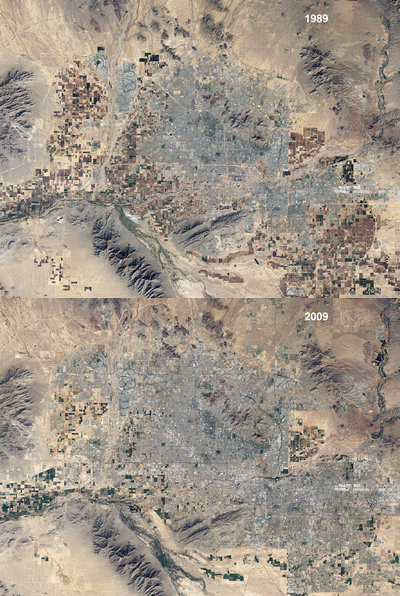
The Suburbanization of Phoenix
Thanks to the Urban Demographics blog for sharing this interactive map of Chandler, a suburb of Phoenix. The images below are taken from NASA. According to the Urban Demographics blog, this suburb grew from just 3,799 residents in 1950 to 176,581 residents in 2000, based on 10-year census figures. "That's an average population growth rate of 8% per year".
The implications of this growth are noteworthy from an urban planning perspective. While I've heard that US Southwest cities are not growing as fast today (due to a slower real estate market among other reasons), interactive maps like these really demonstrate years of suburban growth when developers took advantage of a relatively stable real estate market, good housing demand and inexpensive (and highly undervalued) water supplies. The sad reality is that such suburbs today (particularly in the US Southwest) are really not practical to live in due to the disadvantages of urban isolation and the growing scarcity of water.
Monday, July 25, 2011
Why banning light bulbs is bad policy
Check out Virginia Postrel's article on why banning light bulbs is bad policy. In December 2007, the U.S. federal government enacted the Energy Independence and Security Act of 2007, which requires all general-purpose light bulbs that produce 310–2600 lumens of light to be 30% more energy efficient (similar to current halogen lamps) than then-current incandescent bulbs by 2012 to 2014. The efficiency standards will start with 100-watt bulbs in January 2012 and end with 40-watt bulbs in January 2014. More here.
Here are some of here points:
"Banning light bulbs is one of the least efficient ways imaginable to attack those problems. A lamp using power from a clean source is treated the same as a lamp using power from a dirty source. A ban gives electricity producers no incentive to reduce emissions".
"Nor does it allow households to make choices about how best to conserve electricity. A well-designed policy would allow different people to make different tradeoffs among different uses to produce the most happiness (“utility” in econ-speak) for a given amount of power. Maybe I want to burn a lot of incandescent bulbs but dry my clothes outdoors and keep the air conditioner off. Maybe I want to read by warm golden light instead of watching a giant plasma TV".
More here.
Sunday, July 10, 2011
A great example of Bootleggers and Baptists
I finished reading David Zetland's End of Abundance a couple of weeks ago. A review of his book will come shortly. I first wanted to share an instructive example David uses to illustrate the Bootleggers and Baptists problem (also referred to as "Baptists and Bootleggers"). David refers to this term in different parts of his book.
Bootleggers and Baptists defined: a slang term for an unholy alliance that combines moral righteousness with selfish greed to stop a reform that would benefit degenerates (according to Baptists) and/or the competition (according to the Bootleggers). A Baptists and Bootleggers coalition may also support a harmful change; one example is the coalition of environmentalists and corn-processors that supported a requirement that gasoline contain a minimum share of corn ethanol.
The definition above is derived from the glossary of his book. Using the example of U.S. corn ethanol, here is an excerpt from his book:
"The US corn ethanol program offers a useful example of a Baptists and Bootlegger confluence of greed, corruption and moral superiority. Greed can be traced to big agro-processing companies (ADM, Cargill and others) that make money by trading corn and ethanol. Corruption is connection to congressman who want campaign donations (legal bribes) from these companies and farmers benefit from congressionally induced demand, via per gallon subsidies, mandated corn ethanol fuel blends and tariff barriers that block imports of cheaper, sustainable sugarcane ethanol from Brazil.
The moral superiority component comes from the environmentalists who demand that Americans use more renewable fuels and patriots who want energy independence from dodgy foreigners. Their clamor for renewables gave farmers, processors and politicians the cover they needed to start another program designed to transfer money from taxpayers and car drivers to the agricultural and political sectors. The worst irony is that this "green fuel" may have done nothing to reduce C02 emissions.
In this Baptists and Bootleggers alliance, environmentalists are happy to have more renewable fuel. Farmers and agro-businesses are happy to sell more fuel in the gasoline market. Taxpayers lose and drivers get lower-quality fuel. Politicians win twice, since they can claim to protect the environment at the same time as they collect brides from the corn industry. But there's an additional twist: corn ethanol uses a lot of free water, simultaneously increasing scarcity and pollution. Ethanol production would fall if we priced water for scarcity and purity".
Interpret the example above however you would like, I think it is instructive and insightful because it reveals how groups with potentially different opinions, perspectives and values can lobby for the same end goal and think that the outcome has served their mandate. Unfortunately, this may be a case of unintended consequences not least for the volatility it has brought to the price of corn, but worse yet, to the egregious overuse of cheap and in some cases, free water. Corn ethanol does have its problems and I have become more neutral about its merits as an alternative fuel. But the very fact that it does use copious amounts of cheap water for production is worrisome in an era of increased scarcity.
There are many examples where one can apply the Baptists and Bootlegger model. I think it's pretty fascinating in the case of corn-based ethanol and gets you to think about how and why we advocate for policies that seem to be good on the surface, but can be disastrous in reality.
Monday, June 27, 2011
the air conditioning costs in war
Thank you Marginal Revolution for this fact of the day:
"The amount the U.S. military spends annually on air conditioning in Iraq and Afghanistan: $20.2 billion. That's more than NASA's budget. It's more than BP has paid so far for damage during the Gulf oil spill. It's what the G-8 has pledged to help foster new democracies in Egypt and Tunisia".
With that money, the U.S. could invest in renewable energy projects, spare a few dollars for state/municipal infrastructure upgrades (namely transportation, water and wastewater) and do wonders in environmental education or even money for research and development into more energy efficient air conditioners that can help the country adapt to climate change!
Full story here.
Monday, June 6, 2011
An Oil Sands Pipeline and Obama's Decision...
One of North America's largest and most lucrative petroleum pipeline projects is awaiting the decision from the USA's commander-in-chief. As outlined by the Globe & Mail, TransCanada Corp's Keystone XL pipeline would extend from oil sands-rich Alberta to the gulf coast of Texas, a hub of the American oil industry. Opponents charge that the project will only increase GHG emissions, put entire ecosystems and water sources at risk, and put another significant damper on an already struggling yet budding renewable energy industry.
The developers are ready to go and with little protest coming from governments north of the border, the project is only awaiting the key approvals from various US authorities. The State Department is expected to release its report over the next couple of months, but the growing consensus is that the report will be supportive of the project.
And so, those of the environmentalist ilk will have to hope that their last line of defence will come through in the clutch: Obama. The Department of Energy and the Environmental Protection Agency have grounds to appeal any State Department decision to the president himself, ultimately leaving Obama to approve the proposal, reject it or even slow it down by requiring further study. This has many environmentalists feeling very optimistic. But what they do not know is which Obama will come to the table. Will it be the 2008 campaigning Obama that promised to create a green economy, refuse imports of 'dirty oil' and even considered reopening NAFTA? Or will they get the more centrist Obama that, primarily under political duress, has had to steer many of his policies to the right in order to keep everyone happy?
![]() |
| Image: Pipelines International |
And so, those of the environmentalist ilk will have to hope that their last line of defence will come through in the clutch: Obama. The Department of Energy and the Environmental Protection Agency have grounds to appeal any State Department decision to the president himself, ultimately leaving Obama to approve the proposal, reject it or even slow it down by requiring further study. This has many environmentalists feeling very optimistic. But what they do not know is which Obama will come to the table. Will it be the 2008 campaigning Obama that promised to create a green economy, refuse imports of 'dirty oil' and even considered reopening NAFTA? Or will they get the more centrist Obama that, primarily under political duress, has had to steer many of his policies to the right in order to keep everyone happy?
Sunday, April 3, 2011
Thom Mayne's floatable house
A couple of months ago I wrote a review of Matt Kahn's newest book, Climatopolis. Among many of the stories and arguments Kahn presents on the need to adapt to climate change, he mentioned a UCLA architect named Thom Mayne who designed a floatable house.
"Known as the FLOAT House, the structure is a new model for flood-safe, affordable and sustainable housing and is designed to securely float with rising water levels. The innovative house was built for actor Brad Pitt's Make It Right Foundation, which is helping with the rebuilding of New Orleans' Lower Ninth Ward, one of the neighborhoods hardest hit by Hurricane Katrina."
NPR picked up on this story about a year and half ago. Listen to this 4 minute interview with Thom Mayne to hear about why he designed the floatable house and what he thinks it will be able to do. For anyone interested in climate change adaptation, floatable houses are a very promising design solution. They are expensive and it would be unrealistic to expect flood prone cities like New Orleans to invest in thousands of them, but the potential for reduced damage from flooding can be greatly minimized along with millions of dollars saved from this pro-active and adaptive technology.
Friday, March 11, 2011
Applying a water market system to restore an ecosystem
My friend DM, shared this video with me. It's an inspiring story about how farmers, industry and citizens have an incentive to conserve the amount of water they use and return it to degraded ecosystems (e.g. streams and creeks) that have seen water levels drop over the years. For years, senior water rights in places like Montana have allowed right holders to use copious amounts of water. Why wouldn't they use lots of water? If they don't use the water, they risk losing their water right. Talk about incentive to conserve!
Rob Harmon is now working with farmers to measure water and divide it into one thousand increments, each increment gets a serial number and a certificate. The brewers in the area are worried about their "water footprints" and branding images. They use a lot of water and need some mechanism to return it back to the ecosystem. So they buy those certificates to restore water to the ecosystem.
The market-based system developed by Rob Harmon is based on the utilization of incentives and providing the right information to water users about how they can save money and restore ecosystem integrity.
Subscribe to:
Posts (Atom)