Thursday, April 8, 2010

Enviro Boys Visiting Statistics...

Although Enviro Boys began in January of 2009, it was not until April of the same year that we stumbled across Google Analytics. For about a month I had struggled to insert one of those 'hit counters' to track visits to the site, but could never wade through the website language. Google Analytics, however, as with almost everything Google, was very easy to use. Moreover, it is far more useful than a simple hit counter. In a nutshell, Google Analytics is a free piece of software you can use to track visits to your website and check it in real time. It tracks visits, the city of origin of people reading your site, time on the site, how people found your site, which pages are most popular, and much, much more.

We have been tracking Enviro Boys for exactly one year today: April 8, 2009. I thought today would be an appropriate day to report one year's worth of statistics.

A few things to mention before I go into detail: From May 15, 2009 to June 16, 2009, nothing was tracked because we changed the URL to enviroboys.com and did not update the Analytics until June 17, so really all of these stats are really representative of eleven months; Nothing was tracked for the first three whole months of the site being up and running; Google Analytics is very detailed, but we don't know stuff like your Social Insurance Numbers or banking information.

Since beginning tracking of Enviro Boys on April 8, 2009, we have found the following:

  • 7,273 total visits, from 3,516 different visitors -- which means some people actually come back!
  • 11,462 total page views - approximately 1.5 per visit
  • Average length of visit is 1:30
  • 48% of visits are new visits, meaning over half are from people coming back!
  • Visits have come from 97 countries
    • Most are Canada and the USA, but significant amount from UK and Europe
    • Visitors used 52 different languages - sorry to the non-English speaking folk... 
  • 58% have come from referring sites, 30% from search engines and 12% from direct traffic
  • The most popular page outside of the main page has been Tim's post on Curitiba, which for a long time showed up on the front page when searching 'curitiba transit' on Google
  • The most visits any one day was 66, on April 5th
  • The number of visits per day has increased drastically from ~8 in the first six months of tracking to ~21 in the past six months and ~27 since the new year!
Thanks so much to everyone who continues to read Enviro Boys!  

There's no poop in our water...

Bottled water companies are notorious for the multitude of reasons they use to convince consumers of the desirability of their product. The usual suspects include pictures of pristine freshwater springs -- though lots of bottled water actually comes from municipal sources; lulling descriptions of filtering processes -- "triple distilled through reverse-osmosis, oxygenization, and vapourization and cold-filtered with minerals for taste"; and report after report chastising the health risks of municipal tap water -- even though tap water is regulated to a much higher standard in much of the world.

But today I saw something I had never seen before. A particular bottled water company (whose name escapes me) had a poster up in one of Trent's cafeterias with a bountiful list of the wonderful benefits of its product. At the bottom of the list was the cartoon of a small orange fish with little drops coming out of its backside. Beside the picture read, "No fish swam here".

Wow.

I know the bottled water industry is under attack, but I've never seen anything so desperate to claim that there is no fish poop in the product, let alone that no fish swam in the source water. If there were no fish, where did they even get the water? And is there any life in the water? If not, it might be an indication that the water isn't all that healthy.

Of course, now I'll take an extremely cautious approach to any drink that is not labelled with a "no fish swam here" logo. I don't know about you, but I don't want to drink fish poop...

Tuesday, April 6, 2010

Toronto and commuting times...

As a Torontonian, I am embarrassed to say that my city has an egregious commuting problem. A new study by the Toronto Board of Trade reported that the average commute time (round trip) for a Torontonian is 84 minutes. That is horrendous in comparison to cities like Los Angeles which is at 56 minutes, or New York City at 68.1. When I think of LA I think of highway congestion and commuting problems. Well, apparently Toronto is worse.

Of the 19 cities that were surveyed for the study, we take the gold for worse commuting times. Toronto is a vast metropolis in the heart of the Greater Golden Horseshoe. There are over 6 million people in the GTA alone and many commute from GTA municipalities to Toronto's downtown or even commute great distances within the GTA. One of my geography profs tells me that 86% of the commutes in the GTA are from the automobile, only 14% are on the GO train and other non-automobile forms of transit. Toronto itself desperately needs public transit renewal. Alas, the province is delaying the $4 billion in planned transit spending.

The transit plan is going to bring about several Light-Rail Transit routes which will make the city more sustainable and diverse in terms of transit choice. The city is going to have to think of several policy tools that it could use to bring in some money. It is understood that the province has a massive deficit, however, the city need not be completely dependent on the province for transit funding.

There are a number of tools that can be used (although many are controversial). Electronic road pricing or highway tolls would certainly have merit. Considering how congested the Don Valley Parkway (DVP) is, it can use some sort of toll to reduce congestion and raise revenue for public transit expansion.

Key message: Toronto is a growing city. While most of the population growth is occurring in the GTA, such growth (and high automobility) puts tremendous pressure on the city's transportation networks. As a result, commuting gets worse. I think Toronto should consider a highway toll (as a kick start initiative to sustainable transport) and apply this toll to the DVP.

More to follow about this DVP highway toll recommendation including potential revenue and how revenue could be spent.

Sunday, April 4, 2010

Poll Results: Wind turbines in your community...

Question: A company wants to put a few wind turbines in your community, do you...

Welcome it with open arms? We need more green energy -- 12 Votes (50%)

Learn more about them and get a community group together that could possibly invest in the project? Community power has its advantages -- 10 Votes (41%)

Go about your usual business? Who really cares anyway -- 3 Votes (12%)

Vehemently oppose it and fight the project to the death? They are an eyesore and could be dangerous to my health -- 1 Vote (4%)

Get the hell out of dodge? There's no way I'm hanging around near those behemoths -- 0 Votes (0%)

As expected, most people voted in support of the project. This is fairly common throughout Canada, as the majority of Canadians are generally supportive of wind power. However, things might change if it is in your community. Studies have found that support for projects can be very high initially, but as the details of the project come closer to reality, support can often drop drastically. Even the most staunch environmental supporters can find themselves opposing a project, especially when they didn't expect to in the first place -- which helps to explain why so few are opposed to any project.

The second most popular choice was to learn more about wind power projects. Most people don't know the ins and outs of these things and know only things through word of mouth. In many cases, these things can be false and exaggerated, be it supportive or oppositional to wind power, so it is very important that people get involved and start to learn the facts about that particular project. One of the best ways to do that is to get involved in the project itself by gathering up community members to invest in the project. Community ownership can influence the design of the project to make it more socially acceptable and appropriate in your community.

Just leaving it to others and going on with your own routine was also popular for some. While we at Enviro Boys are fascinated by this stuff, it is likely that many people just don't care whether or not there are any wind turbines put up. This is completely fair. Everyone has their priorities.

Only one person elected to fight it vehemently. This is gaining ground in Ontario as more wind projects are being put up. Some wind developers have undercut communities over the years and left an unappealing mark on the industry, resulting in an all out battle against wind power in Ontario, regardless of the project type. Other regions face this, too. While it is important to recognize the drawbacks of projects, sometimes this opposition can get a little carried away and reject any type of compromise.

No one decided to leave, but it is a reality. Some people can't stand the sight, the sound or even develop health issues related to wind energy -- although the latter is still up for debate. Some also leave before their property values plummet.

Being supportive of wind in general is nice, but the game can change drastically when it becomes a reality in your community.

Coal-loaded ship runs aground on the Great Barrier Reef...


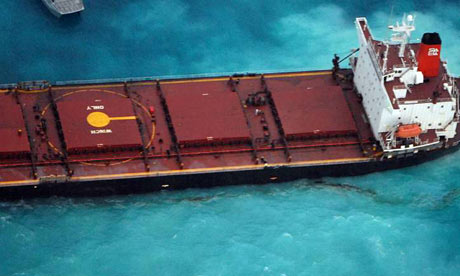
If the rapid development of coal-fired power plants in China wasn't enough to piss off the environmental community, the crashing of a Chinese coal-carrier on the Great Barrier Reef certainly won't help.

The ship ran aground late last night and is carrying 72,000 tons of coal, as well as 1000 tons of oil. Some of the oil has started to leak and local officials are very worried that the ship is on the verge of breaking apart. A break could spell significant environmental disaster on one of the world's most fragile ecosystems.

Australia's Great Barrier Reef is in serious danger from climate change, as rising ocean temperatures tend to cause significant coral bleaching, which, if occurring annually, could very well kill the Reef.

For more information on the story, go here.

This has not been a good week for China's coal industry. In addition to the Reef incident and the constant criticism of its coal plants by environmentalists, 153 miners have been trapped inside a coal mine in China for nearly a week.

Despite all the wonderful economic and energy benefits of coal, there sure are many downsides. Hopefully these downsides start to be taken more seriously before it's too late.

Photo: Guardian Newspaper

Friday, April 2, 2010

The Tories pull a few quick ones...

Environmental politics don't seem to emanate too widely here in Canada, and the Conservatives would love to keep it that way. The two most recent happenings on the environmental front are case in point.

Although publicly released earlier in March, the intricacies 2010-2011 budget were not fully released until a few days ago. In these new details, it was revealed that the federal environmental assessment process was, in almost every sense of the word, being gutted.

When projects are applying for federal government approval, they are normally required to complete an environmental assessment. These assessments, though not free of problems, tend to take at least one year and review each nitty, gritty aspect of a project's impact on the environment. The process is in many ways the strongest line of defence against environmentally unfriendly projects. The new regulations, which were tacked on to the bottom of a budget bill in a particularly sneaky fashion, gives the Environment Minister authority to reduce what parts of a project need to be subjected to an assessment.

Quite simply, the most damaging parts of projects like those in the Oil Sands, wouldn't need to go through a full environmental assessment. This has undoubtedly been a keen interest of the governing Conservatives for some time, so to some this is not all that surprising. However, it is the fact that this aspect wasn't publicly released that is very bothering.

The second dent of the day came when the government announced that the possibility of entering into its extremely popular ecoENERGY home retrofit program was coming to a close. Most programs come to an end, but it was especially alarming that the deadline to enter the program was midnight of the same day the deadline was announced, leaving people to scramble to have assessments done that day. The date was arbitrary and largely unforeseen. For service providers, this means a lot of their clients -- many of which had scheduled months before for a home visit -- will be left without a home visit.

This is also mischievous because the program itself does not end until March of 2011, so the government will still brag about the program. It is true that the program can take over a year to complete in its entirety, but a little more notice would have been nice. Cancelling the program, which has been extremely popular since its creation under the previous Liberal government, has always been controversial (and delayed) because of its popularity. Cancelling it in concert with its very popular Home Renovation tax credit is sure to piss some people off, especially in this time of 'economic stimulus'.

It is not a secret that this government does not consider the environment a priority, but they should at least be upfront about it, rather than pulling sneaky tactics like this.  

The five cent charge on plastic bags in Washington D.C.

A number of months ago, I wrote about plastic bag charging in the City of Toronto. As of June 1, 2009 the city passed a by-law requiring all stores under the Canadian Federation of Independent Grocers (CFIG) to bring about a five cent charge on plastic bags. I do not know the specific statistics, but I would imagine that plastic bag use has dropped with the introduction of the charge.

What I do know is that Washington D.C. has been very successful with their plastic bag charging initiative. The five cent disposable bag fee took effect this January 2010 and like Toronto, it received a tonne of opposition off the bat. The Office of Tax and Revenue reported that the city brought in $150,000 in bag fee revenue in the month of January alone! The big question for all of these charging schemes is what you do with the revenue raised from the charge. What the revenue is spent on in Toronto is quite nebulous, ostensibly it goes to "environmental projects".. whatever that means.

In D.C., the $150,000 will go towards cleaning up the Anacostia River. That is a wonderful initiative and it is good to know that D.C. cares about its natural environmental features. In terms of the plastic bags themselves, about 3 million of them were purchased in January, a drop from the average 22.5 million per month that the city is accustomed to.

We know that the rationale of the five cent charge is to induce citizens to change their behaviour to cut down on their use of plastic bags. In general, a user charge can persuade citizens to make the investment in buying reusable bags which are sturdier, compact and can carry a higher volume of groceries. D.C. provides evidence that such a five cent charge has actually been working and has changed consumer behaviour tremendously.

More fascinating to me is the city's inclination to use the revenue on cleaning up the Anacostia River. The river is something that everyone could relate to. It is a natural environmental feature that has only become more polluted and inundated with things like plastic bags. With a clear vision to clean up their own environment, I think we should applaud D.C. for its hitherto successful five cent charge initiative.

Key message: Changing consumer behaviour, getting D.C. residents to think about the river and cutting down on plastic bags are all positive endeavors for the present and for the future.

Tuesday, March 30, 2010

Why would you cut a Conservation Authority?

Conservation authorities are absolutely critical to the success of watershed and regional planning. When I think of organizations that endeavour to promote environmental stewardship and responsible development, conservation authorities are the first thing that come to my mind. I am not sure how familiar our readers are with Conservation Authorities (CAs) not to be confused with chartered accountants. This post will provide some information. Trent Emeritus Professor of Geography, John Marsh, wrote an excellent letter to the editor on this topic found here.

CAs ensure that housing development is built in a way that minimizes impact (usually runoff from construction) on water quality, watersheds, native species, aquatic species and other. They have intimate knowledge of environmental issues within the communities that they operate. Without conservation authorities, it would be much easier for developers to build their sub-divisions and housing projects with minimal consideration for the environment.

I blog about this because the Otonabee Region Conservation Authority (ORCA) is currently under pressure from being dissolved. Specifically, the township of Asphodel–Norwood (located in Peterborough County) wants to cut the CA. Asphodel-Norwood Township council wants to put the Otonabee Region Conservation Authority out of business. Last week, Council passed a motion to dissolve the conservation authority. They're acting on a recommendation made by the Peterborough County Landowners Association. Landowners association? Are you really surprised? As mentioned, without CAs, the development process is much easier and less resisted.

The thought of putting a conservation authority out of business is not only absurd, but borders on stupidity. We always talk about the importance of more sustainable communities and the need to ensure that our water is safe and our environment protected. Well, in Ontario, Conservation Authorities are our community-based environmental experts. They use integrated, ecologically sound environmental practices to manage Ontario’s water resources on a watershed basis. They also help in maintaining secure supplies of clean water and protect communities from flooding.

The good thing is that CAs are backed by the Conservation Authorities Act which is provincial legislation that ensure the conservation, restoration and responsible management of water, land and natural habitat through programs that balance human, environmental and economic needs. The key here is “balance” something developers do not always like.

The Otonabee Region Conservation Authority has been around since 1959. I actually interviewed them for my thesis on water management and planning issues. I found them to be very professional, insightful and knowledgeable about the critical environmental issues in the area.

Landowners associations or developers in general may very well oppose such community-based organizations like ORCA. They think that ORCA slows down the development process and interferes with their “business”. Well, ORCA’s "business" is to provide analysis and recommendations on how to build around a watershed and environmentally sensitive sites. ORCA's recommendations are in the best interest for the community, the natural environment and native species- all of which are threatened by unmonitored and rampant housing development.

Key message: We should feel honoured and lucky to have conservation authorities in our province. Their expertise and presence has hitherto been critical for environmental protection and ensuring that our water supplies are safe and not threatened by development.

Monday, March 29, 2010

Pedalling a boat to Hawaii...

There are several brave souls who manage to cycle from coast to coast across North America. But once you hit the ocean, there is nowhere to go. That is, unless you build a boat to pedal across the Pacific on.

That is exactly what Greg Kolodziejzyk has done. And he plans to take it all the way to Hawaii under his own power in what he calls the Pedal the Ocean Project. Greg, who already has two human-powered travel world records under his belt, has built an ocean going vessel complete with a sleeping cabin, cockpit and storage cabin. He plans to leave in June from Tofino, B.C. and expects the trip to take anywhere from 40 to 90 days.


Greg is a retired entrepreneur -- retiring in his mid-30s -- and spends much of his time training for extreme endurance events like marathons, triathlons and bike-across-ocean-ons. He is also a motivational speaker. Since his retirement, he has put a significant focus on human powered-travel and its benefits in battling childhood obesity. Indeed, the trip is trying to fundraise 3000 bicycles for kids as a means to help them combat obesity and increase their overall health.

While not saying it directly, Greg is also inspiring environmental action and awareness. Human-powered travel is both good for the health of the pilot, but also healthy for the environment. As health care and the environment become increasingly important issues to deal with, it would be nice to see some collaboration, especially since they can help each other out.

Good luck, Greg! (And thanks to K.O. for telling me about this).


Saturday, March 27, 2010

The Story of Bottled Water...

From the creators of "The Story of Stuff", comes "The Story of Bottled Water". Sometimes the most effective message is a simple one.

Wednesday, March 24, 2010

Poll results: talking transportation

The results are in. We had a total of 23 votes. The poll statement was “talking transportation: I think my city would benefit most through…”

The use of light-rail transit 5 (21%)
More bike lanes and bike paths 3 (13%)
A city-wide public bike rental system 3 (13%)
Improving the subway system 4 (17%)
Making buses more efficient and comfortable 8 (34%)
Making the downtown more walk-friendly 0 (0%)
None of the above 0 (0%)

Total = 23.

What’s important is that public transit and alternative transit methods (walking, biking) are all critical for any green city. However, not every city needs a subway system. Not every city needs light-rail transit. In a city like Peterborough (pop~80,000) the total land area and population density does not justify the need for these massive public transportation projects. However, Peterborough could benefit from more bike lanes, bike paths and making the overall downtown more walk-friendly. Walk-friendly means constant maintenance of sidewalks, having city parks and gardens and other aesthetic features that make the overall walking experience more enjoyable and safe for citizens.

A city-wide public bike rental system. There is only one in Canada, it’s in Montreal and it’s called Bixi. I am not too sure how popular or successful this initiative is but I will get some insight when I visit Montreal on Friday. A city-wide public bike rental system can be expensive to implement. This too would be justified in a city with relatively high cycling ridership, or cities that have decent bike lanes for cyclists. There have been talks about having such a system in Toronto but nothing has come about.

Light-rail transit…. Well it is expensive. Toronto is currently creating 7 new light-rail transit routes across the city. I spoke with a civil engineer from the Toronto Transit Commission and he told me that it costs $30 million for every kilometer of installation (much cheaper than the $150 million/kilometer for subway).

Making buses more efficient and comfortable had the most votes (8 votes). I think everyone can relate to this irrespective of where you live. Both small and large cities alike have some form of a bus system. Peterborough has a bus system that is mostly used by low-income citizens, seniors and students. The buses are decent but many students complain because their scheduling and logistics are horrendous. Making them more comfortable, spacious and efficient in terms of their routes and scheduling times would be great.

Last, when evaluating alternative transit and public transit options in any city, it is critical to get the public perspective. If the city’s planning department thinks that a public bike rental system would be beneficial, then some sort of survey must be done to gather the public point of view. Transit services (especially in Peterborough) need to do a qualitative study looking at the experiences and feelings of students, low-income citizens and seniors when they take the bus. These studies might help inform policymakers about the importance of ensuring efficient, comfortable and diverse transit choices.

Key message: The key to a successful transportation system is multiplicity of choice.

Hockey with a green spin...

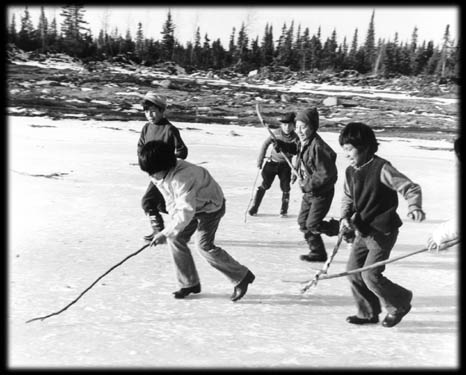
There are few things more Canadian than the outdoor hockey rink. As temperatures dip, snow falls and the infamous Canadian winter sets in, people from all walks of life can be found strapping on their skates to enjoy the newfound outdoor skating rinks. They come in all shapes and sizes, from small backyard rinks, to boarded rinks at the local community centre, to the fantastically open frozen surfaces on rivers and lakes.

Tim and I managed to get out and play some old fashioned shinny -- pick-up hockey -- a few times this winter on the canal in Peterborough. We spent several hours there each time, joining other players for big pick-up games. But as we moved into March, the ice began to melt away and outdoor hockey came to an end. Although ball hockey on the road is also enjoyable, it is not quite the same. And getting ice time in indoor rinks, let alone paying for it, is extremely difficult.

My spirits were raised when I came across this article in the Globe & Mail about a business that had built a hockey rink inside the office. But unlike typical indoor rinks, it was made from synthetic ice. Specialized plastics coated with special oils provide a surface that is nearly identical to ice, allowing you to skate on it without any major concerns. While the synthetic ice is a little slower than typical rinks, it does offer several benefits.

First, you can put it anywhere. There is no season where a synthetic rink won't work and it allows you to go skating or play hockey in any climate. Tim and I are both considering further schooling on the West Coast where temperatures nary dip below freezing. Synthetic ice would be ideal in these locations.


Second, they are easily maintainable. The pieces of plastic simply fit together like a puzzle so you can create a rink as large as you'd like, be it in your basement or a full-sized hockey rink. And there is no need for a Zamboni to resurface the ice repeatedly.


Third, they are considerably cheaper than a comparable indoor rink. Much of this has to do with maintenance. Because the ice has to remain frozen, lots of energy is put into keeping it frozen and keeping the arena cold. Moreover, lots of hot water is used to resurface the ice. From an environmental point of view, synthetic ice is considerably more friendly as there is no need to keep the rink extremely cold.

Now, let me be clear. I would much prefer to play on a natural rink with real ice. It is smoother, faster and more realistic. But it is becoming increasingly difficult to gain access to those rinks. And outdoor rinks only last as long as the cold season does, which in southern Ontario, isn't particularly long. Synthetic ice allows us to at least enjoy hockey year round, with greater access without sacrificing too much quality of play. The environmental benefits are just icing on the cake.

Monday, March 22, 2010

World Water Day...

Happy World Water Day! World Water Day is all about raising awareness of the global water crisis. Yes it is true, Canada has an abundance of water. But that does not mean that we as Canadians can neglect the importance of this day. On average every Canadian uses 343 litres of water per day. We use about 1.5 times more water per capita than most European countries and significantly more than those in the developing world. Check out Peter Gleick's post on World Water Day focusing on water quality in Nairobi.

Chris and I delivered a presentation today in our global environmental policy class. The presentation was on a proposed international convention on water. We have done a tonne of research on the economic, political, social and environmental implications of such a convention. We looked at water as a human right, we explored water as an economic good and water as a property right.

Water is going to be increasingly more important to our planet in the 21st century. It has been fundamental to our existence and will be even more critical considering its dwindling supply due to population growth, climate change and creaking infrastructure. On an optimistic note, there has been a concomitant increase in education around the protection and preservation of water.

One of my thesis recommendations is for the City of Peterborough to have its own World Water Day. Stores such as Home Depot, Home Hardware and Canadian Tire would have a chance to present their latest water efficient technology solutions and encourage city residents to consider purchasing these products.

While Peterborough is fortunate to have an abundant supply of clean and affordable water, the event could raise funds to provide water to some of the most vulnerable populations on the earth. Therefore, the event would raise awareness of water resources both locally and globally. There can also be tours of the wastewater and water treatment plants. Such an opportunity may not be always available. It would provide the public with a much better understanding of the technical dimensions and challenges of water management in the city. This sort of an initiative can take place in any city.

The development of partnerships is integral to the success of World Water Day. Using the example of Peterborough, World Water Day could bring together Fleming College, Trent University, businesses, water-related stakeholders and other groups. This would allow for great potential in the formation of partnerships in promoting sound water practices. These partnerships may promote more effective water management and governance; provide education on the negative aspects of bottled water and information about the use of current technology in the area of water resources. Above all, it would present a networking opportunity for water professionals and student groups wishing to collaborate in a more fruitful and productive way.

Key message: World Water Day should be everyday. However, because it is formally on March 22nd, cities in Canada and abroad would benefit greatly from presenting information about the protection, preservation and ultimately the significance of water resources. As said, World Water Day is becoming more popular; however, ask yourself.... is my city doing anything on this day? Either way, be thankful that Canada provides safe, reliable, and affordable clean water and sanitation -something that 1.1 billion people in the world do not have the luxury of enjoying.

Sunday, March 21, 2010

Ambitious transit plans in the US...


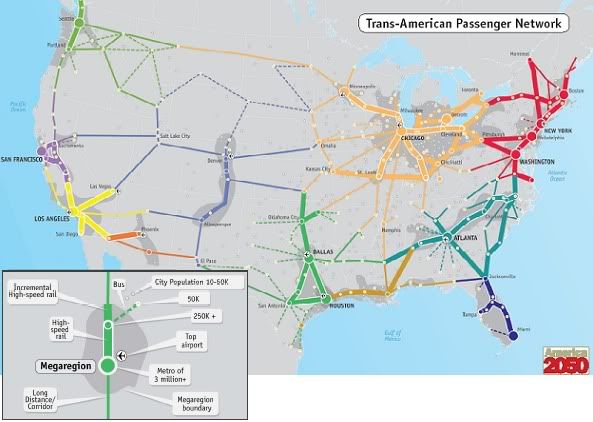
The uncertainties around climate change are forcing countries like the US to invest heavily in transportation infrastructure. This map, courtesy of America 2050, displays the planned Trans American Passenger Network which is a comprehensive inter-city rail network across the United States. There has been a $8 billion down payment made in the American Recovery and Reinvestment Act and $5 billion in Barack Obama's proposed budget towards this.

No matter how long Barack Obama spends on other major federal issues i.e. immigration reform, he has expressed vehement interest in bringing about an extensive passenger rail system which will optimize national transportation flows and efficiencies in America.

Why the pressure to do this? Other than the obvious climate change reason, the US is projected to grow by 140 million people by 2050. This will require massive investments in roads, highways and more importantly, rail networks. Having a Trans-American-Network of national inter-city passenger travel would significantly reduce the need for national flights and alleviate pressure on inter-state highway systems. Both national flights and inter-state highways contribute heavily to the country's greenhouse gas emissions.

So, this plan will provide more travel options for Americans. It is going to require a lot of federal and state investment. This plan recommends that federal investments in inter-city rail be directed towards corridors with the greatest demand for inter-city travel.

It will be interesting to see how this plays out in the US over the next little while. Especially considering the plethora of issues Obama plans on dealing with. For more information, see here.

Friday, March 19, 2010

Re: Travel Behaviour...

I, like Tim, also experienced the same excitement when I got my license. The first thing I did was cruise around the city in my parents' car with my friends, race a taxi (I lost) and see what happened when I pushed the pedal to the floor. (Sorry, Mom & Dad, but you probably wouldn't have let me do that while you were in the car with me). And at this point, I too felt little regard for the environment.

Driving was the norm for me when I was growing up. We have always had two cars back home, my parents drive everywhere and I rarely took the bus. We had bikes, but they were used only recreationally and it was only when I left home for Trent that I started to appreciate their usefulness as methods of transport. I predict that if cycling and other alternative methods of transport been something my parents used regularly, my approach to cars growing up would have been much different.

The point I am trying to make is that instead of trying to make alternative transportation more attractive to youth, we should perhaps focus on making it more attractive to their parents. 

Although my case is not shared by everyone in the world -- I was lucky enough to be born into a family that can afford two cars -- there is a large segment of Canada's population that I do share such an experience with. But imagine if, as you grew up, your parents took the bus regularly or biked to work? And they did this not out of financial necessity, but because it was "cool" (as Tim recommended) or convenient. I reckon that many of us would make the same choices. After all, we tend to do learn a lot from our parents.

This, of course, is a challenging prospect. My parents are both hovering around their 60s, have been driving cars for most of their lives and are not about to hop on a bike to ride 20 km in a Winnipeg winter. Inspiring change in older generations is much more difficult than doing so with, say, relatively poorer university students. 

But it can be done. There is a wonderful CBC documentary called Pedal Power in which it highlights a prosperous Vancouver businessman who bikes every morning to his downtown Vancouver office building. Because of traffic he gets there in less time as he would by driving and he gets a nice workout, too. But we know these advantages already. What is really important is that the infrastructure was put in place to make this attractive, like dedicated bike lanes and bike paths. Young people like Tim and I might be prepared to ride on the roads with cars, but getting someone in their 50s to do so would be far more difficult.

But bike paths aren't everything for him. When he arrives at his downtown Vancouver office, he store his bike safely in a locked, fenced in area, and he can store his stuff in a locker. And the best part? There are showers available so he can clean himself off and not dirty up his suit on his way to work. The combination of everything makes it attractive, convenient and, perhaps the best part, kind of cool because he can differentiate himself from the pack. After all, how many of his work buddies are biking to work?

Bus travel, too, could also be made far more attractive. If more money and effort was put into making buses comparable to a luxury car, I imagine ridership would increase immensely. Imagine things like cupholders, nicer seats, even TVs on the bus? 

And longer travel like GoTrain or GoBus in the GTA could also be made more attractive. A friend of mine pointed out that he would definitely take a four hour trip on Go if free wireless internet access and plug-in outlets were made available on every ride. 

If we make alternative transportation choices more comfortable, convenient and cool, people will start to pay attention. As Tim said, the economic, environmental and health benefits just haven't caught on. But making them attractive just as they are and without an added reason might be what we're missing.

And if the older generation starts to pick it up, just wait and see what the kids start doing. Unfortunately, I don't think it works the opposite way quite as well. My parents expect me to take alternative transportation because I simply can't afford a car. Alternative transportation appears to be something you grow out of, either by age or wealth, so expecting my parents to start using it because their son is might be a longshot. It isn't like an iPod or Facebook.

But it doesn't have to be something you grow out of. Instead, we should make it something we grow into.  

Travel behaviour...


Before I get into the post, I wanted to wish Chris a happy birthday.

The pie chart to the left is a percentage breakdown of greenhouse gas emissions per sector.

I am doing a lot of reading these days about the relationship between travel behaviour and transportation choices. For example, why do people decide to drive their own vehicles (with only themselves in the vehicle) when they are surrounded by public transit choices, bike paths and carpooling options? There are some obvious reasons for this, but travel behaviour can be a lot more complex than this. Understanding travel behaviour has been a focal point of transportation research. More important, it has been crucial for understanding how we can minimize transportation's impact on climate change.

I was reading a study that looked at the factors influencing the future travel behaviour intentions of young people between 11 and 18 and how climate change considerations affect these. The sample was a group of youth in the U.K. Photography was shown by the researchers to the youth to compare photos between things like traffic congestion, motorists who looked happy while driving and pictures of the natural environment. These photos were used as a trigger for discussion about the environmental impacts of transport.

Results show how these young participants are enthusiastic to drive if provided the opportunity because of the speed, cost-savings, convenience, flexibility and freedom. The youth mentioned how walking and cycling is good for health, but it is an inconvenience. Using a car saves their "personal energy", they think that exercising should be separate from traveling. The sample group identified the importance of the environment and climate change, but said that it would still not deter them from their willingness to drive. Indeed, this was identified as the social dilemma where their own efforts to tackle climate change may be rendered worthless by the inaction of others.

What does this mean for policy? Policymakers need to promote cycling as a signal of success and promoting it as "cool" instead of just the obvious environmental and health benefits. Researchers suggest that society must empower young people in relation to their knowledge of climate change and how to tackle this issue as well as their ability to communicate this knowledge effectively to others.

The authors state that there would be merit in gathering more youth together and providing them with different transport choices, seeing what their choices are and their reasoning. Or, introducing “covered” cycle paths and walkways to protect people from the weather. Researchers suggest that these recommendations might help with changing youth’s perceptions regarding driving and climate change. Also, if there were regulations to enforce travel behaviour change towards more environmentally friendly options, then it could help remove the social dilemma identified by the youth.

As mentioned, climate change has become an overarching issue in the transportation research agenda. By developing a better understanding of travel behaviour, particularly for youth, policymakers will be able to implement measurements that promote a more environmentally friendly transportation system while concomitantly addressing the critical issue of climate change.

Key message: We need to understand how our youth perceive (if they even do) the issue of climate change as it relates to things like driving their family car. When I got my license at 16, I was completely excited to drive whenever and where ever I could. I never thought about the environment. Mind you, climate change has become more of a hot topic since, but we still need to communicate and educate our youth about the significant relationship between driving and its impacts on the planet.

Thursday, March 18, 2010

The Value in Maintaining a Good Health Care System...

For anyone interested, there is a special world affairs colloquium (WAC) at Trent today (Friday, March 19th) titled "The Value in Maintaining a Good Health Care System". It will be a panel discussion on Canada’s current health care challenges, opportunities and threats with local examples from Peterborough County and the Kawarthas. The talk starts at 1pm is taking place in the Gathering Space, First Peoples House of Learning, Gzowski College.

In terms of the details, the colloquium will explore some of the current challenges and opportunities that exist in the health care sector in Canada’s urban and rural context. Given the current health care debates in the United States, Canadians are beginning to understand that we too have our own health care challenges. This colloquium will feature a national approach to health care but also a local approach focusing on Peterborough Country and the Kawarthas. Topics will include illness and health, the geography of aging, the evolving role of voluntarism in rural health and discussion around hospital wait times, funding and how we can move forward.

The panel if composed of three speakers. Our first, Dr. Rosana Pellizzari who is the Medical Officer of Health for the Peterborough County-City Health Unit. Our second speaker is Mr. Paul Rosebush, the CEO of Haliburton Highland Health Services. Our final panelist is Dr. Mark Skinner, Trent Professor of Health, Rural and Social Geography.

It looks to be a highly insightful dialogue concerning our health care system and how it is evolving.

Monday, March 15, 2010

Poll Results: Do you support a ban on the sale of bottled water?

Here are the results from last week's poll:

Question: Do you support a ban on the sale of bottled water?

Yes - 10 (52%)
Sale?!? Ban the production completely! - 3 (15%)
Shut up hippie! Give me more bottles - 3 (15%)
Only in public buildings - 2 (10%)
No - 1 (5%)

Total Votes: 19

An overwhelming majority of voters support a complete ban on the sale of bottled water. This is becoming an increasingly popular movement throughout the world, although very few jurisdictions have fully implemented such laws. Given the negative aspects of bottled water -- health concerns because health standards for bottled water are lesser than tap water; environmental impacts because of plastic bottles; and cost concerns because of how outrageously more expensive it is than tap water -- more and more places are looking to ban the sale of bottled water.

At Trent University, both Sustainable Trent, an environmental student group, and the Trent Central Student Association, the student union on campus, have been advocating for a ban on the sale of bottled water by Aramark, the school's main food supplier. In a meeting between ST and an Aramark representative, Aramark stated that it would not be opposed to a ban, but is supportive of the availability of alternatives before a ban takes place. For Trent students and staff, this means accessible water fountains and the availability of reusable bottles. If there are no alternatives on campus, Aramark worries it would take the heat when bottled water couldn't be sold.

It is important to recognize that the infrastructure has to be put in place before a ban on anything can be implemented. When the groups first proposed the ban over a year ago, plans were held back largely because water fountains had not yet been introduced. (They have since been built).

The second most votes were garnered from the views on the extremes. On one side, some people believe banning the sale of bottled water is ludicrous as it impinges on the consumer's right to product choice. There will always be people on that side, regardless of the issue. On the other side, some felt that only banning the sale of bottled water isn't going far enough. One problem with banning the production of bottled water is that it is appropriate in some situations, specifically emergencies -- say, a flood -- when water has to be brought in when local water resources are deemed unfit to drink.

Banning the sale of bottled water in public buildings has been considerably more successful than all out bans. Because the movement is driven primarily by members of the public, bans can exist in places the public owns. Banning the sale in private buildings is a little more difficult. Moreover, it can serve as a testing ground on the impact of banning the sale of bottled water.  

The Percy Schmeiser Case...

In a presentation on genetically modified plants during one of our policy courses, it was mentioned that "we all know the Percy Schmeiser case." But it strikes me that not everyone is familiar with the story or its influence on a growing issue. So here is a summarized version:

In the mid-90s, the biochemical leviathan Monsanto developed a genetically modified canola seed that is resistant to its Roundup brand of herbicide, which became known as Roundup Ready Canola. Farmers are required to purchase a license in order to use the seed. After only two years in use, it quickly constituted one quarter of Canada's canola production.

Percy Schmeiser was a canola farmer in Saskatchewan with a 1,000 acre farm and a custom strain of canola. He did not use Roundup Ready Canola, but found in 1997 that a portion of his crops were resistant to Roundup herbicide, which he used to kill weeds even though his canola plants typically die. But this time, many of them survived. A farmhand later saved the seeds from the resistant plants and they were planted the following season and later sold for feed. When it was revealed that the seeds being used by Schmeiser were the Roundup Ready variety, Monsanto sued Schmeiser for patent infringement.

Schmeiser, a former mayor and former member of the provincial legislature, fought the allegations, claiming that his actions were accidental and that the seeds came onto his property without his knowledge or consent. Although Monsanto admitted this was possible, the federal judge found that it was extremely unlikely and ruled in favour of Monsanto, citing Schmeiser's patent violations. It still remains unclear how the seeds got onto Schmeiser's farm.


Schmeiser, who had received a lot of publicity and (financial) help from environmental & anti-genetic groups, appealed the decision, but it was upheld by the Federal Court of Appeal. Schmeiser then tried the Supreme Court, which in a 5-4 decision, also ruled in favour of Monsanto. It did, however, also decide that Schmeiser did not have to pay Monsanto the nearly $20,000 he had received from sale of the modified canola. More importantly, he also did not have to pay for Monsanto's legal fees, which were well over $500,000.

As a result of the judgements, Schmeiser had to destroy all trace of his custom-bred strain, which he had been using for several decades. He also had a legal bill of approximately $400,000 to deal with. He now travels the world as a speaker telling his story and raising awareness of genetically modified plants, as well as the tactics of major companies like Monsanto. Indeed, many predict that the judge's decision on the poor likelihood of Monsanto's seed spreading accidentally is a reflection of the lack of knowledge we have on genetically modified plants, which have since been shown to spread very rapidly.

Schmeiser did, however, sue Monsanto in 2007 for the clean up costs after more Roundup Ready Canola made its way onto his property. An out of court settlement was agreed upon in 2008. Although it was only for a few hundred dollars, it demonstrates that the danger of seeds spreading is very real.

What is particularly interesting about the case is that none of the three federal courts approached it as an issue over the spread of the seed -- as Schmeiser did in 2008 -- but rather the patent violation. It set a protective precedent for large companies like Monsanto in that it recognizes patent violations as priority over the accidental spread of product, a problem that is sure to increase over the coming years.        

Thursday, March 11, 2010

A Real Canadian Gold Medal Flush...


Chances are, if you live in Canada, you didn't visit the bathroom while Canada and the U.S. were battling for hockey glory. I certainly know that bathroom breaks during play were frowned upon as unpatriotic at the venue where I watched the game.

As a follow up to my post on the energy consumption spikes that occurred during the Men's Olympic Gold Medal hockey game, I came across this graph from The Globe and Mail. Water consumption.

It pretty much speaks for itself, but is certainly an interesting case of cultural influence on our environment. I'm hoping more and more examples of things like this continue to pop up.

Wednesday, March 10, 2010

A cleaner, cheaper, more useful type of clean coal...

Imagine if all you needed to resurface your driveway was a little sea water and some carbon dioxide? And what if I told you that by resurfacing your driveway you would be taking advantage of carbon free energy and even creating some relatively clean water?

Bollocks, you'd probably say (and I would hope in an English accent). Well, there's a company in the United States that is hoping to prove you wrong. Based off the naturally occurring process corals use to make their bones, some very innovative entrepreneurs at Calera have developed a method to take carbon emissions from gas and coal-fired plants and mixing it with ocean water to create calcium carbonate. Calcium carbonate -- the substance making up coral bones -- can be turned into cement or used as aggregate in construction projects.

There are plenty of small innovative firms out there with cool ideas like this, but Calera could very well make a significant impact. It has already attracted attention from Thomas Friedman, author of The World is Flat and columnist for the New York Times, and more importantly, significant investment from a major engineering firm confident enough to build several Calera plants.

There are hopes that this process will actually lead to a "clean coal" future, something that is heavily criticized by many because of the extraordinary expense and excruciatingly slow development of mainstream carbon capture and storage (CCS) technologies. By capturing the carbon emissions from coal and gas plants, it essentially makes them carbon emissions-free. Moreover, the carbon is stored in useful products like cement, as opposed to being pumped in large quantities underground.

A wonderful bonus that comes out of this process is relatively clean water. The salt water used loses about 80% of the properties that make it unsafe to drink, which happens to make it much easier to convert to fresh water using desalination as less energy is required to filter the water.

Considering how much coal is being used to power the world's electricity systems, this process, if actually scalable in an economic fashion, could change the whole playing field. The company is touting the potential of this technology in China and India, which are developing coal plants at a rate of nearly one a day. And since major construction projects and fresh water crises are bound to define much of each country's upcoming future, the technology is especially attractive.

But even if all the potential of this technology does come to fruition, it won't be perfect. Coal is a finite resource. Coal plants, even without carbon emissions, still have significant impacts on our lives. They emit dangerously high levels of toxic chemicals into the air -- even with scrubber technologies -- causing severe health complications. And coal mining is among the most environmentally devastating processes known to our history. I mean, how many other industries can say that they blow the tops off mountains to get what they want?

The trouble is, coal is going to be used excessively whether we like it or not.

No energy technology is perfect, but the Calera technology could at least make a significant dent as we try to lower carbon emissions. It's amazing what we can learn from nature. One hopes we don't kill too much of it off as we do.    

Tuesday, March 9, 2010

No need to salt our roads: Spring is approaching and salt poisons our water…

A geological study from the University of Toronto has found that road salt poses numerous threats to groundwater and water quality. Their research findings come from a study based on Pickering, ON. Pickering is a GTA community relatively close to the 401 highway and a community that has witnessed a lot of suburban growth. Both the 401 and suburban roads use copious amounts of road salt for highway and road safety and to minimize the likelihood of accidents. Alas, in the Pickering context, a lot of this salt has ended up in a nearby watershed called Frenchman’s Bay, a lagoon on the shores of Lake Ontario.

The geologists found that over 3,600 tonnes of road salt end up in Frenchman’s Bay every winter due to direct runoff in creeks and streams. It is no coincidence that the fish population in this lagoon has been declining due to increased levels of salinity. Putting the salinity levels in some context, it is estimated that the lagoon has levels of salt that closely resemble ocean water. Higher levels of salinity simply contaminate the waters and drive the younger fish population away. Younger fish, unlike older fish, do not have the capacity to cope with saline intrusions because they are not used to it.

The impacts of road salt on Pickering's ground and surface water imply a higher than average amount of road salt usage. In Canada, about five million tonnes, or approximately 150 kilograms per Canadian, is used on roads each year to make them safe for travel in winter. A lot of this road salt is applied to roads in Ontario and Quebec.

Where does government intervention fit into all of this? Well, Environment Canada has recognized the “adverse” impacts of salt on wildlife, plants, water, soil etc. In the past, they considered adding road salt to the nation’s list of toxic substances, but... that never happened. Six years ago, the government instituted a “voluntary code of practices” to "encourage municipalities and others to use the de-icer more sparingly", while maintaining highway safety.

It is the province though that is using road salt for the 401 highway, not the municipalities. Plus, communities like Pickering are growing rapidly placing more pressure on local government to salt their roads because it is the most economically sensible way of ensuring road safety.

Voluntary code of practices should not be applied in this particular case. The geological study provides convincing evidence that road salt has negative ramifications for the large Pickering watershed. While other options are currently being reviewed, I think that municipalities must establish regulations that govern the use of road salt to account for their environmental impacts. Quotas must be established until we come up with more sophisticated engineering solutions.

Key message: The use of road salt helps make our roads safer at the expense of contaminating water quality, declining fish populations and wildlife. In an era where we are trying to sensibly integrate public policy with science, we need to find more practical alternatives that benefit society and nature.

Sunday, March 7, 2010

Congestion charging: more than just a few benefits...

Congestion charging is a really fascinating tool used by government; its purpose is usually two-fold: one, to reduce traffic congestion and pollution by charging motorists in certain zones of the city i.e. you drive in the zone, you pay the surcharge. Two, a lot of the revenue made from the charge goes into optimizing public transit systems i.e. subways, Bus Rapid Transit, trams etc.

According to the UK’s Office of National Statistics, people spend about 90 minutes each day traveling (commuting) on average – more time than they spend on childcare, sports, outdoor activities, shopping, social life and eating. If this time could be cut, we could hugely improve our social lives, families and leisure opportunities. Commuting has social and economic costs i.e. huge parking fees in the downtown area and time spent away from family. How do you get more of the middle to upper class to transition from their cars to public transit? Taking public transit can actually reduce commuting times because you avoid egregious highway traffic.

We need to make public transit more sexy in order to get people to use it. Making it sexy requires a lot of capital and financing. Congestion charging can provide the necessary capital to expand transit systems. You can make them accessible to every demographic of the city. Certain neighbourhoods in Manchester, England are totally isolated due to low quality/expensive public transit. This heightens poverty, conflict, racism, alienation and crime.

Public transit is expensive in Manchester because the system is struggling with operating expenses. A congestion charge could certainly provide some flow of capital to the system allowing it to improve in quality and be accessible to the city’s poorest.

Many people are fearful of public transit because it might be dangerous, crowded, noisy, smelly and uncomfortable. These are reasonable concerns that can be alleviated with funding, intelligent design and some creativity. A congestion charge is a smart economic approach for raising revenue because people will still behave (somewhat irrationally) by continuing to drive in congestion charge zones and pay the cost for doing so. Cities can benefit tremendously from such irrationality and secure even more funding for their public transit system. With more money and a few architects and planners on board, cities can really make their public transit services much more appealing.

A congestion charge zone cannot work in every city of the world, but we know it has been successful in London. If it could provide funding for expansion to include the marginalized, provide funding to make the system cleaner, more spacious and comfortable and provide professionals with a chance to minimize their commuting times, then it certainly has some notable benefits.

Key message: Congestion charging has multiple benefits. It may receive poor political acceptability at first, but the possible advantages are plentiful as evidenced in London, Stockholm and Singapore.

Saturday, March 6, 2010

Climate change skeptics are hanging around with the wrong crowd...


Climate change skeptics, please meet your new best friends, extreme creationists. Consequently, this chance meeting might turn out to be your downfall.

An article in the New York Times identified this budding relationship and how it is proving advantageous to both movements in the southern United States. School systems throughout the US have come under fire for several years from the far-right for teaching evolutionary theory and never making reference to alternative views, most notably creationism and intelligent design. Proponents of this exclusion have long argued that they must preserve the separation of church and state. But that hasn't stopped some states from passing laws ordering schools to include both sides in their curriculum.

But most of the time, the creationist movement hits big snags with the government, largely because it focuses purely on a religious topic. But by teaming up with the climate change skepticism movement, it hopes that the government will look at it in a much broader sense. Climate change skeptics have been fighting a similar battle as curriculums tend to focus only on the "pro-climate change" science, while ignoring the views of skeptics. Together, they might be able to use the legal system to get at least something through.

But if you're an environmentalist, you should be licking your lips the same way Democrats are at the thought of Sarah Palin running for president in 2012 -- please run, Sarah, please. And if you're a semi-legitimate skeptic -- not a garden variety looney -- you're kicking yourself. The skeptics and creationists might be winning small battles in a few schools in the southern United States, but the war over climate science could very well tip to the side of environmentalists.

Creationists, at least those of the extreme variety, are largely viewed by the rest of the United States as radical and out of touch. Strong beliefs that dinosaurs are a myth and the Earth is only a few thousand years old are taken seriously by a diminishing minority largely situated in a few specific regions of the US. The majority of the population simply doesn't take them seriously. 

The climate change skepticism movement, on the other hand, has some momentum and a lot of potential support. The leaked emails from East Anglia, overblown claims about glaciers melting and a realization that lifestyles might have to change considerably have fueled a growing movement towards skepticism, in the United States and throughout much of the developed world. Quite simply, the skepticism movement is serious and serious people are paying attention.

But as soon as it links itself to extreme creationists, it will lose considerable credibility. The short term benefits might be nice, but in the long run, it could sink you. Having friends can be nice, but sometimes picking the wrong friends can make things worse. Want some free advice from the other side? Start hanging out with another crowd.    

Friday, March 5, 2010

WAC - "Afghanistan: Rebuilding a Fractured Society"

For anyone interested, there is a special world affairs colloquium (WAC) at Trent today titled "Afghanistan: Rebuilding a Fractured Society". Nipa Banerjee will provide a critical perspective on Canada's involvement in Afghanistan i.e. should we even be there? And if we should be, how can we be more constructive and effective with our efforts?

It will be held in the Lady Eaton College Pit and will start at 3pm. The talk will run for about 1 hour, with 30 minutes for questions.

Nipa Banerjee is the former head of Canada's aid program in Afghanistan (2003-'06). She currently teaches at the School of International Development and Global Studies at the University of Ottawa.

"The World Affairs Colloquium is produced by-weekly by the Trent International Program and Trent International Students Association. As a committee we bring in speakers to discuss interesting topics and international issues.The World Affairs Colloquium is all about producing an insightful and informative dialogue between students, faculty and the community. The colloquium creates a forum for global citizenship allowing a dynamic conversation to take place within our university." Colloquium"

Thursday, March 4, 2010

An electric win for Canadian hockey...

If you were like me and roughly half of Canada's population, you spent Sunday afternoon watching Canada's Men's Olympic hockey team claim victory over the United States. If you're living in Canada, it is likely that at some point you saw some part of the game. After all, some estimates have as many as 25 million people in Canada watching at least some of the game. And you probably watched the game on a TV.

I stumbled upon this interesting news release when perusing the Independent Electricity System Operators's website. Apparently the game had a significant impact on Ontario's electricity grid. Just prior to the game starting Sunday afternoon, the IESO measured an increase of 300 MW on the grid that lasted until just after Sid the Kid engraved his name in hockey history, at which point electricity demand returned to typical Sunday evening levels.

Moreover, during the intermissions, further electricity spikes were measured as people went to refill their drinks and turn on the oven or microwave to make some in-game snacks.

Who would've seen that coming?

300 MW is a lot, but can you even quantify the energy released among Canadians as soon as Crosby scored?

Well done, Canada. And congratulations to all of Canada's Olympic athletes.  

Tuesday, March 2, 2010

Stupid Green Ideas: Dell's Tree-Saving Boxes...

A friend of mine recently had a package delivered to him that looked as though it had been kicked around as a practice ball for England's upcoming stab at the World Cup. The tarnished box came from Dell, one of the world's largest computer and hardware manufacturers in the world. My friend tossed me the box and told me to take a look at the label attached on the side. Expecting to see one of the typical "we are sorry about the condition of the package, it was damaged during travel", I was very surprised to instead see the words inscribed, "We apologize for the condition of this package. Dell is reusing packaging to save trees."

As my friend said in a more polite fashion, what a load of bull. I admire the desire to try and "green" itself, but this is pushing it. My friend rightly believes that they are not reusing the boxes for environmental reasons, but rather to save money. They should admit it, rather than trying to greenwash consumers. It's similar to a case where I tell my friends that I won't wash the dishes for a week because cleaning them in bulk is more efficient than in small spurts and less water and soap will be used. Regardless of whether or not there is any truth to that statement, we all know that the real reason is that I'm just lazy.

Don't pretend to be something you're not. You like like an idiot, and worse, you give the environmental movement a bad name.

But he was a little more sympathetic to the actual state of the box than I was. Granted, it was still structurally sound and the product inside was protected with bubble wrap. But when I saw the box, the first thing that I thought was how bad Dell looked. Now I realize that we live in a consumer culture where aesthetically pleasing packaging is an environmental folly and that we shouldn't focus so much on the appearance of packaging, but there are ways to save money and/or be more environmentally friendly that won't make your packages -- Dell was built on packaged and mailed products -- look like junk. When someone sends me something by mail in a package, significant damage to the package indicates to me that at some point in the trip perhaps something else more important was damaged.

I do not know the packaging industry particularly well, nor do I pretend to understand the technology overly comprehensively, but I'm sure there are substitutes to reusing cardboard boxes that won't have a massive impact on the presentation of the packaging. Perhaps supply chain management could develop some innovative reusable box system or maybe the boxes could be compostable. Of course, Dell would unlikely go for any of those considering its true motive is probably financial.

But if I were Dell, I would look to make 'green' improvements in other facets of my business that don't make the average consumer wonder whether having them send something by mail is a liability to the product. But most of all, as my friend pointed out, don't pretend to do something for environmental reasons if that isn't your main intention.

Poll results: climate change communicators

We express our gratitude to those who continue to vote in our polls. Chris and I enjoy this new poll feature and hope that it stimulates your on-going interest in the environment. It's always good to see the diversity of responses.

The recent poll question was "who of these individuals has been most effective at communicating the importance of taking action on climate change to you?"

David Suzuki (7 votes)
Al Gore (8 votes)
Nicholas Stern (2 votes)
Elizabeth May (2 votes)
Barack Obama (1 vote)
Oprah Winfrey (0 votes)
None of the above (1 vote)

Number of people who voted = 16
Number of total votes = 21

Climate change is one of those subjects that can make you feel depressed, pessimistic and frustrated with the world. Finding consensus on the issue through agreements has proven to be a difficult task. Canada, the US, China and India continue to be the world's largest C02 emitters. However, as individuals striving to make an environmental difference, surely we can live with some optimism. You have to be the change yourself and lead by example. The individuals listed above have all inspired me in some sort of way (with the exception of Oprah) to think more pro-actively about climate change.

Nicholas Stern wrote a report in October 2006 about the 7 trillion dollar warning on global warming. In essence, not taking action on climate change would be more expensive for the world than taking action on climate change. He told us a lot about the economics of it. Al Gore, despite the widespread criticism, raised international awareness over the issue and got people thinking about it. His film "An Inconvenient Truth" illustrated some of Stern's concerns but more importantly, exposed many to this global issue. I commend him greatly for doing that.

I heard David Suzuki and Elizabeth May (Federal Leader of the Green Party of Canada) speak in my year of university. They talked to a large university audience about why we should care about climate change and emphasized how we can take individual action and educate others about it. Education and awareness are fundamental for mobilizing change and getting society to think about climate change more holistically. Suzuki has been Canada's man at articulating the contemporary issues around the environment to all audiences. He continues to inspire me.

Last, Barack Obama, well, he hasn't done much but I am confident that he will take climate change more seriously than his predecessor. He has worked towards increasing fuel economy standards and is more enthusiastic about biofuels and cellulosic ethanol, unlike corn ethanol whom Bush was obsessed with.

Key message: Our optimism and solidarity around climate change needs to be desperately re-invigorated. We have more pessimists today than optimists (especially after Copenhagen). If you are displeased with your leaders and their unwillingness to act, then take action yourself by educating, creating awareness and sharing your knowledge with your community.

Monday, March 1, 2010

Score one for the precautionary principle...

Kermit the Frog might have to start using the female frog change room if he ever takes a bite out of Canadian sourced bread.

The Globe and Mail recently reported that a new study by researchers at the University of California Berkeley has found that when male frogs are exposed to a herbicide commonly used in Canada, they can be turned into female frogs. The study, published in the Proceedings of the National Academy of Sciences, focused on the chemical atrazine, which is a weed killer commonly used in North America but banned by the European Union.

Atrazine has brought up concerns from authorities and health officials as it has been found throughout drinking water systems and especially in agricultural regions. Although Health Canada has explored atrazine before, it has yet to deem it riskiness enough to ban in entirety. The United States Environmental Protection Agency is in the same boat.

The EU has a tendency to ban things that are relatively new, not well understood and could potentially be harmful. It adheres to something known as the precautionary principle, which simply states that we should make decisions very carefully and perhaps not adopt certain things until we know much more about them. For example, the EU has banned almost all food products that have been genetically-modified, citing that just too little is known about them yet to be throwing them into the food supply. In North America, genetically-modified foods run rampant.

The precautionary principle is becoming increasingly important as we start to realize that decisions that were made several years ago are starting to have unexpected consequences. For example, links have been drawn between the chemicals put into the drinking water supply that we flush down the toilet and decreased sperm count in men. Who would've seen that coming? And with more and more technological and biochemical advances being made every day, sometimes it is important to stop and think about what impact it might have.

Sometimes there is no evidence to backup the application of the precautionary principle. But when studies like this come along, it is probably worth taking a stronger look at what effects this herbicide could have. Having human beings starting to change sex could be a little problematic...      

Friday, February 26, 2010

Using Nature to Sell Housing Part 2...


I had some time last week to bike around Peterborough and photograph some of the newer sub-divisions being constructed on Greenfield sites. I have a group presentation next week and we are going to present these pictures and provide some analysis. The picture to the right illustrates the marketing of a sub-division project called “natural habitat”. If you live in Peterborough, or take the East Bank bus to the university, you can’t miss it. It’s just off Armour Road about 1.5 kilometres south of the university’s campus.

It is evident in the picture that the housing development features nature in some sort of way: Waterfront setting, golf and conservation lands. I wonder if the people who purchase property here actually know what conservation lands mean. A golf course is nearby the development and presumably, with more growth, another golf course will be developed in the coming years. Of course, being on the waterfront setting (next to the Otonabee River) is always an added bonus for aesthetic reasons and recreational activities. So, if you are trying to escape the city (because it is polluted, congested, dirty and so on), and if you are looking for a sense of community, then these sorts of sub-divisions might fulfill your needs.

I am not going to delve into the social exclusivity of these sub-divisions, but it is important to understand the inherent paradox. Having access to nature can give us a chance to embrace it, cherish it and ultimately protect it. We could be good environmental stewards when we move into these sub-divisions but it eventually becomes a hard battle to beat the housing market and its eager developers. Demand for these sub-divisions (in Peterborough) appears to be really good. Developers are quickly jumping on this opportunity to build more and more to meet the demand in the market.

So, residents are seeking nature and open communities yet, more and more sub-divisions are being built on these Greenfield areas which can certainly compromise the natural environment. Runoff from construction, paved surfaces and other can contaminate the water and displace native species and plants in the area. If more of these sub-divisions are built, then Big Box stores might come about to provide everyone with their basic commercial needs. Big Box stores do not encourage walking, biking and alternative modes of transport, they encourage the use of automobility which requires massive parking lots. This takes people away from “getting closer to nature”, both physically and mentally.

Developers are using nature to selling housing, they have been successful not matter how hypocritical they are. Dolores Hayden will tell us that these people move to residential developments on these Greenfield areas because they provide a quieter lifestyle, they are good for raising a family, provide a sense of community and they are close to nature. Getting closer to nature is one thing, actually looking after it is a completely different discussion.

More to come on this…

Monday, February 22, 2010

The Fun Theory...

I think the last time I had fun recycling a product was tossing a glass bottle into a recycling bin like a basketball, which quickly turned to guilt-ridden fear as the bottle shattered and I ran away. But for the most part, activities like recycling or cleaning up litter are far from exciting. A self-induced pat on the back is probably the most many people get when they toss their can in the recycling bin.

German auto manufacturer, Volkswagen is trying to change that. As part of an initiative known as the Fun Theory, Volkswagen has launched a website filled with videos that are dedicated to making mundane but important activities fun. According to the website, "This site is dedicated to the thought that something as simple as fun is the easiest way to change people’s behaviour for the better. Be it for yourself, for the environment, or for something entirely different, the only thing that matters is that it’s change for the better."


Some of the videos I have attached showcase how fun is being used to engage people to take part in activities that they might not otherwise engage in. For example, bottle return stations -- not used in Ontario and some other jurisdictions because of curbside pickup programs -- are about as thrilling as watching paint dry. But when they are turned into a flashy arcade game, people flock to it.


Or how about waiting for the bus? In some cities it might be difficult to know whether the bus is actually on its way. And standing around awkwardly not talking to other people is all too common. But this all changes when a street periscope is built at the station. People can look through the periscope to see if their bus is on its way, and can also explore other parts of the city. Plus it gives them something to talk to others about at the station.


And when you are coming off the subway, why would you take the tiring and boring stairs when the elevator doesn't require you to really do anything? To play a song of course! When the stairs are turned into a piano, use of the stairs increases significantly. 


Our friend Kingsley -- who happens to originate many of the ideas that appear on this blog, although he never seems interested in writing anything himself (hint, hint, cough, cough) -- was telling me about can-crushing Plinko. Based on the famous game from The Price is Right, people crushed their cans and then dropped them onto a Plinko board and then settled into a recycling bin. You can only imagine how much of a hit that'd be.


One of the biggest problems with environmental programs is getting people to buy into them and become engaged. No matter how green they are, how convenient they might be, how healthy they are or how nice they are financially, people just might not care enough to get engaged. But if they are made fun and exciting, as the videos above indicate, people will participate.


Now of course, the novelty would quickly wear off if every set of stairs in a city all of a sudden allowed you to practice Beethoven's Fifth and get in your fitness workout at the same time. But there are undoubtedly countless creative and innovative ideas out there waiting to be unleashed on the unexciting but important aspects of our world. 


What is more, having these fun programs out in the public generates all sorts of community energy. Rather than having everyone walk past each other on the street without offering as much as a glance to one another -- as I have encountered far too many times when travelling through downtown Toronto -- people could share in the fun of these activities, talk with one another and generally just have a good time. A happy, lively and friendly community is a good community.


Being told to take part in things in order to evade guilt and simply getting beaten over the head with the negative consequences of our actions is not always the best way to get people to buy into something. Sometimes they might do the opposite just to spite you. But putting a positive spin on things is a win-win for everyone involved. Well done, Fun Theory.  

Sunday, February 21, 2010

A greener and cheaper alternative to wakeboarding...

I've spent much of my life going to the cottage and spending time around boats. One of my favourite things to do is go wakeboarding. For those of you who are unfamiliar with it, it is basically a combination of waterskiing and snowboarding, where you get pulled behind a boat and ride a large board that you can use to jump off the boat's wake and do all sorts of tricks. Some footage can be found here. I am by no means anywhere near the calibre of the guys in the video, but I bet Tim could do all that and more...

Wakeboarding, unfortunately, has an environmental impact. Like many watersports, wakeboarders need a boat to pull them. And often, the bigger the boat, the bigger the wake, and the better the wakeboarding. But, the bigger the boat, the more fuel consumed and usually, the louder the engine. And boats are notorious for their impact on bodies of water, from oil and gas emissions into the water and also into the air.

I recently stumbled upon something very comparable that could serve just as exciting, but without the boat. It is called kiteboarding. You use a similar board, but instead of being pulled behind the boat, you attach yourself to a large kite that you use to pull you across the water. You can also use it to seemingly float in mid air after hitting waves, allowing you to pull off just as many, if not more tricks you could perform wakeboarding. While I have never tried it, the videos I have seen lead me to believe that it offers one a freedom similar to that found in cycling.

There are dangers, of course, the biggest being the wind sweeping you up and throwing you into hazards like rocks or other kiteboarders. But with practice and quickly developing safety technology, many of these dangers can be avoided. Finding places with major wind resources can be a challenge, but in most major lakes and oceanic coasts, winds can get high enough. Throughout the Great Lakes, for instance, there is a multitude of appropriate locations to go kiteboarding.

I'm certainly looking into kiteboarding as something I could do, especially since I have little access to a boat. I certainly can't afford one. But kiteboarding is a little more financially accessible. If you're into this kind of stuff, I suggest taking a look. Here's one of hundreds of videos online.  

Now I am certainly not denouncing wakeboarding or jumping on the proverbial environmental high horse. If someone offered me the chance to go wakeboarding behind a 28 foot ski boat, I would jump at the opportunity. But there would be some guilt attached to it. Several watersports are dependent on boats or other vehicles. Finding ways to get the same excitement without as much environmental impact and as  much as a hit to the wallet can be pretty rewarding.